Make money online fast

Make Money Online Fast: The Ultimate Guide to Earning Quickly in 2025

  Introduction Want to make money online fast? Whether you need extra cash or want to build a full-time income, the internet offers endless ...

Monday, March 13, 2023

Marketing Coach vs Marketing Agency: How To Explain the Difference to Prospects That Just Don’t Get It

For inbound marketing agencies trying to get out of the implementation game, this issue has likely come up more than once: Prospects don’t understand the difference between a marketing coach/consultant and a traditional agency.

As a marketing consultant or coach, you’ll likely hear the same concerns and questions a lot and you need to be able to field them.

Aren’t you supposed to do the work for me?

Why wouldn't I want to just outsource to an agency?

We don’t have the staff to take this on! 

As we have pivoted our services at IMPACT to a coaching model, we've heard these all too often ourselves and we've learned how to combat them.

In this article, we’ll give you everything you need to know (and say) to help prospects and your current clients understand the differences, and, even more importantly, confidently choose between the two for themselves. 

Let’s start from the top.

How to explain marketing coaching vs. agency services

At a high level, the difference between marketing coaches and marketing agencies is who’s executing the client's marketing strategy.
marketing coach vs agency

As a coach, this is a good place to start when speaking to confused prospects. Here's how you can explain: 

Marketing coaching or consulting is a “teach a man to fish” approach to inbound marketing where an outside team or coach helps clients develop their new marketing strategies, and then teaches them how to do the work themselves. 

In other words, coaches don’t write the blog articles or emails for clients, for example — the clients write the content for themselves, with hands-on guidance and feedback from the coach or trainer.   

Traditional marketing agencies on the other hand, “do it for you." They provide strategic guidance and then complete the recommended activities for the client. They deliver the completed work to the client for feedback and/or approval.

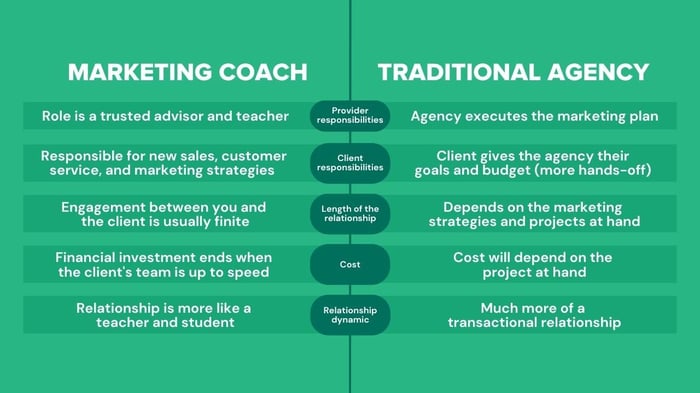
The 5 biggest differences between a marketing coach and a traditional agency 
marketing-coach-vs-traditional-agency

Once a prospect or client understands the basic differences between these two options, you can dig deeper by touching upon five key areas.

1. Provider responsibilities

Marketing coaching:

In a marketing coach-client relationship, the role of the marketing coach is that of a trusted advisor and teacher. 

As a coach or marketing consultant, you provide strategic guidance, support, and a structured learning program, knowing that each student will not need your help forever.

You are preparing the student — or, in this case, your client — to succeed on their own after they’ve mastered the ability to manage their sales and marketing efforts on their own.

Here at IMPACT, we call this “graduation” or self-sufficiency. 

Along the way, you’ll offer feedback, guidance, and accountability, but you don’t do the work for them. To see results, the client needs to do it themselves. You’re there to hold them accountable and ensure they maintain focus on priority work that will impact their business goals. 

Traditional agency:

With traditional marketing agency services, the agency still has the expertise and advises clients on what to do to achieve their goals, but the client simply has to give the green light, and then the agency executes the marketing plan.

2. Client responsibilities

Marketing coaching: 

When working with a marketing coach or marketing consultant, the client is responsible for applying the guidance and teaching they receive.  

In other words, they and their internal marketing teams are responsible for implementing their new sales, customer service, and marketing strategies themselves to accomplish their business goals. 

They own the execution of the work. Their coach will give them advice along the way, but it’s the responsibility of their in-house team to apply it. 

Traditional agency:

With a traditional marketing agency, the client is a bit more hands-off when it comes to execution. They give the agency their goals and budget and may have a say in the strategy before things go to production, but the actual work is taken care of by the agency.

The client just has to trust the agency to do things to their liking, and possibly provide feedback and approval of the work delivered. 

3. Length of the relationship 

Marketing coaching: 

As a marketing consultant or coach, the engagement between you and the client is usually finite.

While the opportunity to continue on as a business coach remains, usually once the client is up to speed, there's no need to. The client is left with the skills they learned for use in the future should they need them. 

As an example, while it will vary from company to company, here at IMPACT we see most clients graduate from our coaching services in 12-24 months.

Graduating from our coaching services is entirely dependent on how long it takes a client’s internal team to develop and maintain the right skills and habits. 

A coaching model lets clients stick to a set budget, while coaches have more freedom to take on new clients and be more profitable over time.

Traditional agency:

In an agency-client relationship, on the other hand, the length of service will depend on the marketing strategies and projects at hand.

For example, a relationship may follow a similar finite, project-based approach (e.g., a website redesign or build-out) that enables the same fixed budgeting and set end-date, or the relationship could be an ongoing retainer, which is the case in most digital marketing engagements.

If and when this relationship ends, however, the client likely won’t be able to continue the marketing efforts on their own, unlike they would with marketing coaching and training. 

This difference in timeline heavily leads to noteworthy cost differences between marketing coaches versus agencies.

4. Cost

Marketing coaching: 

Marketing consultants or coaches often come with a higher upfront cost as you work very closely and dedicatedly with the client’s team. However, since you are teaching the team to own their own marketing efforts, once the client’s team is up to speed, the relationship ends and so does the financial investment.

The client becomes self-sufficient, no longer relying on the outside team to help them along. This expense is eliminated, thus increasing the long-term return on their investment.

Traditional agency:

With traditional marketing agencies, the cost will depend on the project at hand.

If an agency is working on a one-off project like a website launch or a specific campaign, the costs will be set based on the needs of that initiative and end when the project is completed. 

However, if the client needs ongoing work, such as blog publishing, email sending, or social media content creation, this expense will remain a line item in their budget for outsourced support indefinitely. 

5. Relationship dynamic

The biggest difference between working with a marketing coach versus a traditional agency is the relationship dynamic. 

Marketing coaching: 

A marketing coach-client relationship is more like that of a teacher and a student.

You, the coach, are guiding the client through a process and helping them acquire new skills. There is permission for you to offer pushback and the client trusts you to lead the way even if they disagree with specifics.

Traditional agency:

In a traditional agency services relationship, the client owns the relationship and sets direction, budget, and deadlines. The agency delivers the work and makes requested changes until it meets the client’s approval.

In this scenario, the client doesn’t typically have any insight or knowledge of how the work is actually done. Thus, if a change is needed later down the road, they must request those changes or additional work from the agency (and likely at an additional cost). 

While there may be some collaboration, it’s much more of a transactional relationship. 

Choosing a marketing coach vs a marketing agency

After operating many years as a traditional inbound marketing agency, we at IMPACT pivoted to a marketing coaching/consulting model.

Why? Because we realized it helps us be more profitable and our clients more successful in reaching their goals. However, we know this approach may not be for every person looking for marketing help.

Here are some points to help you guide prospects deciding between a marketing coach and agency:

A prospect should hire a marketing coach if…

  • They want to learn the skills and keep their marketing resources and ownership in-house. If a prospect is working with intellectual property or has a lot of confidential information they’d rather not have a third-party be at liberty to access, it’s smart to bring their marketing operations in-house and work with a marketing coach to learn the tricks of the trade. 
  • They don’t want to rely on outside help indefinitely. Working with a marketing coach usually comes with an end date. If a prospect is looking for a short-term external commitment and investment, this is a better option. 
  • They want more control and flexibility. When someone works with a marketing agency, they’re subject to the agency’s pricing, services, and schedule. They’ll likely be just one of multiple clients so they may have limited access to an agency’s team and no power to go faster or pivot without changing the scope of work.

    If a prospect wants more control and flexibility with their marketing, then a coach is the better fit. With a coach, they'll get to grow their own internal staff, move quickly and be able to produce written content, video, and sales results faster and at a higher volume with more control. 
  • They’re looking for the most authentic finished product. At the end of the day, no one knows your business, your culture, and your product/service better than those working in it every day.

    To create the most accurate and true-to-brand finished assets, a business should be creating them on their own and a marketing coach will help that happen. In our experience, we’ve also found this content is also the most effective at building trust and ultimately delivering results. 

A prospect should hire a marketing agency if…

  • They don’t need someone focusing on marketing long-term. If a prospect just needs one video or campaign, investing in their own marketing team or skills likely doesn’t make sense. Hiring an agency would get the job done quickly and effectively. 
  • They’re looking for the highest level of production quality. Marketing agencies are likely going to have the best tools and equipment available to execute a marketing plan or campaign. If production quality is a major concern, working with an agency may be more efficient and cost-effective than working with a marketing coach and bringing those resources in-house.

Putting it all together 

Pivoting from a traditional marketing agency to a coach is hard — both in breaking your old habits and getting prospects to understand why coaching is a solution worth considering. 

Knowing this, your job is to help prospects thoroughly understand the differences between a marketing coach and agency services and pros and cons of both.

Use the information above to educate them, guide your conversations, and ultimately, help them make the best decision for both themselves and your team. 

Still working in a traditional marketing agency model and struggling to be profitable, meet expectations, and help clients achieve their goals?

Learn more about how to overcome this by adopting a coaching model with your free copy of “The Blueprint for a More Profitable Agency.”


* This article was originally published here
How to make $1000/day with affiliate marketing 24/7 - start here!


Thursday, March 9, 2023

What Happens When You Don't Have Buy-in for Your Inbound Strategy?

"A chain is only as strong as its weakest link."

"If they're not working with you, they're working against you." 

While these phrases are cliche, they do come back to one very true message: teams are a collective.

To function at their best, teams need everyone — from the highest leader to the newest intern — delivering their best work, working toward the same goals, and supporting the same vision. 

This is especially true when it comes to implementing something as far-reaching as the inbound methodology in your business.

Contrary to popular belief, inbound is not just a marketing initiative. It touches every part of a business from sales prospecting to return customers. 

That's why, for it to truly succeed, everyone in an organization needs to be fully bought-in and committed to helping the strategy succeed. 

But what is 'inbound buy-in' exactly?

inbound-buy-in

Inbound marketing isn't simple. It's a multi-faceted strategy that takes long-term commitment to see it fully come to fruition.

When we say someone is "bought-in to" inbound we mean they fully support it and are ready to commit to it. 

Hiring the right team members takes time.

Articles take time to research and write.

Website pages take time to design, not to mention get indexed and found in search engines.

Videos take time to produce and edit. 

All of these are valuable assets that can get found in search engines, educate your audience, and get shared in the sales process to combat objections — however, none of this may be possible if people aren't bought-in. 

Inbound buy-in happens when everyone in an organization recognizes that inbound methods will help set your business up for greater success, particularly creating content that positions you as the most trusted teacher in your space. 

For example, it means the team won't push back when you want to write an article that dives into the factors that influence the cost of your offering or the problems that may arise with it.

It also means content isn't seen as "just a marketing thing," but also as a tool for closing new customers and delighting existing customers. 

Inbound buy-in looks like all members of your team understanding the value of answering audience questions and using those questions to guide everything they do. 

The dangers of not having inbound buy-in

Not having buy-in for your inbound strategy is like trying to build a house on quick sand. It may look stable at first, but it's not strong enough to stand the test of time. 

When senior leadership doesn’t understand or support what you’re doing with inbound, you're less likely to get the budget, resources, or autonomy you need to fully put your strategy into action.

They also likely won't help create the culture, processes, or precedent needed to get everyone else on board. 

An organization without buy-in for content and inbound faces a tough, uphill battle that can manifest in several different ways: 

The marketing team will feel isolated

Not having buy-in can lead to your marketing team feeling like their unsupported and "on an island" so to speak. 

Perhaps they won't receive the budget they need to buy tools or build out their team. Maybe they won't get the time they need with other members of the organization because their work is not seen as important. 

Overall, this can lead to an unproductive, ineffective, and even unhappy marketing team.

You'll produce low-quality content that doesn't get found

So much of inbound success comes back to creating high-quality, authentic content that honestly answers your buyers' questions.

However, authenticity depends heavily on capturing the unique insights and voices of your team members. 

If your company (especially your sales team and subject matter experts) are not bought-in, you'll likely have a much harder time creating the caliber of content needed to rank in search engines and win over your audiences.

inbound-buy-in2

You also will be limited in your ability to create content to effectively help in the sales process. 

You'll have a longer, less effective sales process

Speaking of the sales process, when you don't have full buy-in for inbound, your sales team will likely miss out on valuable resources and practices to help improve their sales process. 

Marketing may have trouble getting subject matter experts to dedicate time to being interviewed or writing and reviewing content that can be used for assignment selling. (Sales reps may even refuse to use the content they do get their hands on it.)

Assignment selling enables sales reps to address major prospect objections and questions before they even have their first sales conversation by sharing content.

This way, when the two groups do connect, they spend less discussing generic questions and more time focusing on the prospect's specific needs, and actually closing deals. 

Unqualified leads will continue to waste your time

How many times have you had leads come into your sales department, and, after spending an hour talking with them, your reps realize the leads aren’t a good fit for your company? 

When you share educational content that can be used for assignment selling, buyers are better equipped to figure out on their own if yours is the solution they truly need.

High-quality, honest content tells them what it's realistically like working with you, and let's them decide on their own if you'll accomplish what they need and if they can afford you. 

In turn, you'll drastically reduce the time your sales team spends on leads that will never become customers.

How to get inbound buy-in at your organization

To get buy-in for inbound marketing, you need to get everyone aligned. 

You need to make sure they understand the value and their role in making it a reality. 

We've found the best way to do this is by rounding up everyone in a room, from customer service to sales, to marketing, to the leadership executive team for what we call an "inbound culture workshop." 

inbound-buy-in3

In this meeting, sales, marketing, and leadership sit down to be educated on the inbound methodology together. They hear the same call to action and the reasons behind it. They share in the experience.

You need talk about the habits you all have as buyers, and how you feel when you have to go digging for information before you make a purchase, only to find that much of the information you need either isn’t available or requires a phone call with a salesperson. 

Discuss how your company can use content to make this experience better and, make prospects trust and want to work with you in the process. 

Leadership will understand what it takes to succeed and why inbound needs to be made a priority. Your sales team will learn how content will help them sell way more in less time, as well as their role in helping the marketing team create it. 

Overall, when done right, a workshop creates a lasting shift in the business mindset. This is especially true when facilitated by someone outside of your company.

Need more guidance on how to help build a culture of inbound at your business and get people bought in?

Check out our free course "Building a True Culture of Inbound with They Ask, You Answer" and our free guide, "The Ultimate Inbound Marketing Strategy Playbook 2023."


* This article was originally published here
How to make $1000/day with affiliate marketing 24/7 - start here!


Wednesday, March 8, 2023

Leadership Teams Are Often Blind to Their Own Dysfunction — And The Effects Can Be Devestating

When I start coaching a new client, I spend the first few weeks gathering information and meeting with stakeholders to get the lay of the land. 

I want to hear it straight from the workers themselves — be they front-line, managers, or leadership folks. 

And even then, even in those early days when I’ve still got so much to learn about an organization, I’m on the lookout for red flags that show me there’s misalignment (or worse, dysfunction) at the highest levels. 

I’ve done this long enough to know that upper-level dysfunction creates effects that ripple out much farther than the executive boardroom.

It can harm the whole organization.

Effects-of-dysfunction

And here’s the worst thing: the very leadership team that’s in charge of setting direction, creating culture, and solving problems is often blind to its own challenges.

At any given business, I’m looking for two major signs of dysfunction at the highest levels: 

  • Lack of psychological safety
  • An out-of-touch leader

Here’s what both look like in practice — and how you can fight against them.

First sign of misalignment: Lack of psychological safety

Healthy team dynamics are wonderful to observe. There’s energy, excitement, and discussion. There’s productive debate. 

Psychological-safety

This can only happen, though, if there’s psychological safety. This means people feel comfortable speaking up and sharing their ideas, concerns, or misgivings.

Psychological safety needs to come from the top: a clear indication that everyone’s voice matters and no one’s ideas are beyond reproach. 

If I observe a leadership meeting where this isn’t the case, it can be almost cringeworthy. People sit on their hands and avoid eye-contact. There’s a lot of surface-level agreement and very little debate. It’s clear that allegiance is what’s expected and valued.

These teams are unhealthy, and the blame almost always goes to the person at the top.

Second sign of misalignment: An out-of-touch CEO

When I start coaching a new company, I always want to hear from the CEO to understand the challenges he or she believes the company is facing. And this is where I look for the second red flag: a CEO who is out of touch with the rest of the company.

everythings-not-fine

This can manifest in a few different ways, but I often see it as CEOs who don’t know what’s actually happening in their company. They’ve got a sunny outlook that doesn't match the realities on the ground. In other words, they think everything’s fine when it’s not.

These are often the same CEOs who love to hear themselves talk. The same ones who scorn debate. They don’t look for feedback or guidance, they look for confirmation and allegiance — and they’re convinced their vision is infallible. 

These leaders have not built a culture where it’s okay to disagree and debate.

Now, there are a number of reasons these out-of-touch CEOs exist. 

Sometimes it’s just an ego thing. But it often comes back to something deeper. A false mythology we have in modern business about how great things actually get done. 

The myth of the ‘all-knowing CEO’

Too often, leaders think they’re being dynamic and brilliant when in fact they’ve just misread the histories of our greatest business leaders. I call this “The myth of the all-knowing CEO.”

We have this dangerous myth in America of the brilliant, all-knowing CEO who leads with a singular vision and never deviates. This goes back at least to Henry Ford — and probably earlier — and the best business books today tell stories of business leaders so famous that you probably only have to read their first names to know who they are: Steve, Mark, Bill, and so on.

myth-ceo

But here’s the thing, these leaders were certainly brilliant, but they did not accomplish anything on their own, and they certainly didn’t stifle disagreement. They hired great people who brought energy and debate to leadership meetings.

There’s a famous anecdote about Steve Jobs in which he was talking with some members of his leadership team about his idea for a certain new iPhone feature. The team discussed a few other opinions, but Jobs was convinced his idea was the best. 

Eventually, Jobs was angry when developers came back and his idea wasn’t as great as he had hoped. He was furious with his team for letting such a bad idea go through. “But Steve,” they said, “that was your idea!” 

“I know,” replied Jobs. “And it’s your fault you let such a bad idea go through. You need to squash bad ideas — even when they’re mine.”

healthy-communication

Jobs knew that success at Apple depended on assembling a great team of brilliant, driven, outspoken leaders. 

And he knew that he himself was a flawed individual. 

Jobs famously worked with acclaimed coach John Mattone. According to Mattone, Jobs was intensely focused on his own limitations so he could improve his leadership style.

When CEOs look to Jobs for inspiration, they shouldn’t just think of him as a brilliant leader (which he was), but also as someone who: 

  • Knew that he needed input from his team to be successful
  • Knew that his own abilities were limited

And that’s why he was among the greatest business leaders of the modern era.

When we dispel the myth of the all-knowing CEO we can start to solve the internal problems holding back our leadership teams. 

Here’s how.

How leadership teams can recognize and solve their dysfunction

Whether you’re the CEO or another member of the leadership team, there are tangible steps you can take to break free of dysfunction and establish a healthy team dynamic. 

For the CEO

Learn to encourage debate: You need to reorient your thinking to see that debate is productive. Whether it’s you or someone else, make sure there’s someone playing the role that gets people thinking, talking, and discussing.

In The 5 Dysfunctions of a Team, Patrick Lencioni uses the phrase “mining for conflict,” which I’ve always liked. Conflict and disagreement are healthy. In fact, they’re essential. You can only get to the best ideas if people raise objections and top leaders encourage debate.

If your leadership team is not used to this kind of meeting culture, get someone on the team to play the role of conflict seeker. Now, they’re not picking fights or being uselessly contrarian, but they should start asking “why?” and “how?” and “why now?” a lot more than before.

By doing so, they’ll bring other voices into the conversation as well. If you’ve got that quiet team member who tends to nod and go along with the group, now’s the time to get that person to speak up and share. All voices matter.

For all leaders

Talk to your CEO about psychological safety: Your CEO needs to make the group feels comfortable disagreeing. If that’s not the case, someone needs to bring it up. 

Set aside some time during a 1:1 or another meeting where you can bring up the idea of psychological safety. Explain how debate and discussion result in better strategy. 

Be honest about challenges: Out-of-touch CEOs are created when they get fed a steady diet of platitudes and rosy reports from VPs and team members. If you want a healthy leadership team, start being honest. I get it, no one wants to deliver bad news, but it’s much worse to have an Emperor's New Clothes situation where no one’s comfortable telling the truth.

facing-real-challenges

Instead of “everything’s great,” be comfortable saying “Here’s what’s challenging right now — and here’s how we’re trying to solve it.”

Utilize a coach or consultant: We all have blindspots. An outsider who’s trained in group dynamics and team communication can help your leadership team see the limitations it can’t see on its own.

Just like Steve Jobs working with John Mattone, great leaders and leadership teams value outside expertise that can hold up a mirror and prompt true growth. 

The long-reaching effects of a misaligned leadership team

A dysfunctional leadership team casts a long shadow over a business. If C-level and VP-level employees can’t disagree with each other, the same thing will happen all the way down the ladder. 

Healthy companies commit themselves to good communication practices that exhibit transparency and candor — and this needs to start at the top.

CEOs must stay on the lookout for the two big signs of leadership team dysfunction, and must actively work against sliding into these ruts. Make it clear that it’s okay for other members of the leadership team to disagree with you.

In fact, it’s essential.


* This article was originally published here
How to make $1000/day with affiliate marketing 24/7 - start here!