Make money online fast

Make Money Online Fast: The Ultimate Guide to Earning Quickly in 2025

  Introduction Want to make money online fast? Whether you need extra cash or want to build a full-time income, the internet offers endless ...

Thursday, March 23, 2023

5 Ways to Get Your Sales Team Excited About Creating Content

For much of my soon-to-be decade at IMPACT, I held the herculean responsibility of getting everyone in our organization to contribute content to our marketing efforts. 

From leadership and admin to client service and design, I worked with every member of our team (up to 65 people at its highest) to each put together a piece a least once a month.

Running a successful content marketing program is no small feat. It requires a full investment and support not only by marketing, but by your entire company.

One team that is of particular importance in your content marketing effort is sales.

Now, I know what many of you are thinking — "Sales needs to focus on selling" — and I won't lie to you; getting our sales team to contribute content was probably one of the hardest because of this belief.

The immortal words of Alec Baldwin in 1992's Glengarry Glen Ross

But this sales-needs-to-focus-only-on-selling mindset is increasingly outdated. 

You see, modern buyers are more averse to sales pitches than ever. They want to navigate more of their buyer's journey on their own and only interact with salespeople if its absolutely necessary.

They don't trust businesses or salespeople to have their best interests in mind. They expect salespeople to do anything to make the sale; to trick them buying something that's not right for them. 

In order to overcome this stereotype and win the trust of contemporary buyers, salespeople need to pivot to focus less on pitching and more on helping. Enter content.

Sales' insight is the secret sauce in content

In a perfect world, by the time prospects engage with you in a sales conversation, they’re ready to act. 

get-sales-to-create-content

They come to your reps with a good understanding of your company and what it does and also feeling like they can trust your team to help them make the best purchase decision for their needs. 

Content has the power to help you build this trust with potential buyers before they've even met you.

It lets you offer valuable information and education; to answer the questions keeping them up at night and be seen as a helpful guide.

Nobody knows this information better than your sales team. 

They speak to your prospects every single day. They have detailed insights into what potential customers need to know and hear to feel comfortable making a purchase no one else does. 

This is the first-hand information that will set your content apart from your competition and truly resonate with your audience. 

But how do you get your sales team invested and excited about creating content for your company?

How to get sales teams excited about creating content

Here are six lessons I’ve learned about getting sales to lean in. 

1. Lead with the sales process

Great marketing content can be a salesperson’s best friend.

It’s like having an assistant that works 24 hours a day, 7 days a week to educate and qualify your prospects and never needs a raise or vacation.

This "on-demand" nature can be of particular value to folks in sales.

get-sales-to-create-content2

That said, to get your sales team excited about creating content, lead with how they can use content when reaching out to prospects. 

Explain how offering something of value to cold prospects (like a blog article addressing a problem they're facing) is a more friendly and effective way to grab their attention than simply asking them to set up a call. 

Furthermore, talk about how sales reps can use content in the sales process (a practice we call assignment selling) to address questions or combat objections buyers might have as or even before they come.

Doing this helps both prospects and sales reps save time on sales calls discussing common questions and more time diving into a prospect's specific needs and goals. 

Better educated, qualified leads means more efficient and effective sales conversations. 

2. Ditch fluffy topics

get-sales-to-create-content3

I can’t stress enough — if you want salespeople to contribute content and you’ve started with why it’s going to help them, you have got to come to them with topics that will actually educate prospects and help them close. 

Nothing will kill your sales team’s enthusiasm more quickly than having them create content they’ll never see the value in. If they don’t see the clear benefit of how a topic will help them close deals, it will be like pulling teeth every time.

So how do you avoid this trap?

Ask them what questions they get most frequently in the sales process. What questions do they wish they had a resource to share when prospects asked them?

More than often these questions will relate to your price and how you compare to competitors, among other things. However, rather than assume,  let your sales team brainstorm their own topics so they are fully invested in what they're helping marketing create. 

3. Offer to interview them

Okay, so you’ve been reading so far, thinking, “this all makes sense, but my VP/CEO/COO will never in a million years sign off on my salespeople spending the requisite time to write a blog post." Or maybe it's, "my salespeople aren't writers!"

Believe me, I've heard excuses dozens of times. 

But here's a solution for you: Have marketing interview your sales people.

As long as sales reps can effectively communicate their knowledge, they can be a part of the content creation process. 

All they have to do, in this instance, is make themselves available for  15-30 minutes to talk through the subject matter to whoever will be creating the content.

Someone from the marketing department can then either ghostwrite an article for them, use the information to inform their work, or simply publish the interview as the article.

With this approach, your sales reps don’t have to be the ones to actually sit down and write the content. 

As long as your sales team is contributing what they know to your content marketing effort, they’re doing their part to put their expertise on display and educate the market.

4. Explore other mediums

Great content doesn't have to be written. 

If you have a salesperson or sales team that can’t or isn’t willing to write, or would rather not be interviewed, there are plenty of other ways they can contribute to your content marketing effort.

It can be a podcast, video, infographic, or webinar, to name a few. In fact, many people in your audience may prefer these mediums. 

get-sales-to-create-content4

73% of people say they'd rather watch a short video than consume any other type of content. They are also twice as likely to share video content with their friends. 

If your sales team doesn’t like to write, have them record videos answering common questions. You can then publish this to social media, use it as is in the sales process or on your website, or even transcribe it into article in the future. 

Where there is a will, there is a way. Be flexible and work with people's strengths. 

5. Show them the impact

get-sales-to-create-content6

I can't say it enough: Sales wants to see that what they're contributing their time and effort to improves the bottom line.

That's why the best way to get sales excited about creating content is by showing them how content has contributed to closed deals.

Share reports of how content was consumed throughout a customer's journey to close.

For example, you can analyze how many pages or articles a customer viewed before becoming a lead or the page that brought them onto the website for the first time.

(Tools like HubSpot Attribution Reports can help you dig into this information.)

Doing this will help sales reps better understand how content fits in the big picture of closing new business and, in turn, make them more inclined to help where they can. 

Sales needs content as much as content needs sales

As essential as sales insight is to successful content, great content is essential to an effective sales process.

Each feeds the other and only when marketing and sales teams lean into this reliance will they be able to drive better leads and sales results in the coming years. 

Need more help getting your sales team on board with your marketing efforts? Check our free on-demand courses, "Assignment Selling: Content Is Your Greatest Sales Tool" and "The Revenue Team Approach to Sales Enablement Content."


* This article was originally published here

How to make $1000/day with affiliate marketing 24/7 - start here!


Monday, March 20, 2023

How to Ghostwrite Content for a Subject Matter Expert

As a content marketer, it’s your responsibility to share the knowledge, insights, opinions, and expertise of your company with your audience — typically through blog articles, but also podcasts, videos, and so on. 

You stand as a primary ambassador for your brand, guaranteeing that the content published checks all the boxes.

  • Answering customer questions
  • Building trust
  • Optimizing for search

To do this, you need to be the creator who harnesses the knowledge of busy subject matter experts and catapults it into the world.  

In many cases, this means writing content in their voice. 

So, how do you do it?

Writing as others

One of the most challenging parts of your job will likely be ghostwriting as a team member. To do so, you need to consciously not sound like yourself, which is weird and liberating at the same time. 

ghostwriting

When I need to do this, I follow the seven steps I lay out below.

1. Agree on a topic and clear up logistics

Just like with any interview, ghostwriting begins with making the subject feel comfortable with the whole process.

The subject should know the process and trust you.

Start by setting up a pre-meeting or phone call — or at least an email or Slack conversation — to set the parameters.

Assure them that they will have final say over any content published under their name and that they can be as involved in every step of the process as they’d like.

In most cases, the subject is likely exceedingly busy and, thus, will be appreciative of your help. However, wariness is not uncommon. It is the responsibility of the writer (meaning you) to put the subject at ease before any writing begins. 

Other pre-writing logistics involve setting a time for an interview and agreeing on a topic, which might be something chosen by the marketing team or suggested by the subject themselves. 

2. Create a 'style guide'

When writing as someone else, I create a style guide before I begin.

I know it sounds like a pain, but your future self will thank you, I promise.  

Start by doing some research.

Ideally, you would have some of their written work to go by, maybe previous blog posts or articles. Even a few emails can suffice. 

If your subject is a company leader, perhaps you have heard them speak at meetings or other events. 

Either way, before you even write questions, start a blank document with an outline of how the person sounds, and what their writing looks like.

Here’s an example:

SME-style-guide-john-becker-impact

I try to get down general ideas about how the person sounds — style, tone, and phrases — as well as some common phrasings. 

This helps in two ways.

  • First off, the process of creating it forces you to scrutinize the subject's work and articulate what makes it different from someone else’s.
  • Second, the guide is a quick reference that you can read over before drafting or while revising. 

The small details that I’ve accumulated in my guide can be used to drop in a phrase or tweak a sentence. 

3. Write questions (which will also serve as an outline)

When you’ve decided on a topic, write a series of questions for your subject. I say questions, but these are really more prompts. 

You want to establish a trajectory that you think the eventual article might follow, but leave room for exploration. Do the necessary research to gain an understanding of the topic at hand, but be prepared for potential diversions.

Once you reach this point, prepare much the same way you would for an interview, only with more structure. 

After you write your questions, run them by the subject. However, when ghostwriting, put the questions into an outline under headings that will become H2s in the final piece. 

For example: 

Screenshot 2023-02-07 at 3.49.54 PM

You can see I've laid out my topics and the order — as well as some notes. 

In general, we'll both keep this document open while we’re talking and it becomes a sort of road map that we can each check as needed.

4. Conduct the interview

I’ve written elsewhere about the skills necessary to complete great interviews. The same rules apply here, but the interview itself feels a bit looser. 

When interviewing for a ghostwritten piece, try to feel more comfortable following tangents. A standard interview demands cogent, well-crafted questions, but an interview for a ghostwritten piece can be more like a discussion. 

In turn, the subject tends to feel more at ease — and the process will feel more collaborative.

When I interview for ghostwriting, I will frequently jump in to ask for clarification, push the discussion in a direction that feels essential, or keep us from running too long.

Honestly, the shorter the better.

ghostwriting-process

In order to prevent biting off more than you can chew, I recommend not doing more than a 30-minute interview. A shorter interview keeps the topic manageable.

I always record the interview and use a service (like Rev) to prepare a transcript.

5. Write a rough draft

After you’ve assembled your style guide, your transcript, and any other information you need, you should begin drafting.

My earnest advice for drafting a ghostwritten piece is this: Don’t over-plan. Don’t overthink. Let the magic happen.

Keep your subject in mind as you pursue your topic, but don’t impede the writing process with relentless analysis.

Ghostwriting-advice

Don’t confuse writing as someone else with producing a forgery. Although you have been asked to produce something that imitates their voice, you were given this task because of your writing ability. 

Your skill should blend with their subject matter expertise in a collaboration. Sprinkle in elements that mimic the subject’s style, but remember that it is your job to help deliver their knowledge in the most effective way possible. Trust your ability.

6. Ask for feedback

It is critical that your subject have frequent opportunities for input. Once you’ve drafted and edited, share the document . Allow your subject to make suggestions and edits. 

In my experience, subjects are so glad to have the onus of article writing removed from their busy schedule they will be tremendously appreciative of your hard work. Very rarely will you encounter a subject interested in micromanagement or trivialities.

If you have a particular section you struggled with, leave comments in the document (I recommend Google Docs for this) to help guide the feedback process. 

7. Take the article over the finish line

You have been asked to write as someone else. This means your company trusts you and your voice. It is critical that you allow your subject to provide feedback on the draft, but don’t feel the need to involve them in minutiae. 

Once you’ve had them approve the overall direction of the piece, you don’t need to contact them again to permit you to make minor changes, tweak formatting, add links, or amend a header.

ghostwriting-editing

Polish the piece to your company’s standards and get it ready for publication. 

Taking the fright out of ghostwriting

No matter the reason, writing for someone else is a responsibility that requires both your skill and your judgment. 

If you try to internalize some of their linguistic mannerisms and convey the information you’ve garnered from your interview, the product will naturally be a fair representation of their content and style. 

It doesn't have to be scary. Trust your instincts. 

As long as you write with your subject’s voice in your head, trust your own ability to structure, pace, and organize your article.

Then, when it comes time to finalize the piece and you get the go-ahead from your subject, slap his or her name on there. Your subject’s voice and expertise will be broadcast, and you will have taken a time-consuming task off of someone’s plate.

No one will be the wiser and you will have done a great service to your team. 


* This article was originally published here

How to make $1000/day with affiliate marketing 24/7 - start here!


Thursday, March 16, 2023

A New Marketing Agency Model for a More Profitable Future

When IMPACT was in its infancy, we spent a lot of time doing what all agencies do.

We learned about our client's so we could come up with “the perfect” marketing plan that turned website traffic into leads and leads into valuable customers. 

It was nothing revolutionary. It was the model most marketing agencies followed and still do. 

There was just one problem: No matter how much effort we put into our deliverables, we always had some clients who just didn't get the results they wanted.

Traffic would come in and not convert. Or the leads would come in and be a poor fit. 

Over the years, we began to see that no matter how talented our staff might be, it would always be difficult to create content that sounded authentic to our client's brand and moved their sales needle in a meaningful way.

While it wasn’t clear to us at the time, we now realize that no one can know a business, brand, or its customers as well as those who work in it everyday. In other words, our clients themselves. 

So we made like Ross Geller from Friends and pivoted. 

We  switched to a different agency model, where instead of creating content and implementing inbound strategies for clients, we employ a team of coaches and trainers who teach clients how to do it for themselves. 

Our clients are happier and more driven to succeed. Our employees are more fulfilled, and our business is more profitable. 

more-profitable-marketing-agency

Why "teaching them to fish" is a better agency model 

Switching from being a traditional agency to a coaching and training company  wasn’t out of the blue.

IMPACT CEO Bob Ruffolo saw the potential in this new model after connecting with author Marcus Sheridan, who was already training and coaching his clients to do the heavy lifting at his former agency The Sales Lion.

There was an interesting dynamic there: Instead of bending over backward to do work he hoped clients would approve and see results from, Marcus’ team taught clients to do the work themselves. 

This put Marcus and The Sales Lion in the driver’s seat and in control of the client-agency relationship.

And it was working.

The Sales Lion's clients were succeeding in unimaginable ways, growing their traffic, leads, and sales faster than anything we had seen before.

Soon after, The Sales Lion became a part of IMPACT and the whole company adopted the same model.

As a result, we saw our profit margins increase by about 10%, but that wasn't the only benefit we saw.

Clients were happier and more invested

No one knows a business better than those working in it everyday. So, of course, as clients took more ownership over their marketing execution, results began to improve as well.

Clients were happier and since they became more accountable for their own results, they became more invested in their own growth as well.

Employees experienced more job satisfaction 

By helping clients succeed in the long term versus running short lead campaigns that generated temporary results, our in-house staff also thrived. They experienced less burnout and we saw less employee turnover. 

Differentiation from traditional agencies

As great as this "teach them to fish" model is, not many agencies are embracing it.

That makes it a major differentiating factor that can be helpful in the sales process.

Over the years, we’ve learned a lot about how powerful teaching clients to take charge of their own success can be — for the client and the agency.

This is why we believe the traditional model is broken and also why we’re so passionate about changing the way marketing agencies approach their business.

We believe coaching can help your agency focus on a major differentiating factor and enjoy the same success as we’ve seen by making this change that few agencies are doing.

How to build a more profitable agency by pivoting to coaching

To switch your marketing agency model from doing to coaching, there are a few steps you need to take:

Focus on getting buy-in from client leadership

If you’re going to coach clients to take ownership of their marketing implementation, you have to start with getting buy-in from their leadership.

This can be especially tricky with existing clients who are used to you doing the work for them.

If your client’s leadership doesn’t understand the benefits or importance of owning marketing in-house, your relationship will be doomed from the start.

Marketing will be less likely to get the budget or resources they need to accomplish its goals or the support from others in their organization. 

The best way to avoid this is aligning everyone from the get-go with what we call an "inbound culture" workshop.

In this meeting, you run through discussions and activities to get all the decision makers on the same page — agreeing that today’s buyer has changed and your business needs to understand this and meet your customer where they are.

Then you can go into why your team will be able to do this better than any agency could. 

Develop client-facing coaches and trainers instead of strategists

Though you want to have great marketing strategists and content creators on staff for your own marketing efforts, focus on building a team with strong coaching skills such as communication and leadership when it comes to client service.

At IMPACT, we have coaches work with the C-level executives on the overall marketing plan, and then more tactical trainers teach content managers and videographers to create the necessary content and marketing materials.

Client content managers will be doing a lot of the work and come to your coaches and trainers for advice to be sure the content they’re creating is on track and strategic enough to grow the business.

Your coaches will work with executives to be sure they're hitting metrics and implementing the overall marketing plan effectively. 

They need to work with your clients’ marketing and sales teams. 

The best coaches and trainers will know how to effectively communicate and work with individuals at all of these levels and be able to put together a keen strategy. 

more-profitable-marketing-sales-agency

Fast track your marketing agency success with coaching

When IMPACT first embraced a coaching and training agency model, we didn’t realize how much it would transform what we do — and how it would improve our clients’ results.

We believe this business model will do the same for your agency, and with our Certified Partner Program, you can work with us to fast track your success in this new marketing agency model too.

Set a time to meet with one of our coordinators, who can answer any questions you might have. 

IMPACT's Certified Partner Program will help your agency:

  • Learn the They Ask, You Answer framework to help your team members become more effective coaches and lead your clients toward bigger growth, faster.
  • Find its niche and set itself apart from the overcrowded marketing agency landscape.
  • Strengthen communication skills so your agency can feel confident in providing clients with more value.

With this simple shift in approach and skills, your inbound marketing agency will be able to better meet the needs of your clients and set them (and your agency) up for long-term success.


* This article was originally published here

How to make $1000/day with affiliate marketing 24/7 - start here!


Monday, March 13, 2023

Marketing Coach vs Marketing Agency: How To Explain the Difference to Prospects That Just Don’t Get It

For inbound marketing agencies trying to get out of the implementation game, this issue has likely come up more than once: Prospects don’t understand the difference between a marketing coach/consultant and a traditional agency.

As a marketing consultant or coach, you’ll likely hear the same concerns and questions a lot and you need to be able to field them.

Aren’t you supposed to do the work for me?

Why wouldn't I want to just outsource to an agency?

We don’t have the staff to take this on! 

As we have pivoted our services at IMPACT to a coaching model, we've heard these all too often ourselves and we've learned how to combat them.

In this article, we’ll give you everything you need to know (and say) to help prospects and your current clients understand the differences, and, even more importantly, confidently choose between the two for themselves. 

Let’s start from the top.

How to explain marketing coaching vs. agency services

At a high level, the difference between marketing coaches and marketing agencies is who’s executing the client's marketing strategy.

marketing coach vs agency

As a coach, this is a good place to start when speaking to confused prospects. Here's how you can explain: 

Marketing coaching or consulting is a “teach a man to fish” approach to inbound marketing where an outside team or coach helps clients develop their new marketing strategies, and then teaches them how to do the work themselves. 

In other words, coaches don’t write the blog articles or emails for clients, for example — the clients write the content for themselves, with hands-on guidance and feedback from the coach or trainer.   

Traditional marketing agencies on the other hand, “do it for you." They provide strategic guidance and then complete the recommended activities for the client. They deliver the completed work to the client for feedback and/or approval.

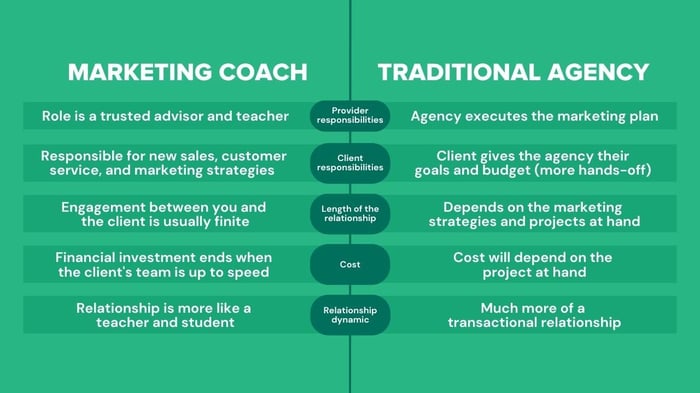
The 5 biggest differences between a marketing coach and a traditional agency 

marketing-coach-vs-traditional-agency

Once a prospect or client understands the basic differences between these two options, you can dig deeper by touching upon five key areas.

1. Provider responsibilities

Marketing coaching:

In a marketing coach-client relationship, the role of the marketing coach is that of a trusted advisor and teacher. 

As a coach or marketing consultant, you provide strategic guidance, support, and a structured learning program, knowing that each student will not need your help forever.

You are preparing the student — or, in this case, your client — to succeed on their own after they’ve mastered the ability to manage their sales and marketing efforts on their own.

Here at IMPACT, we call this “graduation” or self-sufficiency. 

Along the way, you’ll offer feedback, guidance, and accountability, but you don’t do the work for them. To see results, the client needs to do it themselves. You’re there to hold them accountable and ensure they maintain focus on priority work that will impact their business goals. 

Traditional agency:

With traditional marketing agency services, the agency still has the expertise and advises clients on what to do to achieve their goals, but the client simply has to give the green light, and then the agency executes the marketing plan.

2. Client responsibilities

Marketing coaching: 

When working with a marketing coach or marketing consultant, the client is responsible for applying the guidance and teaching they receive.  

In other words, they and their internal marketing teams are responsible for implementing their new sales, customer service, and marketing strategies themselves to accomplish their business goals. 

They own the execution of the work. Their coach will give them advice along the way, but it’s the responsibility of their in-house team to apply it. 

Traditional agency:

With a traditional marketing agency, the client is a bit more hands-off when it comes to execution. They give the agency their goals and budget and may have a say in the strategy before things go to production, but the actual work is taken care of by the agency.

The client just has to trust the agency to do things to their liking, and possibly provide feedback and approval of the work delivered. 

3. Length of the relationship 

Marketing coaching: 

As a marketing consultant or coach, the engagement between you and the client is usually finite.

While the opportunity to continue on as a business coach remains, usually once the client is up to speed, there's no need to. The client is left with the skills they learned for use in the future should they need them. 

As an example, while it will vary from company to company, here at IMPACT we see most clients graduate from our coaching services in 12-24 months.

Graduating from our coaching services is entirely dependent on how long it takes a client’s internal team to develop and maintain the right skills and habits. 

A coaching model lets clients stick to a set budget, while coaches have more freedom to take on new clients and be more profitable over time.

Traditional agency:

In an agency-client relationship, on the other hand, the length of service will depend on the marketing strategies and projects at hand.

For example, a relationship may follow a similar finite, project-based approach (e.g., a website redesign or build-out) that enables the same fixed budgeting and set end-date, or the relationship could be an ongoing retainer, which is the case in most digital marketing engagements.

If and when this relationship ends, however, the client likely won’t be able to continue the marketing efforts on their own, unlike they would with marketing coaching and training. 

This difference in timeline heavily leads to noteworthy cost differences between marketing coaches versus agencies.

4. Cost

Marketing coaching: 

Marketing consultants or coaches often come with a higher upfront cost as you work very closely and dedicatedly with the client’s team. However, since you are teaching the team to own their own marketing efforts, once the client’s team is up to speed, the relationship ends and so does the financial investment.

The client becomes self-sufficient, no longer relying on the outside team to help them along. This expense is eliminated, thus increasing the long-term return on their investment.

Traditional agency:

With traditional marketing agencies, the cost will depend on the project at hand.

If an agency is working on a one-off project like a website launch or a specific campaign, the costs will be set based on the needs of that initiative and end when the project is completed. 

However, if the client needs ongoing work, such as blog publishing, email sending, or social media content creation, this expense will remain a line item in their budget for outsourced support indefinitely. 

5. Relationship dynamic

The biggest difference between working with a marketing coach versus a traditional agency is the relationship dynamic. 

Marketing coaching: 

A marketing coach-client relationship is more like that of a teacher and a student.

You, the coach, are guiding the client through a process and helping them acquire new skills. There is permission for you to offer pushback and the client trusts you to lead the way even if they disagree with specifics.

Traditional agency:

In a traditional agency services relationship, the client owns the relationship and sets direction, budget, and deadlines. The agency delivers the work and makes requested changes until it meets the client’s approval.

In this scenario, the client doesn’t typically have any insight or knowledge of how the work is actually done. Thus, if a change is needed later down the road, they must request those changes or additional work from the agency (and likely at an additional cost). 

While there may be some collaboration, it’s much more of a transactional relationship. 

Choosing a marketing coach vs a marketing agency

After operating many years as a traditional inbound marketing agency, we at IMPACT pivoted to a marketing coaching/consulting model.

Why? Because we realized it helps us be more profitable and our clients more successful in reaching their goals. However, we know this approach may not be for every person looking for marketing help.

Here are some points to help you guide prospects deciding between a marketing coach and agency:

A prospect should hire a marketing coach if…

  • They want to learn the skills and keep their marketing resources and ownership in-house. If a prospect is working with intellectual property or has a lot of confidential information they’d rather not have a third-party be at liberty to access, it’s smart to bring their marketing operations in-house and work with a marketing coach to learn the tricks of the trade. 
  • They don’t want to rely on outside help indefinitely. Working with a marketing coach usually comes with an end date. If a prospect is looking for a short-term external commitment and investment, this is a better option. 
  • They want more control and flexibility. When someone works with a marketing agency, they’re subject to the agency’s pricing, services, and schedule. They’ll likely be just one of multiple clients so they may have limited access to an agency’s team and no power to go faster or pivot without changing the scope of work.

    If a prospect wants more control and flexibility with their marketing, then a coach is the better fit. With a coach, they'll get to grow their own internal staff, move quickly and be able to produce written content, video, and sales results faster and at a higher volume with more control. 
  • They’re looking for the most authentic finished product. At the end of the day, no one knows your business, your culture, and your product/service better than those working in it every day.

    To create the most accurate and true-to-brand finished assets, a business should be creating them on their own and a marketing coach will help that happen. In our experience, we’ve also found this content is also the most effective at building trust and ultimately delivering results. 

A prospect should hire a marketing agency if…

  • They don’t need someone focusing on marketing long-term. If a prospect just needs one video or campaign, investing in their own marketing team or skills likely doesn’t make sense. Hiring an agency would get the job done quickly and effectively. 
  • They’re looking for the highest level of production quality. Marketing agencies are likely going to have the best tools and equipment available to execute a marketing plan or campaign. If production quality is a major concern, working with an agency may be more efficient and cost-effective than working with a marketing coach and bringing those resources in-house.

Putting it all together 

Pivoting from a traditional marketing agency to a coach is hard — both in breaking your old habits and getting prospects to understand why coaching is a solution worth considering. 

Knowing this, your job is to help prospects thoroughly understand the differences between a marketing coach and agency services and pros and cons of both.

Use the information above to educate them, guide your conversations, and ultimately, help them make the best decision for both themselves and your team. 

Still working in a traditional marketing agency model and struggling to be profitable, meet expectations, and help clients achieve their goals?

Learn more about how to overcome this by adopting a coaching model with your free copy of “The Blueprint for a More Profitable Agency.”


* This article was originally published here

How to make $1000/day with affiliate marketing 24/7 - start here!


Thursday, March 9, 2023

What Happens When You Don't Have Buy-in for Your Inbound Strategy?

"A chain is only as strong as its weakest link."

"If they're not working with you, they're working against you." 

While these phrases are cliche, they do come back to one very true message: teams are a collective.

To function at their best, teams need everyone — from the highest leader to the newest intern — delivering their best work, working toward the same goals, and supporting the same vision. 

This is especially true when it comes to implementing something as far-reaching as the inbound methodology in your business.

Contrary to popular belief, inbound is not just a marketing initiative. It touches every part of a business from sales prospecting to return customers. 

That's why, for it to truly succeed, everyone in an organization needs to be fully bought-in and committed to helping the strategy succeed. 

But what is 'inbound buy-in' exactly?

inbound-buy-in

Inbound marketing isn't simple. It's a multi-faceted strategy that takes long-term commitment to see it fully come to fruition.

When we say someone is "bought-in to" inbound we mean they fully support it and are ready to commit to it. 

Hiring the right team members takes time.

Articles take time to research and write.

Website pages take time to design, not to mention get indexed and found in search engines.

Videos take time to produce and edit. 

All of these are valuable assets that can get found in search engines, educate your audience, and get shared in the sales process to combat objections — however, none of this may be possible if people aren't bought-in. 

Inbound buy-in happens when everyone in an organization recognizes that inbound methods will help set your business up for greater success, particularly creating content that positions you as the most trusted teacher in your space. 

For example, it means the team won't push back when you want to write an article that dives into the factors that influence the cost of your offering or the problems that may arise with it.

It also means content isn't seen as "just a marketing thing," but also as a tool for closing new customers and delighting existing customers. 

Inbound buy-in looks like all members of your team understanding the value of answering audience questions and using those questions to guide everything they do. 

The dangers of not having inbound buy-in

Not having buy-in for your inbound strategy is like trying to build a house on quick sand. It may look stable at first, but it's not strong enough to stand the test of time. 

When senior leadership doesn’t understand or support what you’re doing with inbound, you're less likely to get the budget, resources, or autonomy you need to fully put your strategy into action.

They also likely won't help create the culture, processes, or precedent needed to get everyone else on board. 

An organization without buy-in for content and inbound faces a tough, uphill battle that can manifest in several different ways: 

The marketing team will feel isolated

Not having buy-in can lead to your marketing team feeling like their unsupported and "on an island" so to speak. 

Perhaps they won't receive the budget they need to buy tools or build out their team. Maybe they won't get the time they need with other members of the organization because their work is not seen as important. 

Overall, this can lead to an unproductive, ineffective, and even unhappy marketing team.

You'll produce low-quality content that doesn't get found

So much of inbound success comes back to creating high-quality, authentic content that honestly answers your buyers' questions.

However, authenticity depends heavily on capturing the unique insights and voices of your team members. 

If your company (especially your sales team and subject matter experts) are not bought-in, you'll likely have a much harder time creating the caliber of content needed to rank in search engines and win over your audiences.

inbound-buy-in2

You also will be limited in your ability to create content to effectively help in the sales process. 

You'll have a longer, less effective sales process

Speaking of the sales process, when you don't have full buy-in for inbound, your sales team will likely miss out on valuable resources and practices to help improve their sales process. 

Marketing may have trouble getting subject matter experts to dedicate time to being interviewed or writing and reviewing content that can be used for assignment selling. (Sales reps may even refuse to use the content they do get their hands on it.)

Assignment selling enables sales reps to address major prospect objections and questions before they even have their first sales conversation by sharing content.

This way, when the two groups do connect, they spend less discussing generic questions and more time focusing on the prospect's specific needs, and actually closing deals. 

Unqualified leads will continue to waste your time

How many times have you had leads come into your sales department, and, after spending an hour talking with them, your reps realize the leads aren’t a good fit for your company? 

When you share educational content that can be used for assignment selling, buyers are better equipped to figure out on their own if yours is the solution they truly need.

High-quality, honest content tells them what it's realistically like working with you, and let's them decide on their own if you'll accomplish what they need and if they can afford you. 

In turn, you'll drastically reduce the time your sales team spends on leads that will never become customers.

How to get inbound buy-in at your organization

To get buy-in for inbound marketing, you need to get everyone aligned. 

You need to make sure they understand the value and their role in making it a reality. 

We've found the best way to do this is by rounding up everyone in a room, from customer service to sales, to marketing, to the leadership executive team for what we call an "inbound culture workshop." 

inbound-buy-in3

In this meeting, sales, marketing, and leadership sit down to be educated on the inbound methodology together. They hear the same call to action and the reasons behind it. They share in the experience.

You need talk about the habits you all have as buyers, and how you feel when you have to go digging for information before you make a purchase, only to find that much of the information you need either isn’t available or requires a phone call with a salesperson. 

Discuss how your company can use content to make this experience better and, make prospects trust and want to work with you in the process. 

Leadership will understand what it takes to succeed and why inbound needs to be made a priority. Your sales team will learn how content will help them sell way more in less time, as well as their role in helping the marketing team create it. 

Overall, when done right, a workshop creates a lasting shift in the business mindset. This is especially true when facilitated by someone outside of your company.

Need more guidance on how to help build a culture of inbound at your business and get people bought in?

Check out our free course "Building a True Culture of Inbound with They Ask, You Answer" and our free guide, "The Ultimate Inbound Marketing Strategy Playbook 2023."


* This article was originally published here

How to make $1000/day with affiliate marketing 24/7 - start here!