Make money online fast

Make Money Online Fast: The Ultimate Guide to Earning Quickly in 2025

  Introduction Want to make money online fast? Whether you need extra cash or want to build a full-time income, the internet offers endless ...

Wednesday, April 5, 2023

Fix Your Sales Process by Asking: ‘What Decisions Does Someone Need to Make To Buy From Us?’

I hear this a lot from business leaders — and it’s always kind of sheepish: “Chris, how do we actually make a sales process?”

And I get it. Sales processes don’t just happen. They don’t just appear out of thin air. 

Instead, healthy, growing companies realize that they don’t actually have a sales process in place. 

It often comes about like this: Company founders do a lot of the selling in the early days. Owners know what I mean. They have their hands in everything as their trying to get the business off the ground. 
sales-process-creation

You gain some traction and see some success and start growing. Leaders find themselves hiring their own replacements. 

They hire marketers to take over marketing, designers to take over design, finance people to take over the numbers. And, sometimes last of all, they hire sales. 

Whether that’s the path your company took or not, you might find yourself in the same situation: Suddenly trying to standardize a process for several (or more!) sales reps who might be new to the business.

If you’re building a sales process for the first time — or tweaking an existing process — it’s important to get this right.

Here’s how. 

Make your sales process about buyer decisions, not arbitrary stages

Every time I start working with a new sales team, I ask the same question: What decisions does a customer have to make to buy from you?

Every time, I get the same answer: “Well, Chris, we’ve never really thought about it like that.”

That’s a problem. And it results in a lot of backward sales processes. 
sales-process-buying-decisions

Too often, businesses try to build a sales process by separating it into stages.

First you have your discovery stage.

Then your qualification stage.

Then there’s a prescription stage.

Then there’s a logistics stage covering contract details.

Yours might look different, but you get the idea.

And businesses tend to think of each stage as a meeting or call. So, first you have your discovery call. Then you have your qualification call, and so on.
buying-process-divisions

That’s the wrong approach because it imposes false, unnatural divisions in the buying process.

And there are two costly results from this:

  1. Rushing people through a process before they’re ready, making them less likely to buy.
  2. Dragging people through steps they don’t need to take, making them less likely to buy.

There’s nothing wrong with stages, per se, but we should adapt them to the buyer, not the other way around.

Buyer decision points are the foundation of sales

Let’s go back to that first question: What decisions does a customer have to make to buy from you?

Buyer decision points should be the foundation of your sales process.

Think about it like this. If you sell cars, what decisions does a buyer need to make before they are ready to buy? 

  • First off they need to decide that it’s time to upgrade their old car. 
  • Then they need to decide about their budget. 
  • Then they need to decide about brand, model type, and features, and everything else.

If you start your sales process by talking about how your pickup truck model has better towing capacity than its competitor — that message won’t mean anything if the person is not in the market to buy a car at all. 

If they haven’t made the decision to actually buy a car, the message fails to resonate.

Next up is budget. 

If your product is way outside what they’re looking to spend, even the best sales pitch is not going to land.  Sure, I might be interested in the fact that a Rolls-Royce Ghost has more horsepower than a Bentley Continental GT, but that’s not going to prompt a purchase because I’m not about to drop $250,000 on a car. 
sales-process-decision-points

If I haven’t made the decision to spend a quarter million on a car, the message fails to resonate. 

These mistakes seem obvious from the outside, but we do the same thing in our sales processes all the time. 

The car selling process has to start with a shared understanding that the person you’re talking to is in the market for a car. If they haven’t made that decision, there’s no sense moving them on to the next stage of the sales process. 

But it works the other way, too. If someone comes in with a strong intent to buy (they’re in the market, have the budget, and know what model they want), there’s no sense in slowing them down and saying, “I’m glad to hear you’re in the market to buy. Come back next Saturday and we can talk about your budget.”

Now, apply this same logic to your own sales process.

What decisions does your buyer have to make?

Get together your key sales leaders and start with a blank whiteboard. 

At the top, write “What decisions must a prospect make to buy from us?” (If what you sell is diverse enough to need to do this more than once, do it more than once.)

Working together, start to chart the decision points your buyer goes through. 

Don’t skip steps. Some of the decisions might be bundled together, but don’t worry about that now. Just get everything down. 

Once you’ve got it laid out, start to build your sales process around these decision points. This way, your stages won’t feel arbitrary. 

The buyer-centered sales process

When I do this with my clients, I always remind them of a few things:

  • Most purchases start with a potential customer who is ‘problem aware’. Whether it’s a new problem (I need insurance for the boat I just bought) or a persistent problem (We’ve needed a better project management tool for a while, and this last mistake was the final straw), this is when they’re ready to start exploring their options. But it will take a while before they’re ready to buy. 
  • Some buying decisions are made long before the prospect enters your sales process. Good marketing should take care of a number of these, providing materials to help prospects self-educate and then opt into a sales process that’s well-suited to their needs. 
buyers-journey-1

  • Not every decision point needs to be handled in a separate meeting. Your buyers might have 10 big decisions to make. Those definitely don’t need to be 10 different meetings. Think about the car example above. No good car salesperson is going to force someone to go home and think more about the features they want. If someone is ready to move forward and has crossed a few decision thresholds at once, no need to hold them back.
  • …But don’t move people forward until they’ve crossed each decision threshold. At the same time, you don’t want to move people forward before they’re ready. If you’ve got a prospect and they haven’t made a certain decision, don’t move them forward. They’re likely not ready. And moving them forward too soon will make it less likely they’ll buy from you.
  • You need to make room for non-traditional customers. You’re going to standardize your sales process based on your ideal customer profile (ICP). That’s a good thing. But remember that there will be buyers who don’t fit the mold. Be prepared for them, too. 

Finding the right balance: rigidity and personalization

There are clear benefits to a standardized sales process: It’s repeatable, quick to learn, and easy to measure.
repeatable-sales-process

There are clear benefits to a bespoke, personalized sales process: Every buyer is different, every salesperson has different skills.
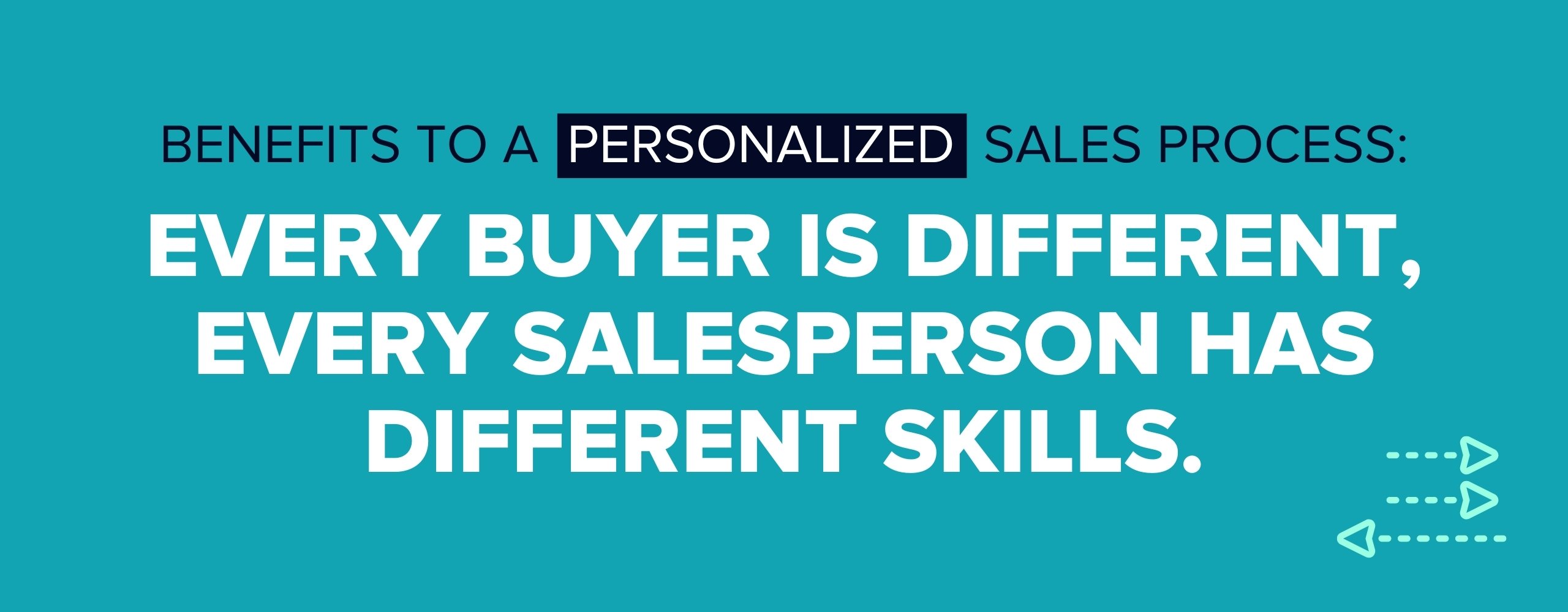
personalized-sales-process

The sweet spot is somewhere in the middle. You need a tried and true sales process for all the obvious reasons, but you need adaptability, too.

In the course of growing your business, the pendulum may swing back and forth. 

At IMPACT, we went through a phase where we made our sales process very cut and dry. It was simple and prescribed and easily repeatable by a variety of sales reps. 

The only problem was that we were forcing ready-to-buy prospects to jump through hoops that made no sense for them. If we had a CEO who was eager to move forward, we’d hold off on introducing them to a coach because that usually didn’t happen until the third call. So we’d slow the deal up because the process said so.

We eventually realized how detrimental this was, and we loosened up our process to allow for more customization. 

Eventually we may feel like we’re playing too fast and loose, and we’ll go back in the other direction.

The lesson here is that sales processes are never finished. They’re never perfect.

Need a better sales process? Listen to your customers 

If you have a sales process already, let me start by confirming what you’re already guessing: it’s not as good as it can be. 

If you don’t have a sales process at all, you should build one based on the advice above.

Remember that the solution to either problem is right at your fingertips: Your customers. Sales leaders need to watch more sales calls and check in with prospects — both those who buy from you and those who don’t. Listen to their fears, worries, and concerns. 

Pay attention to decision points. What are the decisions that most buyers need to make before they commit to a purchase? 

When you build a process with your buyers’ needs in mind, you’ll close more future prospects.  


Author: cduprey@impactbnd.com (Chris Duprey)

* This article was originally published here
How to make $1000/day with affiliate marketing 24/7 - start here!


Monday, April 3, 2023

How To Create a Sales Process That Closes More Deals

With inflation and threats of a recession afoot, sales are becoming harder to close for businesses of all shapes and sizes. 

A continuous flow of new business is what keeps food on the tables of your employees and the doors of your offices open. So naturally, if sales are drying up, it’s likely a great concern to everyone in your organization.

Where are we going wrong? Are we attracting the wrong leads? What’s missing from our product or service? 

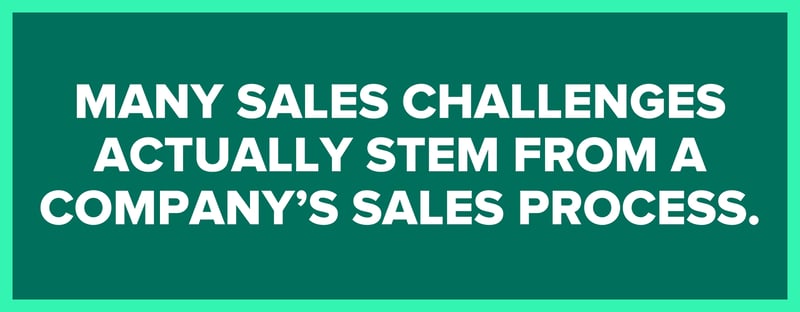
All these questions may be flooding your mind, but in our experience, many sales challenges actually stem from a company’s sales process.

sales-process-challenges

Perhaps your sales team is being inconsistent, neglecting crucial steps in the buyer’s journey, or not effectively addressing questions or objections that arise.

A well-thought-out, optimized, and standardized sales process helps you avoid common mistakes like these and increases the odds of your sales team moving deals across the finish line.  

Over the last decade, IMPACT has tested and fine-tuned its sales process and helped others do the same to ultimately close more deals and move them through the sales pipeline faster.

In this article, we’ll share some of those secrets.

First, why does your sales team need a documented sales process?

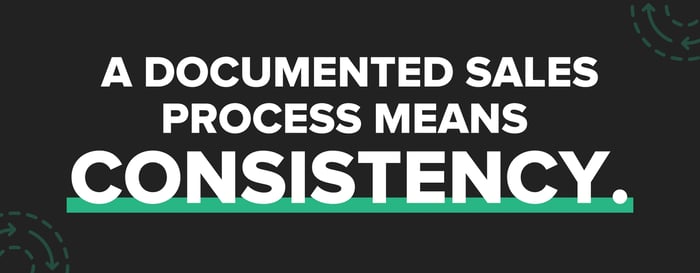
A documented sales process sets the standard for the sales experience inside and outside of your organization. In other words, it means consistency.

sales-process-creates-consistency

When executed by your sales team, a good sales process creates consistency in language, deal visibility, and results.

According to Derek Baer, sales strategist at Kurlan Associates:

“A formal sales process provides sales teams with a foundation to model proper sales behavior on and refer to when questions arise.

"It guides their conversations with prospects, instructs on next steps, and helps maintain control of the sales process by providing direction.”

A sales process also helps assure that all the necessary qualifying information is collected, realistic expectations have been set, and the opportunity has been positioned for the greatest chance of success. 

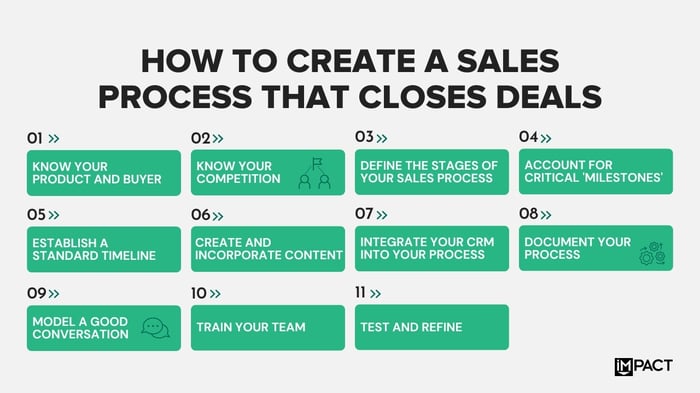
How to create a sales process that closes deals

how-to-build-a-sales-process

Ideally, your documented sales process is the most optimized version of the journey to a purchase. Here's how to put yours together. 

1. Know your product and buyer

This is a bit obvious, but you first need to know what you’re selling inside and out. Know what problems and pain points it fixes and what kind of people can benefit from it. Know what would push someone to make a change.

This provides your foundational value proposition and grounds for qualifying or disqualifying prospects. 

2. Know your competition

Who else is offering a solution to the problem you solve? How does it work? How is it different from yours? How is it better or worse?

Knowing the answers to these questions will help you better understand how to position yourself against them. 

3. Define the stages of your sales process

Put yourself in your customer’s shoes.

What's their buyer's journey look like? What are the steps someone typically takes from the discovery of your product to purchase? 

Knowing these are crucial to understanding what happens and needs to happen for someone to move toward a purchase.

They are also the foundation of the stages of your sales process. 

A good place to start with defining your stages is with the decisions a buyer has to make or conclusions they need to come to before they make a purchase.

sales-process-based-on-decisions

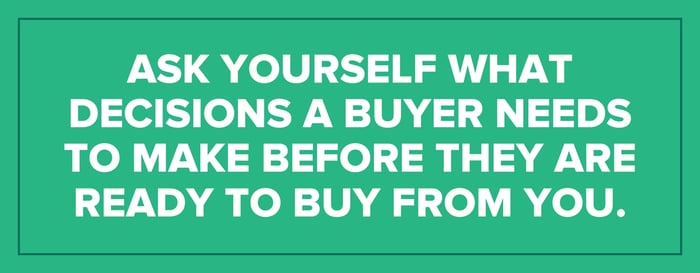
For example, if you sell cars, ask yourself what decisions a buyer needs to make before they are ready to buy from you.

First, they need to decide that it’s time to upgrade their old car. 

Then, they need to decide on their budget. 

Then, they need to decide about make, model, and features, and everything else.

Some of these decisions may come in a different order or many may come at the same time. Regardless, however, each decision is a natural transition and is likely a smart place to mark as the end of one stage and the start of another. 

4. Account for critical 'milestones'

Once you know the steps of your typical buyer’s journey and the stages of your sales process, Baer stresses accounting for three critical milestones.

Identification of the problem

You can’t sell your product or service if you don’t know what value it can bring to the buyer, and frankly, different products can have different values to different people. That’s why in your sales process you need to make sure you learn why a prospect needs your help.

What is the pain they are feeling? What is the problem they are trying to solve? What is the challenge they face?

You want to understand this from both a practical standpoint as well as an emotional one. This will help you shape future conversations around what is most important to your prospect. 

Quantification of the problem

Part of understanding and defining the problem includes quantifying the problem. 

This means understanding how much time or money the existing problem is costing your potential customers.

How much time are they investing to deal with this problem and what is their time worth? How much money has the problem cost the prospect? Are they losing money or customers? 

Quantifying the cost of the problem may help you and your prospect justify the budget required to solve the problem.

It will also help you better grasp your prospect’s point of view and what kind of information you need to deliver to guide them closer to making a purchase.

Defined commitment

If the prospect were to move forward, what would that look like? Who would have to be involved? Who would make the final decision? What conditions would have to be met on both ends? What does the prospect need to do?

A clear understanding of the commitment required from your prospect and your company brings more clarity to what you need to do next.

Discussing and defining commitment with a prospect, or the lack of it, also provides insight into their likelihood to close. 

5. Establish a standard timeline

Speaking of closing, how long will it take?

Establish a benchmark for how long a deal should be in each stage of your process so you can keep it moving along. 

For example, while the prospect stage may take only seven days, how long should it take to move through the other stages at your company?

When discussing commitment, you should also discuss a timeline for when your engagement would begin, when a decision will be made, and how long it will take to get started.

This helps hold prospects accountable and helps sales reps from letting deals go cold.

6. Create and incorporate content

Often what’s keeping your buyer from moving forward is an unanswered question, concern, or objection.

Enter sales enablement content.

Sales enablement content helps move your prospect through the sales pipeline faster by addressing these unanswered questions and concerns head-on as they come up.

Rather than being at a loss for words when a question or comment comes up, you can implement what Marcus Sheridan calls assignment selling. 

Assignment selling is the process of using educational content to resolve major concerns and questions of prospects and ideally move them closer to making a purchase. 

This may mean sending content to review before you hop on a call or even sharing something while you’re in conversation for them to look at before your next meeting. 

The content shared can be written (like a buyer's guide, article, or case study), visual, or even interactive.

In fact, 80% videos, self-service tools, and articles on product comparisons or pricing are just some of the types of content that can be very effective in your sales process.  

All in all, knowing your sales process and the journey of your potential customers, create or gather the content you need to aid it.

7. Integrate your CRM into your process 

A well-maintained customer relationship management (CRM) database and software can make executing your sales cycle much more efficient and effective.

With this in mind, take a look at your new sales process and determine when and where it can be aided by your CRM. 

In other words, is there an automated email that can be sent out when a particular field is filled out or after a meeting occurs? Should your sales reps be noting particular things in the CRM as they hold conversations? 

Outline all of this and add it to your process. Sales process automation can make a world of difference. 

8. Document your process

With these steps and guidelines in hand, document them! Get the sales process written out in detail and shared somewhere everyone in your organization, especially sales, can easily view and access it.

9. Model a good conversation  

To further aid your team, outline what a typical successful sales conversation or sales pitch may sound like. This should also include when you would make notes or turn to your CRM or incorporate content. 

While not all conversations will be the same, this sample will give your sales team something to model their approach on and something to strive for. 

10. Train your team

Next, train your sales team on the new process.

Of course, the new documentation will be available for reference, but it’s important to actually walk your sales reps through the new process and give them the opportunity to ask questions or provide feedback before they start implementing it. 

11. Test and refine

As great as it would be, it’s more than likely that your sales process won’t be perfect right off the bat. You need to see how it performs in real life to spot any gaps or areas for improvement. 

Once your sales reps are trained, have them follow the process to a T and take note of what worked, what didn’t, what was missing, or what wasn’t needed. 

Based on their feedback, your sales team can connect and refine the process as needed.

If you find yourself struggling to work through this process on your own, you might want to consider reaching out to a professional sales development firm to help you define the stages and get set up in a CRM, among other things.

Baseline Selling by Dave Kurlan is also a helpful read for getting you on the right track. 

Next steps for your sales team

Selling is not easy, but having a well-thought-out, consistent, and of course, tried and tested sales process can do wonders to help you close more qualified leads.

Use the advice and steps above to start setting yourself up for sales process success, and if you still need guidance, we can help.  


Author: gsukhraj@impactbnd.com (Ramona Sukhraj)

* This article was originally published here
How to make $1000/day with affiliate marketing 24/7 - start here!


Sunday, April 2, 2023

7 Days Your First Dollar Mastery Course

Dear Affiliate Marketers! If you’re looking to take your affiliate marketing to the next level, then this 7 Days Your First Dollar Mastery is a perfect choice. A step by step course to write an E-Book in 7 days and make 5 figures form it.

* This article was originally published here
How to make $1000/day with affiliate marketing 24/7 - start here!


Wednesday, March 29, 2023

Use These 2 Touchpoints to Learn What Your Customers Aren't Sharing [Infographic]

The greatest source of information about how your company’s performing is your customers. 

I know that sounds obvious, but I think thousands of companies are underutilizing the value their customers can bring to their marketing and sales.

customer-data

Many organizations do a few surveys and some net promoter scores (NPS), but these are only scratching the surface. 

A lot of people are very cautious about bothering their customers — burdening them with requests and making them feel alienated.

And I get that – but if you approach your customers the right way, you’ll actually build a stronger bond, all while learning valuable insights to improve your sales and marketing.

Below, I’ll explain exactly what I would ask of my customers about our sales and marketing — and when I would ask it. 

You can use my formula to glean as much information from them as possible. Which, in turn, will help you fine-tune your messaging and your sales process.

Let’s jump in.

The two often-ignored customer touchpoints

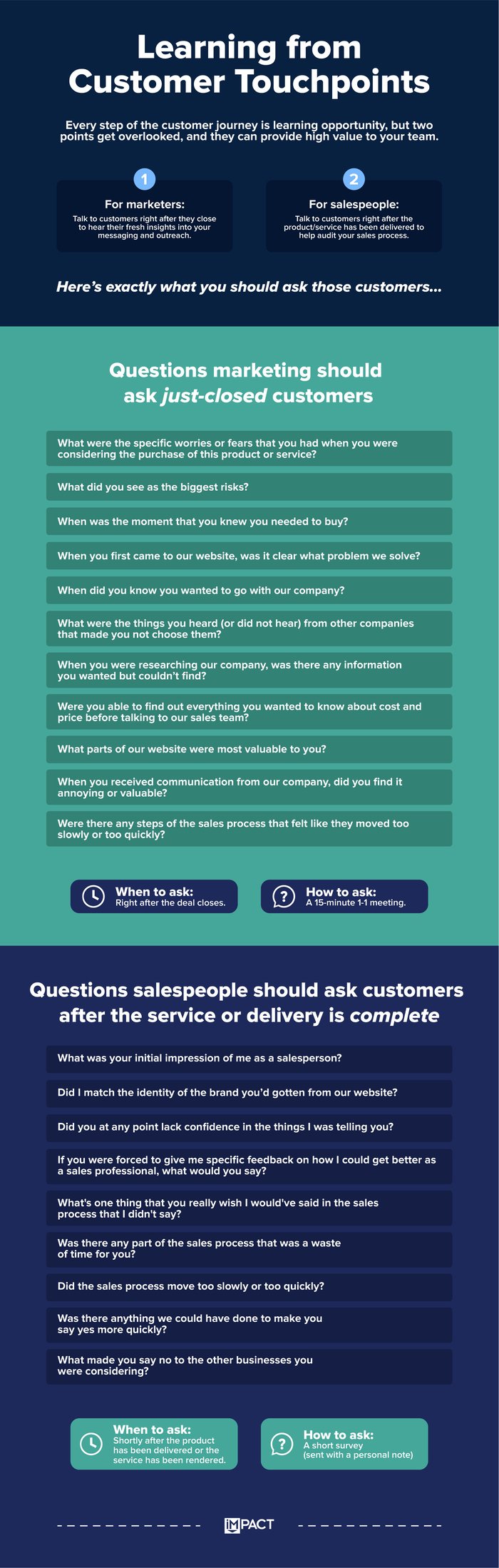
Every step of the customer journey is a learning opportunity, but, in my experience, two key points get overlooked, which can provide high value to your team. 

If you can have your team connect with buyers at these key touchpoints, you’ll get insights you’ve been missing. 

For marketers

Talk to customers right after they close.

It’s easy for marketers to stop paying attention to leads after they get passed onto the sales team, but this is a unique missed opportunity for feedback.

A newly-signed customer is the culmination of the efforts of both sales and marketing. They will have fresh insights into your messaging and outreach that may get forgotten down the line. 

key-touchpoints

For salespeople

Talk to customers right after the service has been performed or the product has been delivered. 

It’s easy for salespeople to stop paying attention after a deal is closed, but this is a missed opportunity too. A closed customer can help you audit your sales process and service experience with their perspective. 

These are the touchpoints where the customer will be able to give you the most feedback on your performance. 

Here’s exactly what you should ask those customers.

What marketing should ask just-closed customers

A customer who has just closed is at the very end of your entire marketing and sales process. 

Why is this important? Whatever you did worked — Congratulations! However the lead came to you, whatever they bought, they are proof that your process was effective. Now, you want to attract more people just like them. 

So, what should you ask? Here’s a run-down.

When to ask: Right after the deal closes.

How to ask: A 15-minute 1-1 meeting (as opposed to a survey or focus group)

What to ask:

  • What were the specific worries or fears that you had when you were considering the purchase of this product or service? 
  • What did you see as the biggest risks? 
  • When was the moment that you knew you needed to buy? 
  • When you first came to our website, was it clear what problem we solve?
  • When did you know you wanted to go with our company? 
  • What were the things you heard (or did not hear) from other companies that made you not choose them?
  • When you were researching our company, was there any information you wanted but couldn’t find? 
  • Were you able to find out everything you wanted to know about cost and price before talking to our sales team? 
  • What parts of our website were most valuable to you? 
  • When you received communication from our company, did you find it annoying or valuable?
  • Were there any steps of the sales process that felt like they moved too slowly or too quickly?

The point of this conversation will be to have new customers reflect on what brought them to you and got them into your funnel. At this point, the whole customer journey is fresh in their mind, so they’ll likely be able to give you more detailed answers. 

Make sure to record these meetings so you don’t lose access to the insights. 

Keep in mind, you don’t need to interview every customer. For some businesses, that’s not at all reasonable. But if you sell bigger ticket items, you might only sell to a handful of buyers each quarter, so every individual purchase is a big deal for your company.

No matter what you offer or how many you sell, plan on having a few of these interviews every month. That way, you’ll have enough information to draw meaningful conclusions. 

What salespeople should ask customers after the service or delivery is complete

I know, salespeople already know so much about their buyers. But after the sale, they hand over the customer to the services team, or the customer gets the product, and that’s usually it. Sales reps turn their attention to their next prospects. 

But sales conversations are full of promises — and sales reps should check in to make sure their promises were kept when the product was delivered or the service was rendered. 

If we create an additional touchpoint, the sales team can use the relationship and trust they’ve established with a customer to get candid feedback and learn a whole more — and then apply it to future sales conversations.

When: Shortly after the product has been delivered or the service has been rendered. 

How: A short survey (sent with a personal note)

What they should ask:

  • What was your initial impression of me as a salesperson? 
  • Did I match the identity of the brand you’d gotten from our website?
  • Did you at any point lack confidence in the things that I was telling you? 
  • If you were forced to give me specific feedback on how I could get better as a sales professional, what would you say? 
  • What's one thing that you really wish I would've said in the sales process that I didn't say? 
  • Was there any part of the sales process that was a waste of time for you? 
  • Did the sales process move too slowly or too quickly?
  • Was there anything we could have done to make you say yes more quickly?
  • What made you say no to the other businesses you were considering?

After the customer has completed the purchase, they’re in a great position to evaluate the whole customer experience.

Now, you might not want to survey them the very day their new product gets delivered; they might need a couple weeks. But you don’t wait too long. You want the experience to be fresh in their mind.

Prompt them to be honest. Use words that encourage them to give real feedback. You don’t want to just hear them say everything was “fine.” 

Learn from (but don’t pester) your customers

I hear from too many businesses that give lip service to customer research but don’t actually get all that much out of it. They have NPS as a core vital they’re tracking, and they think that’s sufficient.

It’s not. 

Use these touchpoints to get honest feedback on your sales and marketing processes so you can better serve your future customers.

Learning-From-Customer-Touchpoints (1)

And if you want to learn more about optimizing your sales and marketing, join IMPACT’s Zach Basner and Nick Bennett every week for a free session focusing on a current issue we see our clients facing. 


* This article was originally published here
How to make $1000/day with affiliate marketing 24/7 - start here!


Monday, March 27, 2023

9 Best Customer Feedback Tools for Businesses of Every Size

We live in a buyer's market.

Thanks to the internet, buyers can do their research independently and learn all about your product or service without ever speaking to a member of your sales team. Heck, with Yelp, Angi, and G2 among others, they don't even have to turn to you to necessarily get that information. 

In other words, power is firmly in the hands of the consumer to choose where, how, and with whom they spend their money. 

This is one of the many reasons marketers and businesses as a whole need to be putting their customer's interests first in everything they do.

We need to answer their most urgent questions, give them more of what they want and need to see and do, relieve their pain points, and help them make the best decisions for themselves. 

Putting the customer first is how you can not only build trust with potential buyers, but close more sales. 

But what does this look like?

Collecting customer feedback can be one the easiest and most effective ways to inform and shape your strategy. 

Why is customer feedback so important?

Whether you’re offering a product, service, or even both, knowing how your customers feel about you is essential.

Customer feedback — be it offered explicitly or gathered through data and behavior tracking tools — can help you understand where you’re struggling and succeeding and course-correct problems.

With feedback from your customers you’ll be able to:

  • Understand what motivates them and how you can better help them reach their goals
  • Gain a better understanding of how they perceive you and your company
  • Improve your performance and their satisfaction based on their feedback

But to be successful in this any of this, you first need to effectively gather these insights. A good customer feedback tool can help. 

Best customer feedback tools for 2023

While there are many customer feedback platforms and tools out there, not every one will be the best fit for any company.

Depending on your needs and the nature of your product and your marketing and sales strategies, you may find yourself needing a specific solution.

In no particular order, here are nine of the best customer feedback tools (covering a wide range of needs): 

1. Typeform

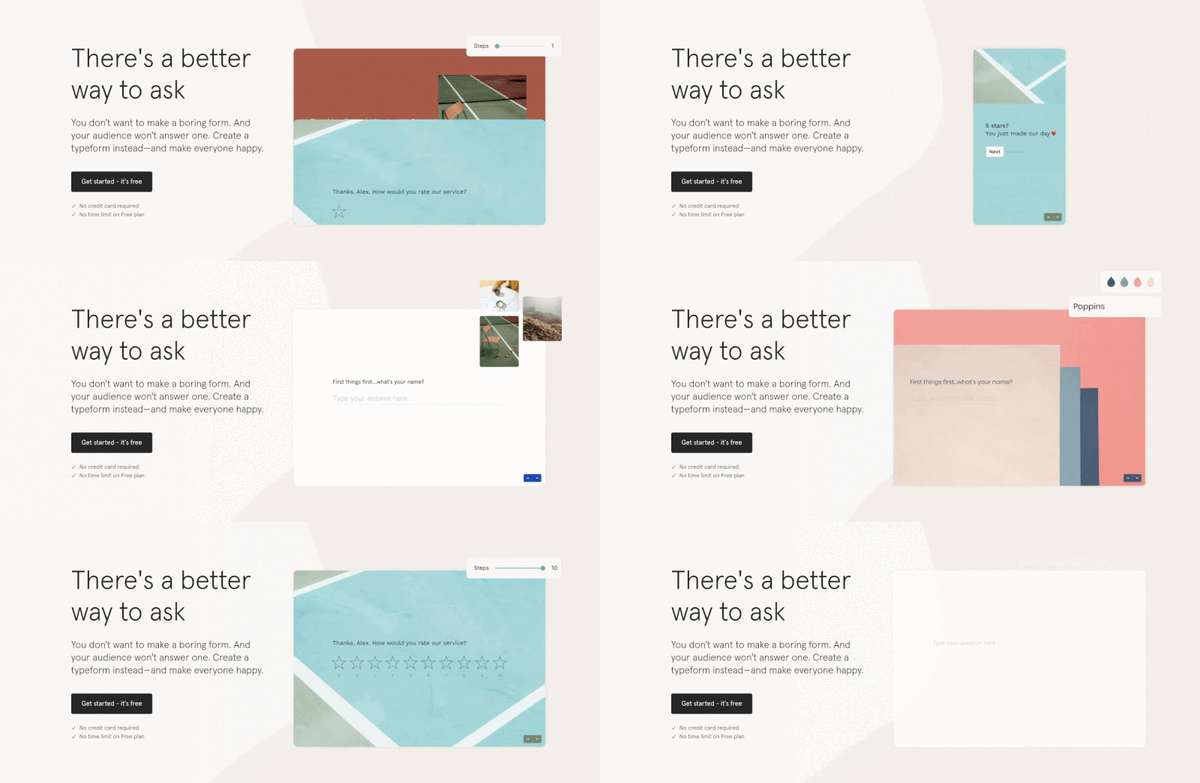
Typeform is known for its unique approach of displaying one question at a time in its finished products. It's quite popular and with good reason — it's extremely versatile.

best-customer-feedback-tool-typeform

Brands have used it to create quizzes and dynamic interactive experiences on their websites, but it can also be used to create forms, surveys, and quizzes to gather feedback from your customers. 

For example, you can inquire about what they like about your brand, products, and services, and what needs improvement. 

To add to its sleek design, Typeform also has built-in video and photo libraries that let you add more visual depth and context to surveys and questions.

Price: Free to get started, then $25-83 per month depending on the plan

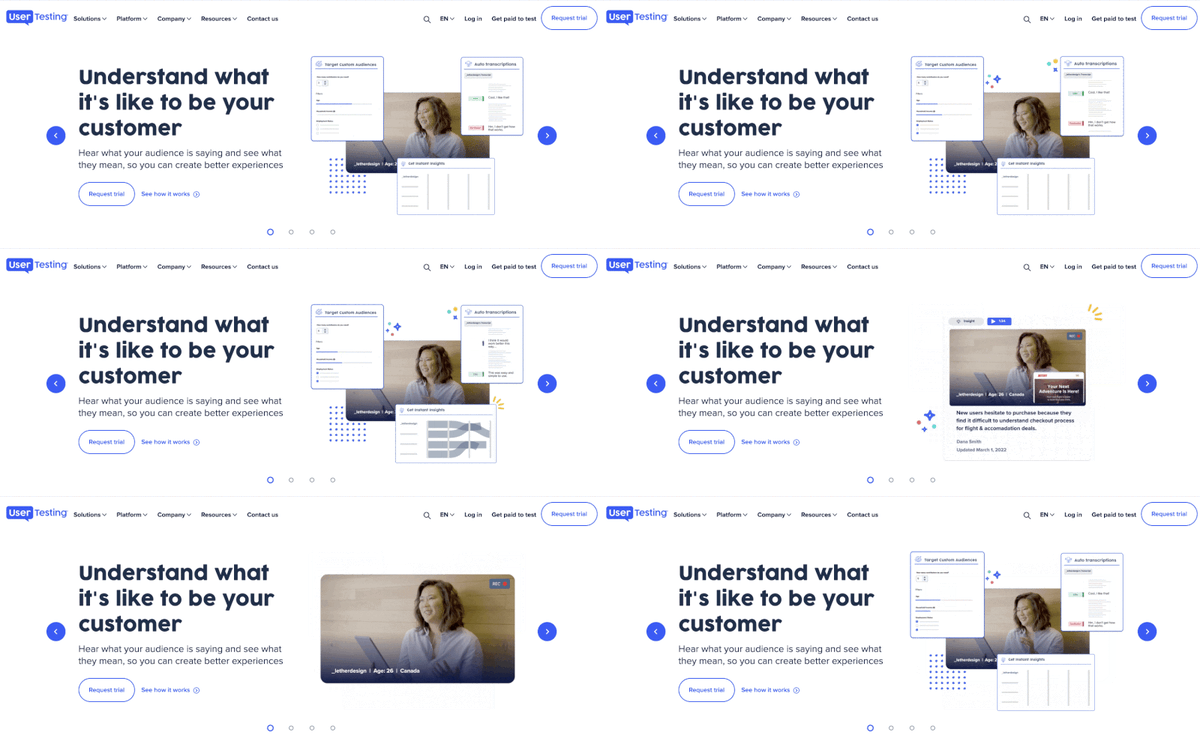
2. UserTesting

With more and more business being done digitally, it's important to know how you stack up in that department. In terms of customer feedback, UserTesting is unique in that it focuses on your digital presence, specifically your websites, apps, and platforms. 

It's also not simply a survey or form customers "fill out" or answer.

With UserTesting, you actually get to see recordings of how a customer interacts with what you've created. This means you get to see their facial expressions and hear any verbal reactions in addition to their clicks and navigation behaviors. 

All of this helps give you a more complete vision of the kind of experience you are creating for your customers and give you real-time feedback on to help improve. 

best-customer-feedback-tool-usertesting

Price: The specific price is unlisted, but according to PollthePeople, "They offer tests that cost $49 per test, but only if you’re testing with 15 users or less." Three plans are available and the price for varies depending on the number of users, types, and features.

3. Hotjar

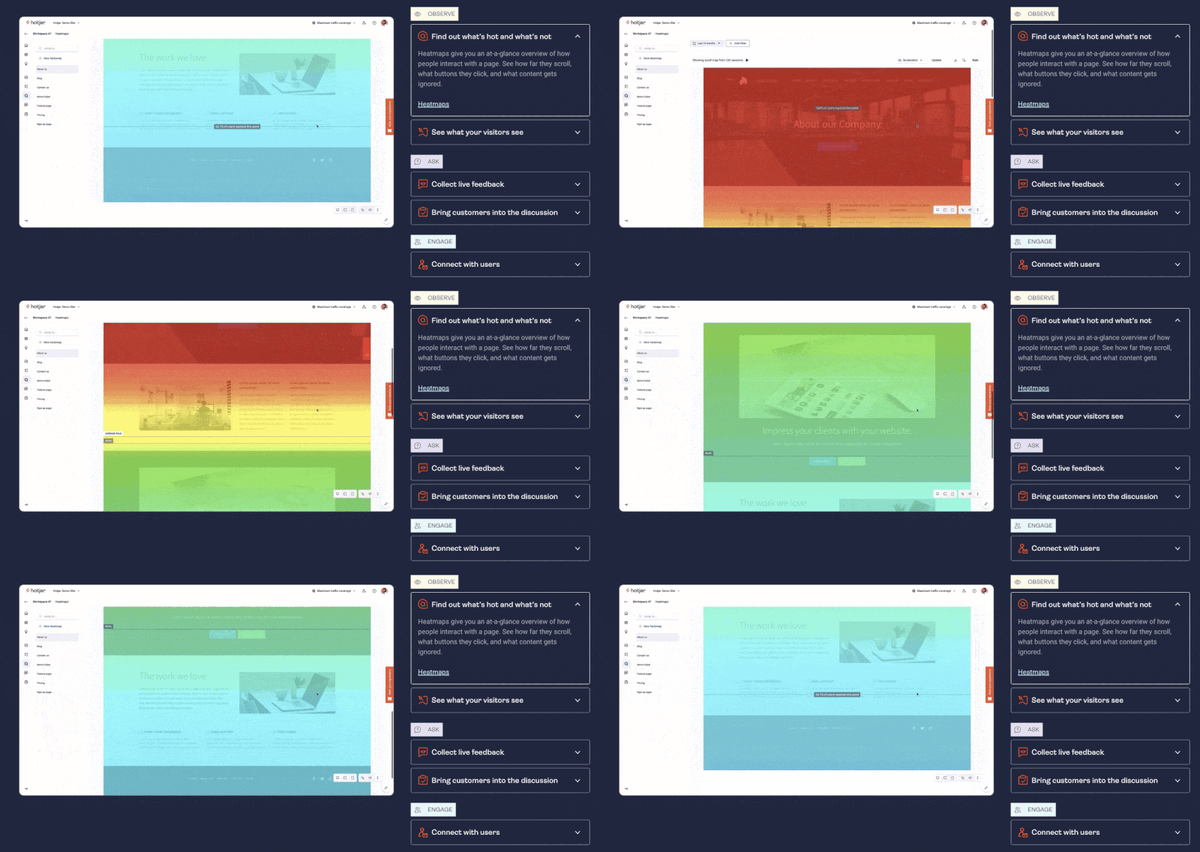
Hotjar is another tool that focuses on collecting website feedback from your customers.

It's most widely known for showing you the "hot spots" on your webpages — where users are spending most of their time, which buttons they click on, and what they avoid — using heat maps.

But it also helps companies dig deeper with recordings and on-page feedback widgets and surveys.

best-customer-feedback-tool-hotjar

Overall, Hotjar combines visual and analytical product experience insights, user behavior analysis, and customer feedback to connect the dots between what's happening on your site and why it happens.

This information can then be used to improve the experience on your website by removing friction and giving users more of what they like. 

Price: Free to get started, then starting at $32 per month depending on the plan

4. Qualaroo

Context is top priority with Qualaroo. It is a survey tool that strives to ask the right questions to the right users at the right time as they navigate through your website or app. 


With its tools, you can target visitors based on where they are your site, who they are, how much they pay, as well as visit history (among other things) to gather actionable user insights to improve your product and performance. 

Users can choose from professionally designed questions and templates or create their own. They can also create custom "nudges" with your company colors and branding for a less disruptive experience. 

Price: $69-299+ per month (billed annually) depending on the plan

5. Instagram Stories

This may seem like an unexpected addition to our list, but if you have a large audience, Instagram Stories can be one of the most effective, free feedback tools available to your business. 

Within Instagram Stories, there are a number of interactive "stickers" you can use to engage with viewers and, in this case,  gather feedback. Some of the most effective are "polls" and "questions."

First, the "polls" sticker allows you to ask a question and give your viewers options to choose from, like South Asian brands HoliChic by Megha Rao and BeautyByTamanna did in these examples:

        customer-feedback-tools-instagram-stories

HoliChic, a clothing brand, asks its audience what color it prefers for an upcoming design, while BeautybyTamanna, a makeup artist, asks her audience what type of hands-on classic they would like her to hold.

customer-feedback-tools-instagram-stories2

Both of these polls allow each brand to gather feedback from their customers on which product they like more to ideally create something that will be more profitable. It also helps customers feel "heard" and, in turn, closer to the brand. 

While with the "questions" sticker, you can give your viewers a question and collect open-ended answers:

customer-feedback-tools-instagram-stories3

Both options can also be included in "Reels" you create.

It is important to note, however, that either option will only be able to collect responses for 24 hours. So, if you don't have a large or active following, you may not collect a large enough sample size to make truly informed decisions. 

Price: Free

6. Delighted

Unlike traditional surveys where you might want to ask them a number of different questions, with Delighted you’re only going to ask them one to help you measure:

  • NPS (Net Promoter Score)
  • Product/Market Fit
  • Customer Overall Satisfaction (5-star surveys, "smiley" surveys, "thumbs up/down" surveys)

With this tool, customers receive your question via email, app or web popup, link, or in-person kiosk. They rate your product/service in one click and the result appears instantly in your dashboard.

For each option besides the kiosk, they can even add feedback in their own words if they like. It's quick and easy for your customers and gives you a quick "pulse" of how you're doing.

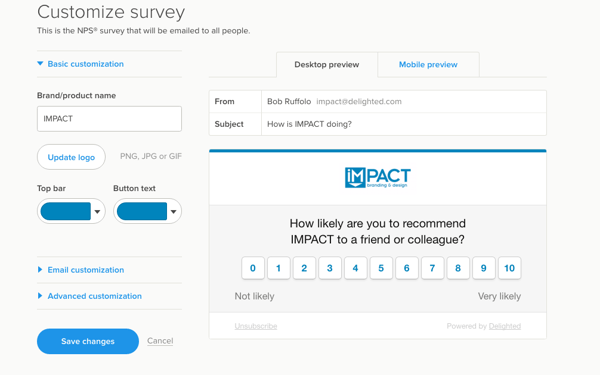
Need a little inspiration? Here’s a look at what an NPS email survey from IMPACT may look like:
 Delighted-customization.png

Price: Free for their basic plan, then starts at $224 per month (billed annually) depending on the plan

7. Poll Everywhere

Are you giving a presentation? Or even giving a product demo? Wouldn’t it be cool if you could get feedback in real-time from your audience or customers?

That’s possible with Poll Everywhere.

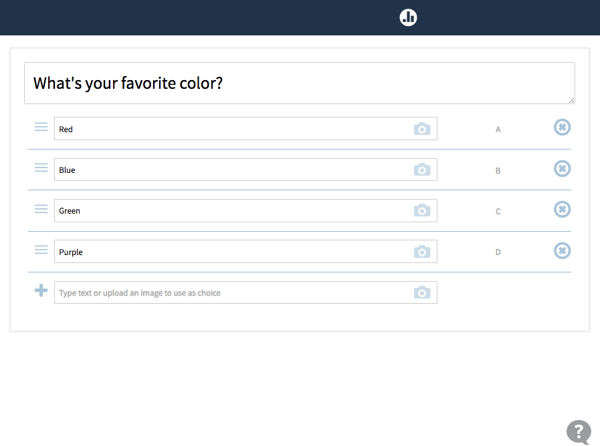
Poll Everywhere allows you to ask questions in the following formats:

  • Q&A / brainstorm
  • Clickable image
  • Open-ended
  • Multiple choice

Once you’ve created your survey, you have the ability to embed the poll into a presentation or share a link, allowing your audience and customers to engage with you in real-time.

All you have to do is have your audience send a text message and the results will automatically appear on screen.

Poll_Everywhere.png

Poll Everywhere is a great tool for companies hosting events or routinely giving sales presentations. It gives your customers a quick and easy way to provide feedback so you can adapt in the moment or take note for improvements next time. 

Price: Free for their intro plan, then starting at $120 per year depending on the plan

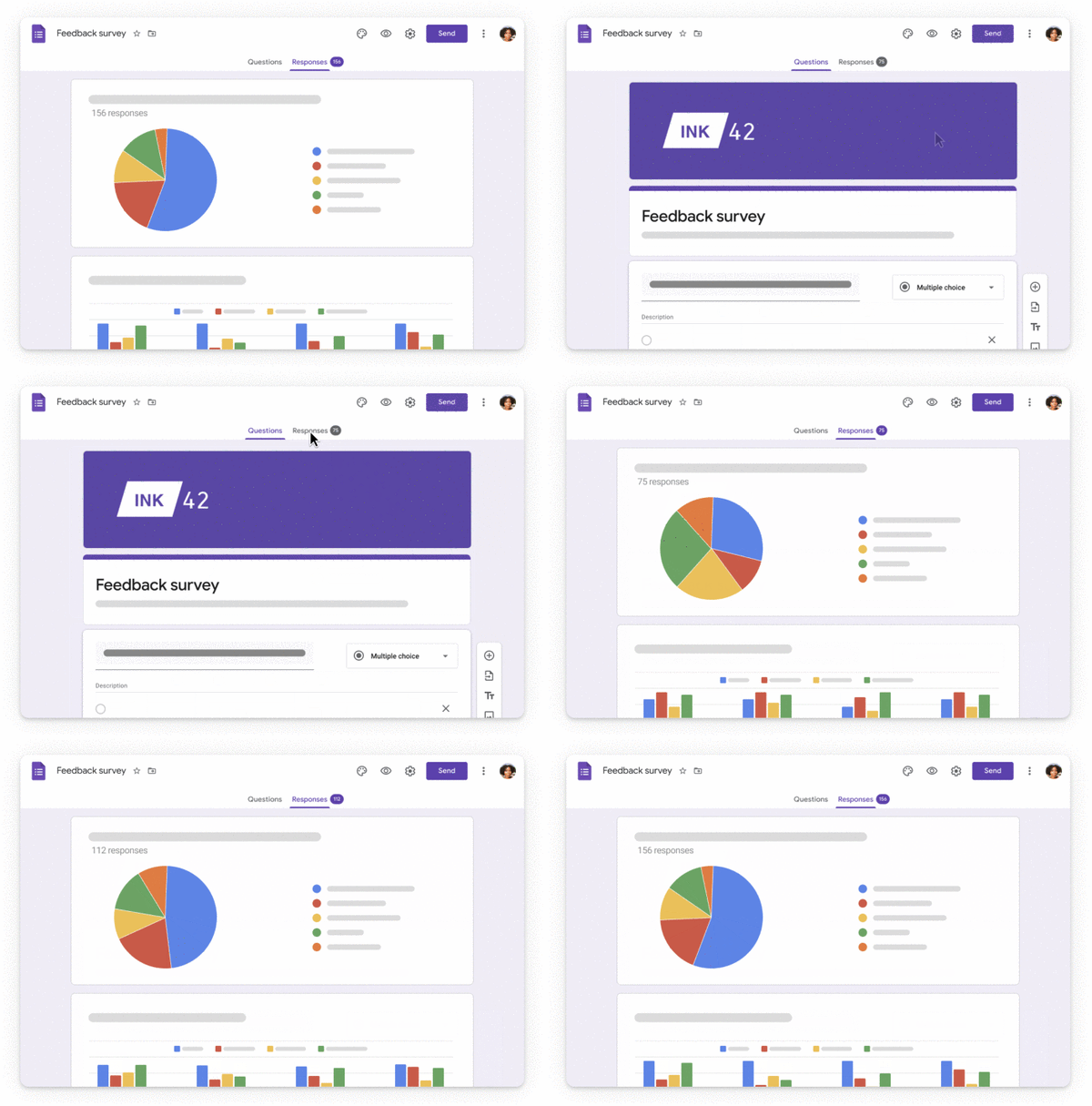
8. Google Forms

Google Forms is a great option for teams looking for easy data collection and collaboration. 

Not only is the platform free, but with it you can create unlimited forms, send them to as many participants as you want, and you can even embed the form into an email or a site page.

Once people start replying, all of the data is automatically collected within a Google Spreadsheet. No need to lift a finger.

best-customer-feedback-tool-google-forms

In addition to this, you can invite as many team members to collaborate and edit the survey or view the data as you like. 

Plus, you can easily upload your own photo or logo and Google Forms will pick the right colors to complete the overall look and feel of your form, should you not like any of their curated themes. 

Price: Free

9. Survey Monkey

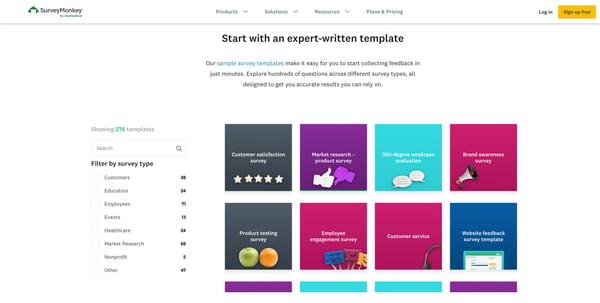
While last on our list, SurveyMonkey is one of the best-known customer feedback tools on the market.

It's a great option for beginners as it has hundreds of expert-written templates available for you to choose from, where you need a "market research survey, customer satisfaction questionnaire, a political poll—or anything else."

best-customer-feedback-tool-surveymonkey

Plus, the tool basic plan is free, allowing users to send unlimited surveys with up to 10 questions (via links, email, or by embedding surveys and forms on your website), though response limits apply.

The tool is easy to use and lets you "analyze responses at scale using simple, built-in reports or advanced dashboards that you can customize and share with your team."

Price: Free for their basic plan, then starting at $39 per month

Give your customers more of what they want

At the end of the day, your business cannot thrive, let alone, survive if its customers are not happy.

Using the tools above will help you gather invaluable customer feedback on your product, services, website, sales process, and marketing among other.

These are the first-hand insights you need to give your customers more of what they want and need now and stay proactive about their needs in the future.

Want to learn more about what your customers want from your marketing? Check out our course, "4 Content Guides to Convert Leads, Close Deals, and Delight Customers" in IMPACT+!


* This article was originally published here

How to make $1000/day with affiliate marketing 24/7 - start here!