* This article was originally published here
Tuesday, August 8, 2023
Forex Marketing: Strategies, Tips, and Key Considerations for ... - NNN NEWS NIGERIA
Forex Marketing: Strategies, Tips, and Key Considerations for ... NNN NEWS NIGERIA
* This article was originally published here
Discover how to make money fast with affiliate marketing - subscribe here!
* This article was originally published here
How to Promote Your Infographic on Your Blog and Social Media [Infographic]
Get the most out of your infographics with these promotion tips.
* This article was originally published here
Monday, August 7, 2023
How To Measure The Trust You've Built With Your Audience (with template)
Years ago, when I was a salesman, I started to realize a fundamental truth about business.
I had always known salespeople to be ready with a smile, a handshake, and good manners, but, soon, I came to see that sales success was more than that.
It wasn’t just about being liked. Sure, people are more willing to buy from people they like — after all, that's why celebrity endorsements work so well. But I started to understand that sales was about more than being liked. It was about being trusted.

If a prospect trusted me, that prospect was much more likely to close. This became fundamental to my worldview. I came to understand that whatever industry we’re in, we are all in the business of trust.
This became my mantra.
As I traveled to give keynotes to business groups and at conferences, whether I was talking about marketing, sales, communication, or leadership, the core of my message was the same: People buy from companies they trust.
Trust is the reason for brand loyalty. Trust is the reason the deal gets signed.
Trust is the foundation of all future success.
But trust was hard to measure and easy to misjudge because we lacked the tools to measure it.
Below, you’ll find the building blocks of a trust index that you can use to evaluate how much your audience trusts you — and see whether your business is building trust or losing trust in the marketplace over time.
Breaking the 'I know it when I see it' myth
Trust is invisible, but that doesn't mean it can’t be measured.
If you’re thinking, “of course, my audience trusts our business,” you might be right — but you also might be wrong, and without a way of measuring, you’ll never be sure.
Keep in mind that your audience is a multitude of people so they’re not all going to feel the same way about you.
However, if you commit to building trust with your audience overall, you’re going to be moving in the right direction with those who need the help. And the metrics below will allow you to measure that progress.
I’ll break down the trust index into three buckets:
- Measuring trust before the sale
- Measuring trust during the sale
- Measuring trust after the sale
Then, I’ll include a template version of the spreadsheet we use at IMPACT to monitor trust signals from our audience.
Note: Not everything that appears below will apply to every business, but I’m hoping you can use what I present below to start measuring your own trust index.
Part I: Measuring trust before the sale (i.e. at the top of the funnel)
This is where it all starts.
A potential future customer just begins to learn about your brand. As the old saying goes, you never get a second chance to make a first impression. When a visitor is just getting introduced to your brand, you have a huge opportunity to build a relationship.
At the same time, you must remember that every single page of your website can be someone’s first introduction to your brand, so you need to pay attention to every weak link.
At the top of the funnel, trust is built with honesty — and it's measured by engagement. Searchers are looking for information, not a sales pitch or a product demo. When your content offers unbiased information, you’re on your way to building trust.
But what does that trust actually look like?
I’ve found that if you pull together the right data points and track them week by week, you can see if your efforts to build trust with your audience are paying off.
I advise businesses to keep track of the following metrics. Now, admittedly, some are harder to track than others, but with a good CRM and Google Analytics, you can get a lot of useful data.
Keep in mind, these are not the only numbers your marketing team should pay attention to. There are plenty of others that are important to your goals. But the ones listed below should form your trust index.
Track these metrics to measure trust (in aggregate)
- Session length: On average, how much time are your visitors spending on your site? The longer we give something our attention, the more trusting we are.
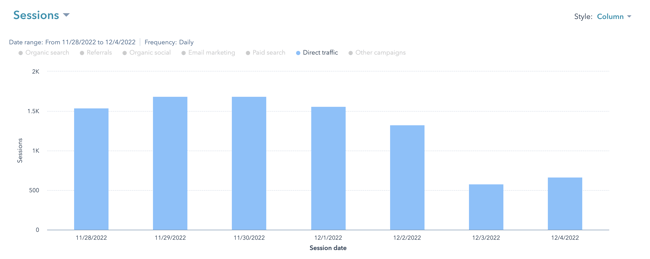
How to measure: Use your CRM or Google Analytics to measure average session length across your entire website. - Direct traffic: Visitors are typing in a URL specifically so they can come to one of your pages. The fact that they’re seeking you out by name shows that you’re a recognized, trusted resource.
How to measure: Both your CRM and Google Analytics can measure direct traffic. In HubSpot, select it from the list in your traffic analytics report.
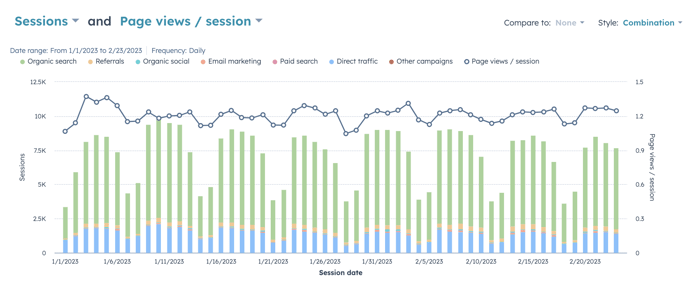
- Average page views per session: Someone spending time on your page and reading your content is a sure sign of trust. If they’re willing to click through and read more, they’ve trusted the content they’ve found.
How to measure: You can measure page views per session in your CRM using a combination report. If you’re a local business, you can filter based on location, too.
- Subscriptions: We all have overcrowded inboxes. If someone chooses to subscribe to your newsletter or RSS feed, they’re inviting you into their everyday work life.
How to measure: You should track your total number of subscribers week over week using your CRM. Don't just track the aggregate number of subscribers. See how many signed up and how many dropped out. - Newsletter engagement: Those inboxes are crowded for a reason. We’ve said yes too many times in the past. Open rates and click-through rates show that your audience is actually consuming (and maybe even enjoying!) your content.
How to measure: Each time your newsletter goes out, you should track the basics like you would for any marketing email: open rate, click-through rate, and anything else you’re looking to see. But keep in mind that you’ll have to establish baseline numbers to get started. The engagement you’ve been seeing from typical marketing emails might not translate to your newsletter.
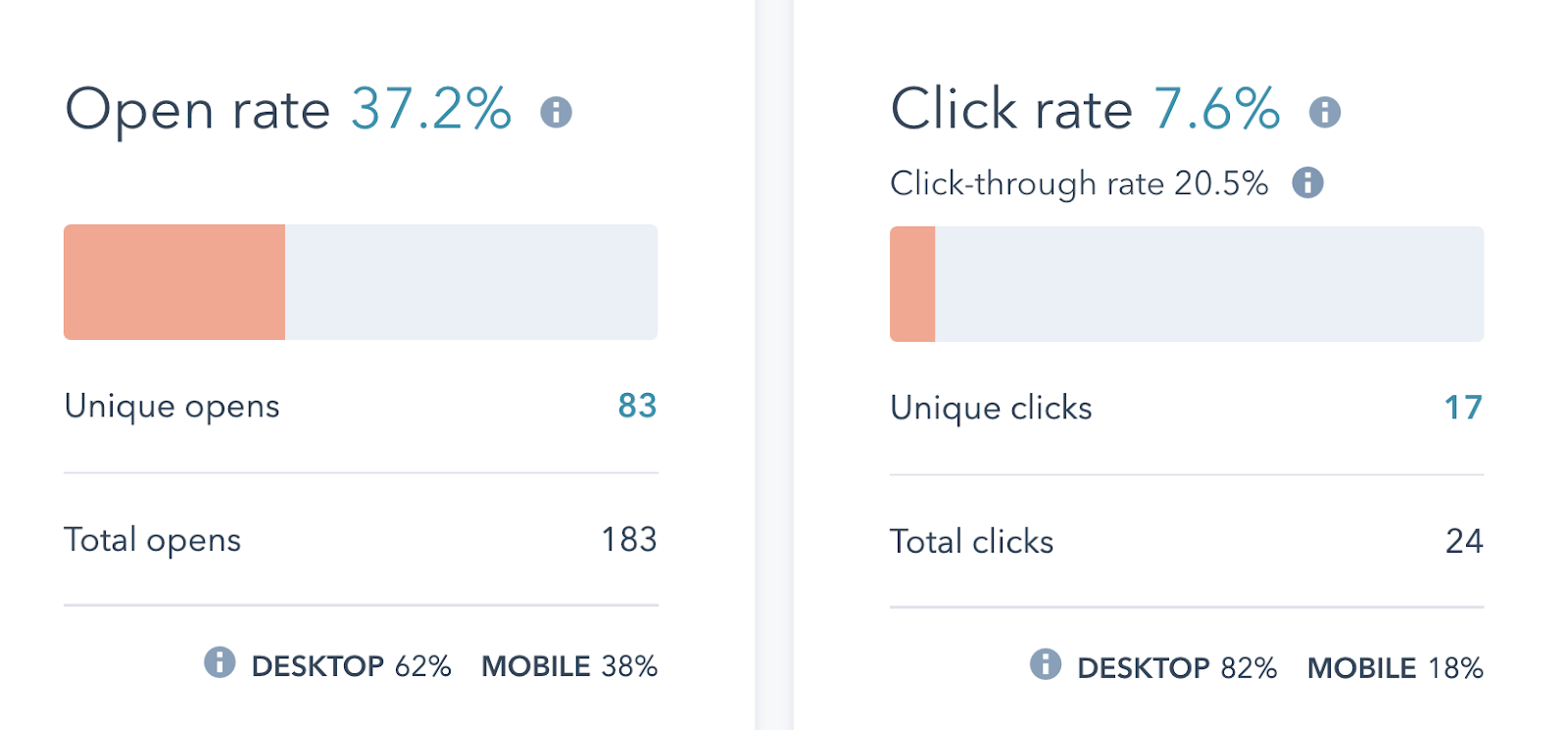
- Private responses (to marketing emails or social posts): Public comments on LinkedIn are great, but they’re as much about building that person’s brand as they are about your content. A private message or a response to an email newsletter takes more effort and means more.
How to measure: Make sure your newsletter comes from a person, not just from brand@company.com. In the text, encourage replies. These replies can get routed straight to the sender, who can report on them each week.
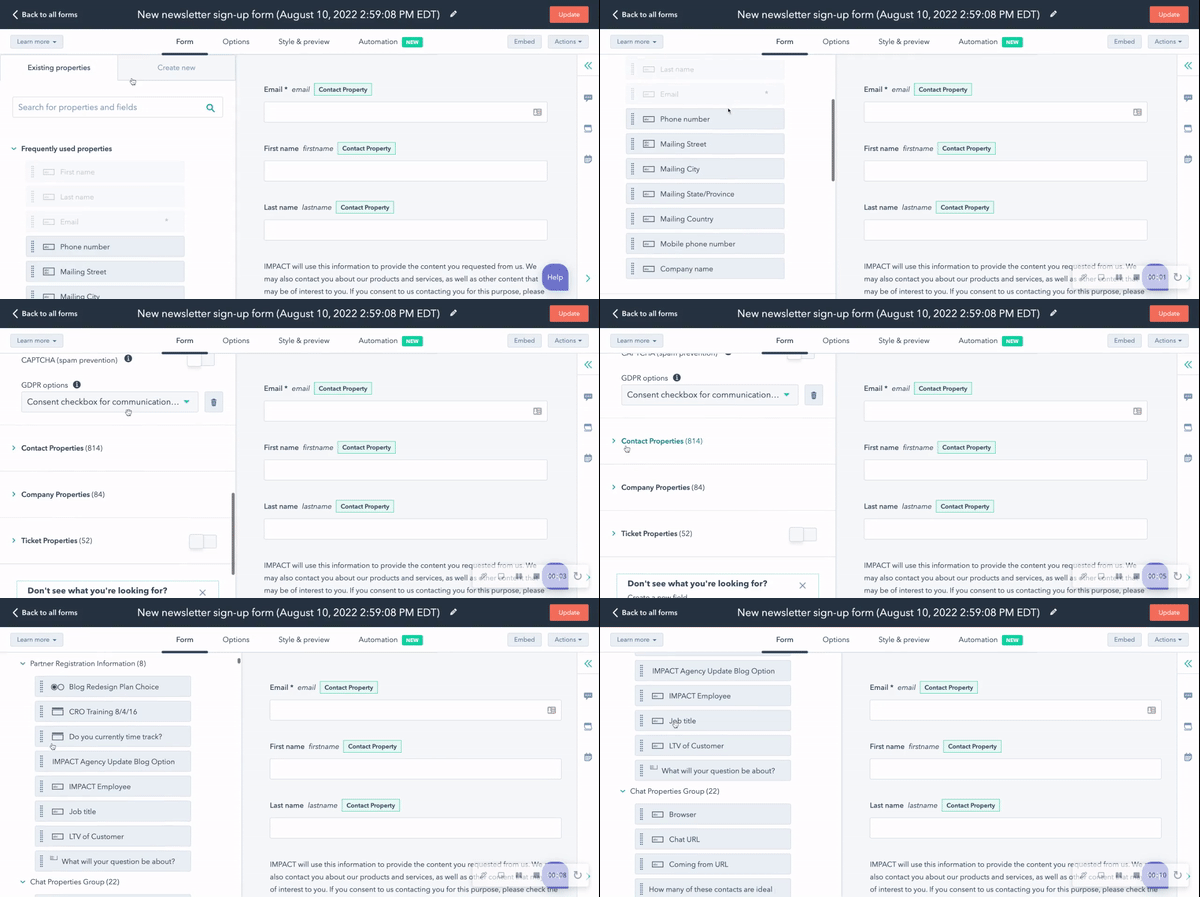
- Complete form fills: When someone converts and becomes a lead, they often do it on a form. The more information they’re willing to give, the more trusting they are. A simple form with just name and email is bare bones. If you’re asking for additional information and visitors are giving it, that’s a good sign.
How to measure: Marketers are always striking the balance between asking for the information they want and getting fewer form fills. My advice: Ask for what you need and what’s reasonable, and provide value in return. And be very clear about next steps. Serious buyers who trust you will give you what you’re looking for.
At the same time, be sure to look at HubSpot’s form step completion report to check your completion rate. You want to see a high completion rate based on the number of times the form has been viewed/interacted with.
Track these metrics to measure trust (for an individual lead)
- Total page views before becoming a lead: If a person keeps returning to your site before they convert and become a lead, they’ve begun to build a relationship with your brand.
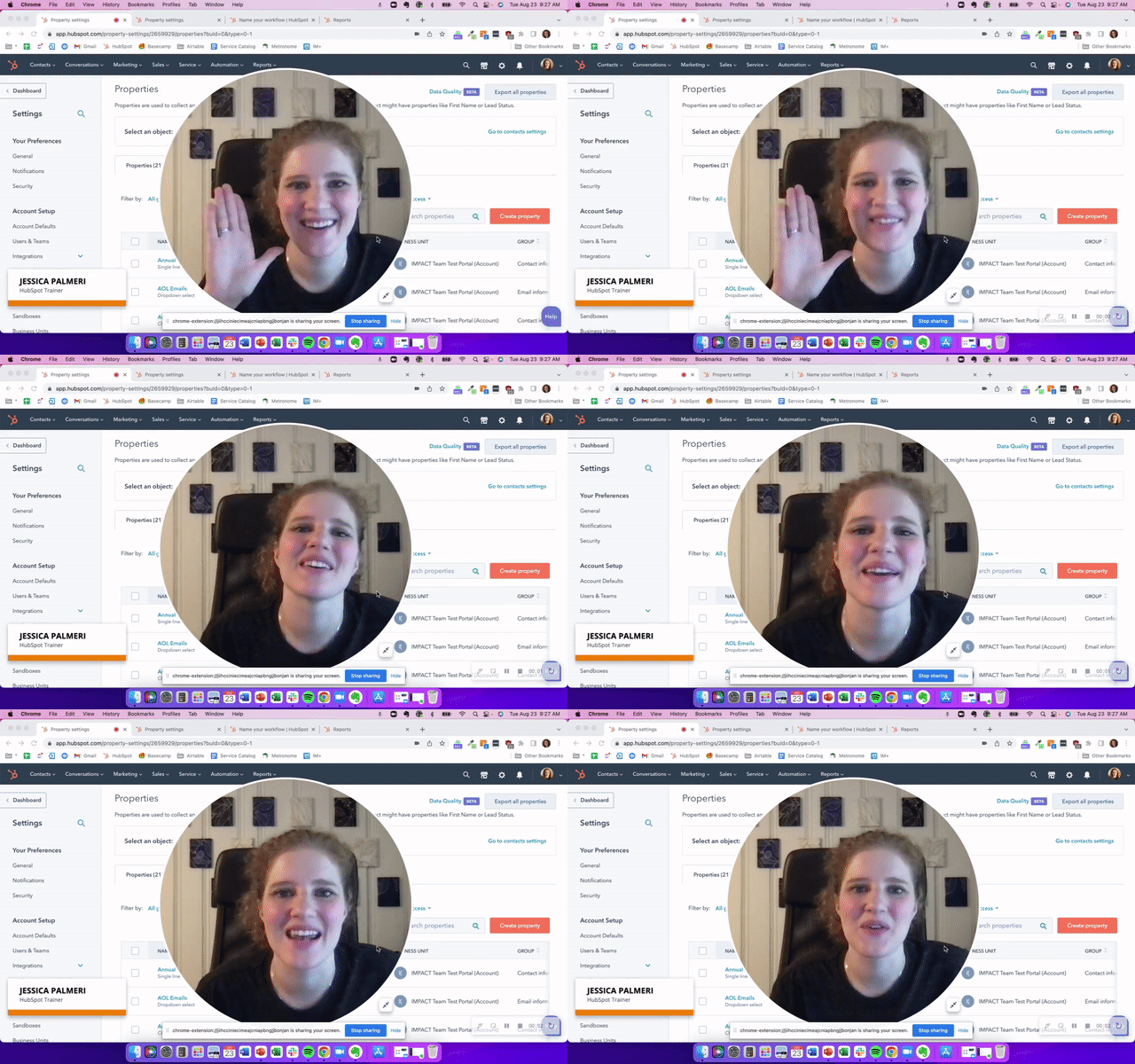
How to measure: Once someone has converted on your website, your cookie tracking should allow you to see the pages they’ve viewed in the past. This information will live in their contact record in your CRM. However, that number will keep growing as they see more pages during the sales process or after they become a customer.
Here’s how to track the number of pages they viewed before becoming a lead, with help from Jess Palmeri, our lead HubSpot trainer.
- Total video watch time: This demonstrates the same thing as site views — this person is investing time in your content.
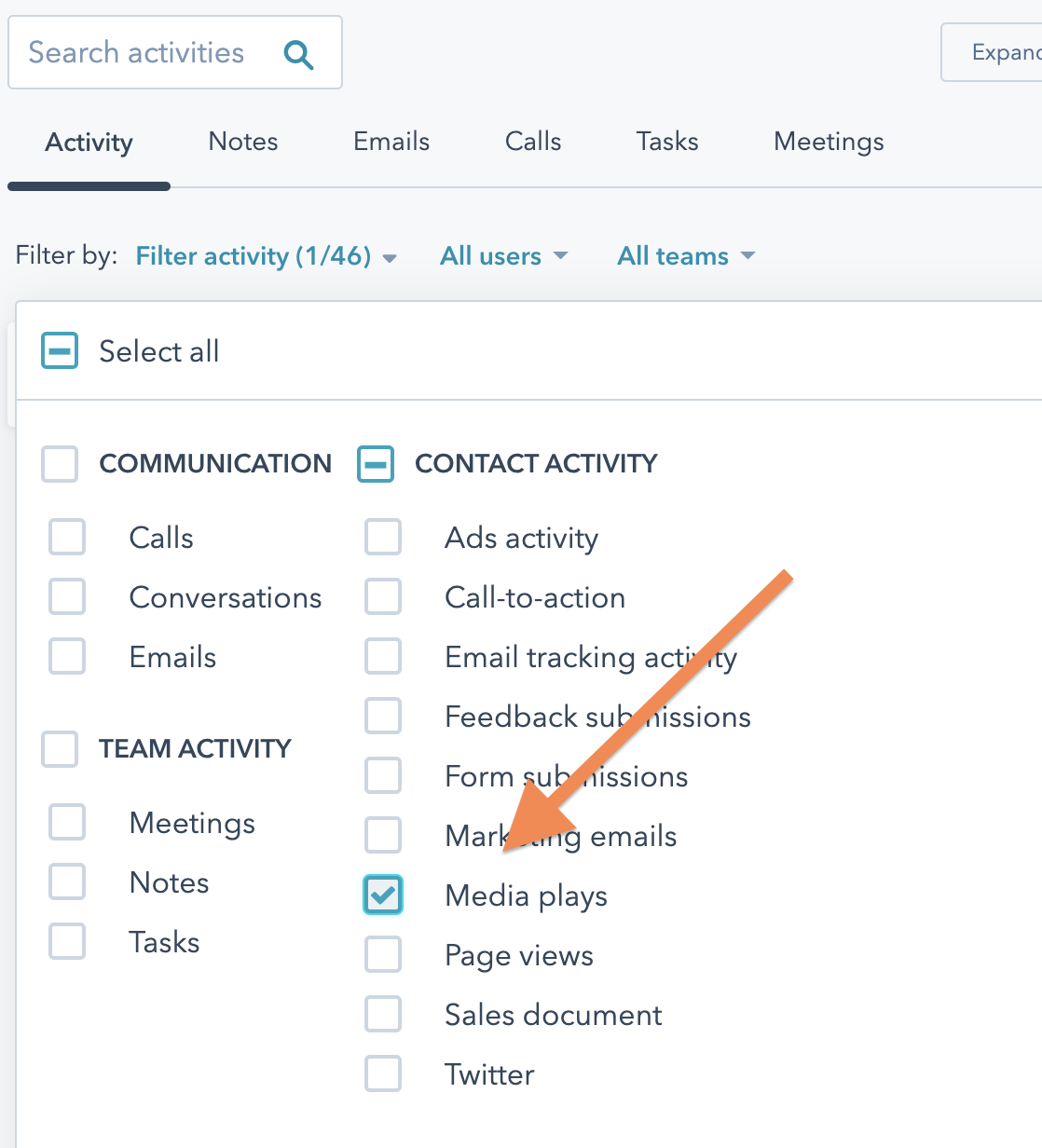
How to measure: This one’s trickier because it depends on where your videos are hosted. YouTube gives data in aggregate, but embedded videos on your site that are hosted by another platform can give you individualize insights. Here's what this looks like in HubSpot Video when you filter contact records by media plays.
- Content shares: When you share something (through email or social media), you put your own credibility on the line. If someone is sharing your content, they believe in your message.
How to measure: Because content shares can take different forms, tracking this one can be a bit of a challenge. It could be backlinks to your content, reposts of your social media videos, or forwarding your guidebook in an email.
Part II: Measuring trust during the sales process
If your marketing efforts have paid off, prospects should enter your sales process with a relationship with your brand already established.
For our clients, it’s not uncommon for their prospects to have already read dozens of articles and become YouTube and newsletter subscribers.
When that’s the case, you can imagine the sales team’s job is that much easier. With trust already established, the salesperson becomes the steward of that trust. They don’t have to start from scratch.
Still, there are key metrics to watch for to make sure your team is doing everything right.
- Average time to close: The more trusting the prospect, the easier the sale. They’ve already read your content and gotten to know your brand.
How to measure: Keep a running tally of deal length from first call to closed/won. Depending on your sales cycle, you can report on this weekly, monthly, or quarterly. Summarize the length of the average sales cycle during that period and share it with your team. - Personalization of the sales process: This feels more qualitative, I know, but it helps you better understand your sales process. See how much one sales call differs from another. The more personalized, the more trusting the relationship.
How to measure: You can measure this in an individual call using AI tools like Chorus or Gong. Track words that are unique to the prospect so you can see how much of each call is about the prospect’s needs — and how much is about your product or service.
Part III: Measuring customer trust after the sale
Some of the strongest indicators of trust come after a prospect becomes a customer. At that point, they’ve already trusted you enough to make a purchase.
So, are they likely to become repeat customers, to recommend you to their friends, and to stay in the orbit of your brand? Or are they going to leave you a one-star review and actively criticize your organization?
- Net Promoter Score (NPS): This metric measures customer satisfaction on a scale of 1-10, with the goal of identifying those customers who are so pleased that they become “promoters.” It’s not a perfect tool, but it’s handy to use.
How to measure: You can find out more at this website. - Number of referrals given: The customer who’s so happy that she refers your business to her network is someone who trusts your brand deeply.
How to measure: The best way to measure this is on the lead side. On intake forms, be sure to ask how the person heard about you. If it was from a referral, be sure to ask who. - Post-sale engagement with your community: The minute a sale closes, it concludes one relationship and starts another. Customer service is where real brand loyalty gets built. You want your customers to become repeat customers and brand ambassadors.
How to measure: You can track this a number of ways. Maybe you have a customer newsletter or other communication that goes out. Or an online community like a Facebook or LinkedIn group. You can track engagement there. And check if your customers follow your brand on social media or YouTube.
- Event attendance: Will your past customers attend your future events? Do they still see your business as important to them? You can safely believe that every attendee at the next Apple event has already bought an Apple product. Probably several. And they’re sure to be repeat customers in the future.
How to measure: If you host events, track attendees who are already in your system. Maybe they can get a special marker on their badge that notes they’re a past customer. You can always consider offering buddy passes or discounts, too.
Tracking your trust index
Now, not everything listed above will apply to every business. You might not have a newsletter, you might not host events, etc.
But most of the metrics above should be tracked by you and your team every week.
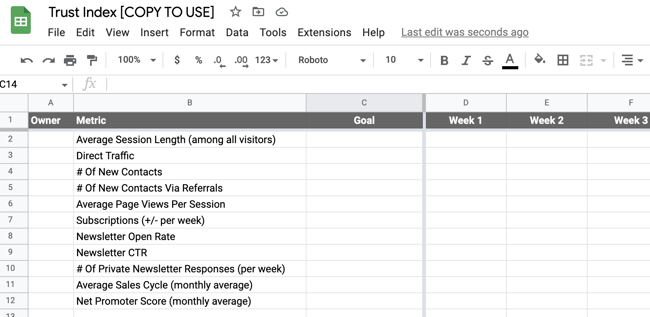
To get you a headstart, I've built a simple spreadsheet you can use to begin tracking these metrics today. It's nothing fancy. I haven't added in calculations or conditional formatting. I'll leave that to you. Just open the file and make a copy so you can change the template to suit your needs.
The power of the trust index
In a landmark study of more than 30,000 respondents, researchers at Edelemen found that only 54% of Americans trust businesses to do the right thing. Think about that. You’re selling to a marketplace that likely does not trust you.
To overcome this trust deficit, you must commit to honesty and transparency, replacing a hard-sell approach with buyer education and relationship-building.
This approach will yield big gains in the long term. Relationships are slow to develop, but they’re powerful and valuable once they do.
Trust matters.
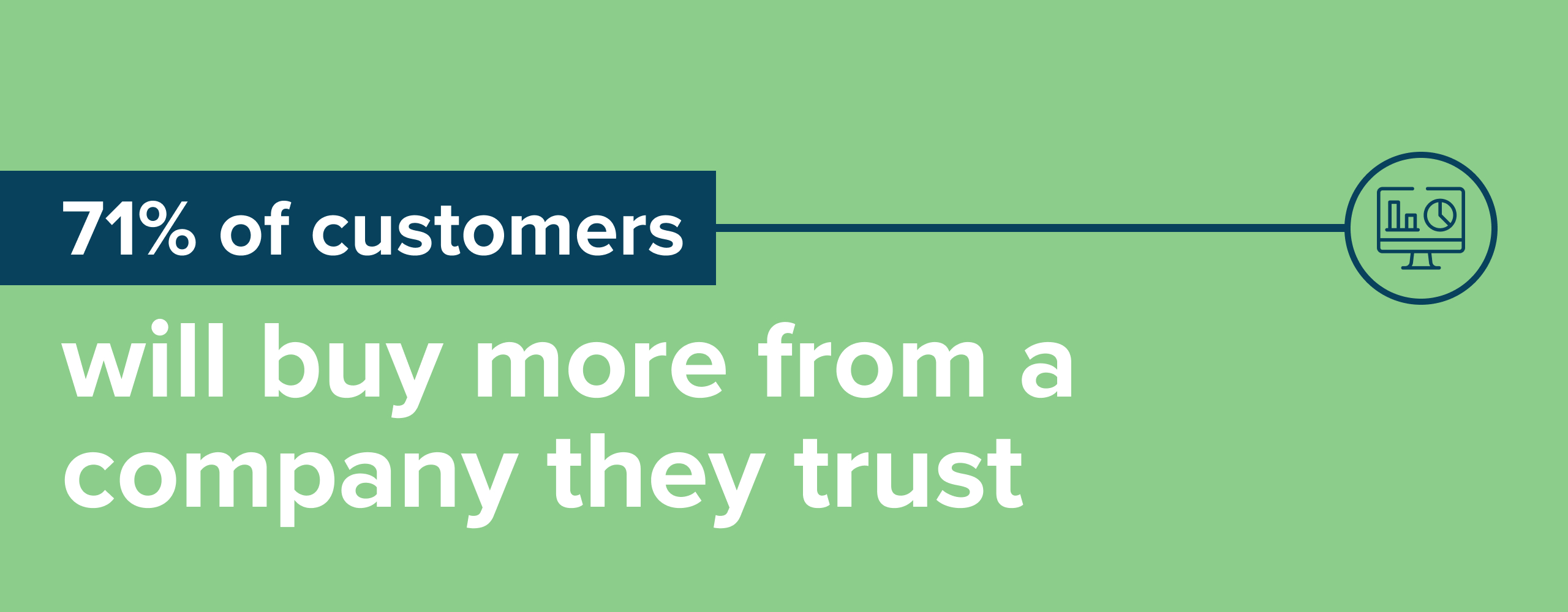
Research from Adobe shows that 71% of customers will buy more from a company they trust — and I’d wager the number is actually even higher. After all, when was the last time you gave your money to someone who wasn’t trustworthy?
If you want to build trust, don’t think of it as a vague concept that’s impossible to measure. Track the metrics listed above. Build your trust index to be sure your business is engaging in the most important work there is for long-term success.

Author: msheridan@impactbnd.com (Marcus Sheridan)
* This article was originally published here
Sunday, August 6, 2023
TikTok Announces New Changes to EU Users, Which Will Could Impact Usage
The changes will ensure TikTok adheres to the new requirements of the EU Digital Services Act.
* This article was originally published here
Saturday, August 5, 2023
X Users Can Now Participate in Spaces Streams via Desktop PCs
Now you can use your professional audio equipment for Spaces.
* This article was originally published here
Friday, August 4, 2023
X Will Now Display Posts from Communities You’ve Joined In Your Main Feed
X is looking to reignite interest in communities.
* This article was originally published here
Thursday, August 3, 2023
10 Marketing KPIs You Should Be Tracking
When setting and tracking marketing key performance indicators (KPIs), it's easy to give all your attention to the usual suspects:
- Sales revenue
- The number of sales-qualified leads generated
- Cost per acquisition
These common KPIs are decent indicators of success, but there are a number of other marketing metrics that will help your business lead a more successful digital marketing strategy.
The right marketing KPIs help you identify which campaigns and tactics have the biggest impact on whether you reach (or fail to reach) your sales and marketing goals.
Without information from the right metrics, you'll struggle to see the whole picture — and your company might make decisions based on incomplete information.
But with so many possible marketing KPIs to track, it can be pretty overwhelming to know where to start.
As a marketing training company, IMPACT has taught hundreds of businesses how to build and analyze world-class marketing programs, and we've included information below that we teach to our clients.
Here's our list to the 10 most important marketing KPIs you should track. These are the key performance indicators that provide the best benchmarks for your progress and wins. In this article, we’ll explain:
- Which marketing KPIs you should track
- Why you should track them
- Methods you can use to track these key performance indicators
This way, you’ll know exactly which metrics you should pay attention to that will help you grow your business.
1. Marketing Revenue Attribution
Why it's important
How much revenue have your digital marketing campaigns brought into your company? In other words, how much of your revenue can be attributed to your content marketing efforts?
Understanding this metric is important because it allows you to see how effective those campaigns are. No company wants to spend money on something that isn’t generating a return on investment (ROI).
As They Ask, You Answer author Marcus Sheridan says, the only content that works is the content that generates sales. This is why, of all the marketing KPIs, revenue attribution is at the top of this list.
This is something you can use to track and evaluate all of your efforts, and not just as a whole. You can also track how the individual pieces of your marketing strategy, such as blogging or social media, impact sales.
What to do
There are various models you can use to track revenue attribution, for example, single-touch attribution models look at your website users’ first or last interactions. You can also analyze multi-touch attribution models that divvy up the deal credits over each touchpoint.
With marketing revenue attribution, you’re looking beyond the number of qualified leads you close to see how much of your revenue is influenced by your marketing efforts. Tracking this information is a great way for your team to show the monetary value of their efforts.
If you’re using HubSpot, they make it easy for you to track and report on these numbers. Learn more here.
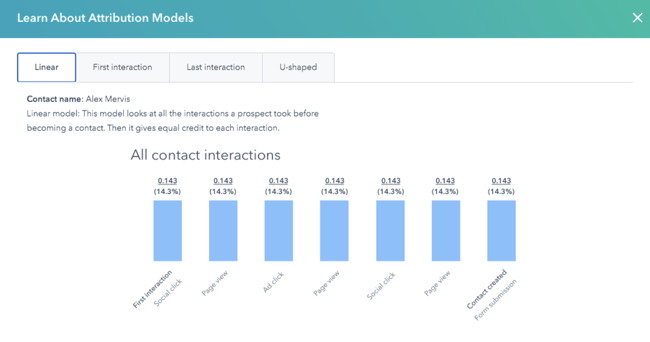
If your entire company helps create content marketing materials, revenue attribution is a great way to show how their efforts have helped close deals. This gives your stakeholders a reason to continue contributing to your content marketing program.
2. Customer Acquisition Cost
Why it's important
Customer acquisition cost (CAC) looks at the total sales and marketing spend needed to gain a new customer. This includes all program and marketing costs, salaries, commissions, technology, software, and any overhead associated with a lead becoming a customer.
You'll want to calculate your CAC for digital marketing and for outbound marketing as well. This way, you can understand the full scope of your efforts and which are working best.
What to do
When calculating this metric, you first need to determine the time frame you’re going to use (e.g., month, quarter, year).
Once you’ve decided on your time frame, use the examples below to help calculate your total sales and marketing costs associated with digital and outbound marketing.
Calculating CAC for digital marketing, relevant costs include:
- Manpower (salaries for sales, creative, and technical)
- Technology and software such as HubSpot, Vidyard, Adobe, and Semrush
- General overhead
Calculating CAC for outbound marketing, relevant costs include:
- Advertising
- Marketing distribution
- Manpower (sales and marketing)
- General overhead
You can calculate your CAC from digital or outbound marketing by utilizing the following calculation:
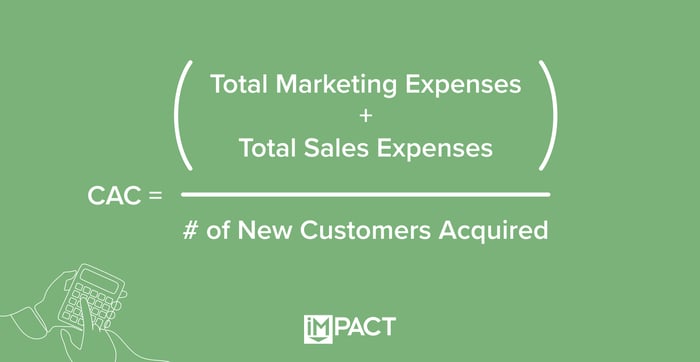
By calculating the costs associated with your digital and outbound marketing campaigns, you can directly account for new sales, as well as better allocate budgets for each campaign.
If your company is utilizing mostly digital marketing, you can break down that component further by campaign types, and then assess how successful and profitable each activity is. Then, you can then implement activities to improve effectiveness over time.
One way you can improve your customer acquisition costs is by optimizing your conversion rates and dedicating resources to high-value projects.
3. Customer Lifetime Value
Why it's important
Customer lifetime value is how much revenue a business can reasonably expect over the average lifespan of a single customer.
Of all the marketing KPIs, this one is especially important. If you know your CAC, you understand just how much you invest in getting a single new customer. If you can generate more revenue from existing customers, your cost per lead drops and your marketing budget can be spent on better-quality prospects.
What to do
You can determine the lifetime value of your customers by using the following calculation:
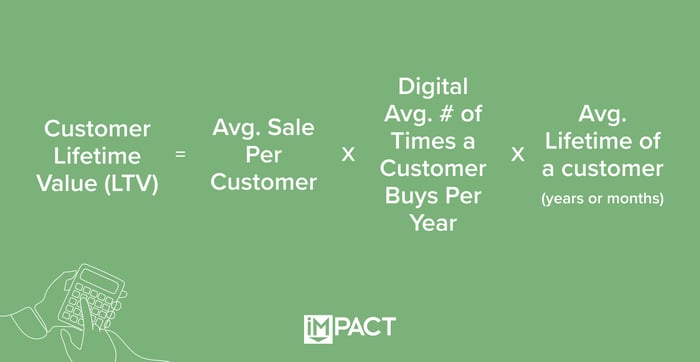
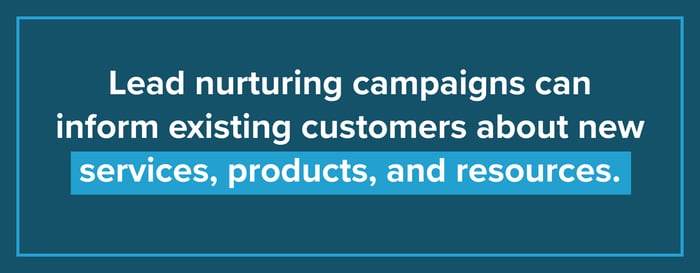
One way that you can increase the lifetime value of your customers is by developing lead nurturing campaigns that reach out to existing customers, providing you and your sales team the opportunity to inform existing customers about new services, products, and resources.
But remember, automated messages can often feel impersonal. Consider getting to know your customers on a personal level, like you would a friend. A personal message will always mean more.
4. Digital Marketing ROI
Why it's important
Every company wants to see a return on its marketing investment.
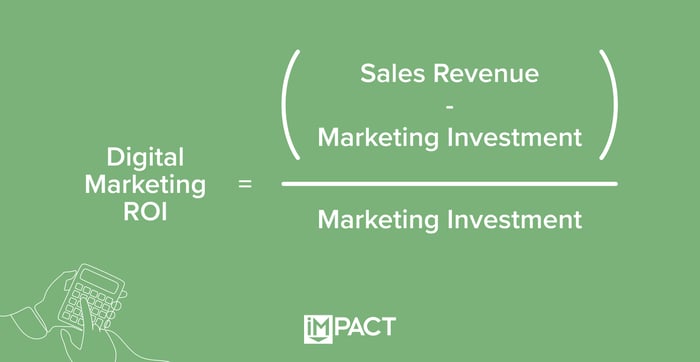
Calculating your digital marketing return on investment is crucial in evaluating your monthly and annual performance.
You don’t want to continue increasing your budget for an ineffective marketing activity that is costing your company.
So, no matter what marketing strategy your company is using, your return on investment will determine how you should proceed in the future.
What to do
Use the formula below to calculate your digital marketing ROI:
5. Traffic-to-Lead Ratio (or New Contact Rate)
Why it's important
Understanding your website traffic is very important, especially knowing where it is coming from — whether it’s organic, direct, social media, or referrals.
If your traffic is steady or increasing, but your traffic-to-lead ratio is low or decreasing, that’s a surefire sign that something is missing on-page.
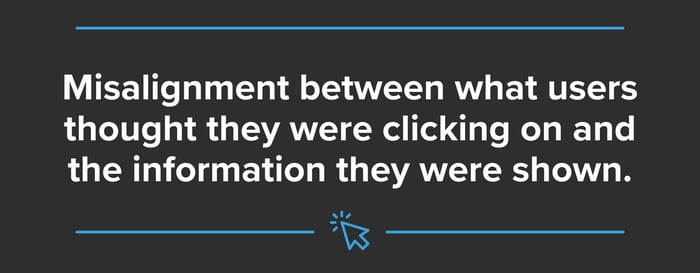
There could be a number of culprits, but the biggest is misalignment between what users thought they were clicking on and the information they were shown.
You might also be showing them content they aren’t yet ready for, or that simply didn’t answer their questions, leaving them to find another resource that will.
What to do
We use native tools within HubSpot to track our new contact rate, which separates the numbers by source and date.
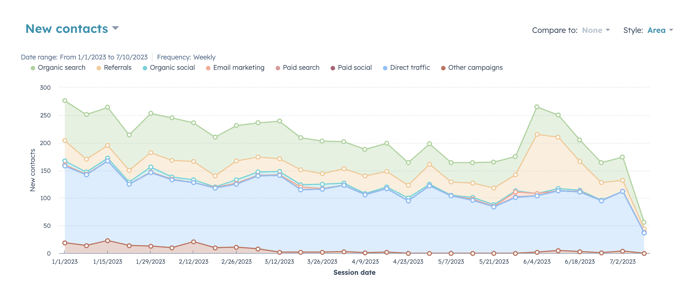
But before you start optimizing your content to bring in more contacts, it’s important to identify what pages have the highest bounce rate and the lowest view-to-contact rate. Arming yourself with this information will help you identify which pages you should optimize first.
Another tool you might want to consider adding to your marketing report is a heatmap, especially on your landing pages and high-performing blog posts. Heatmap tools you can utilize include Lucky Orange and Hotjar.
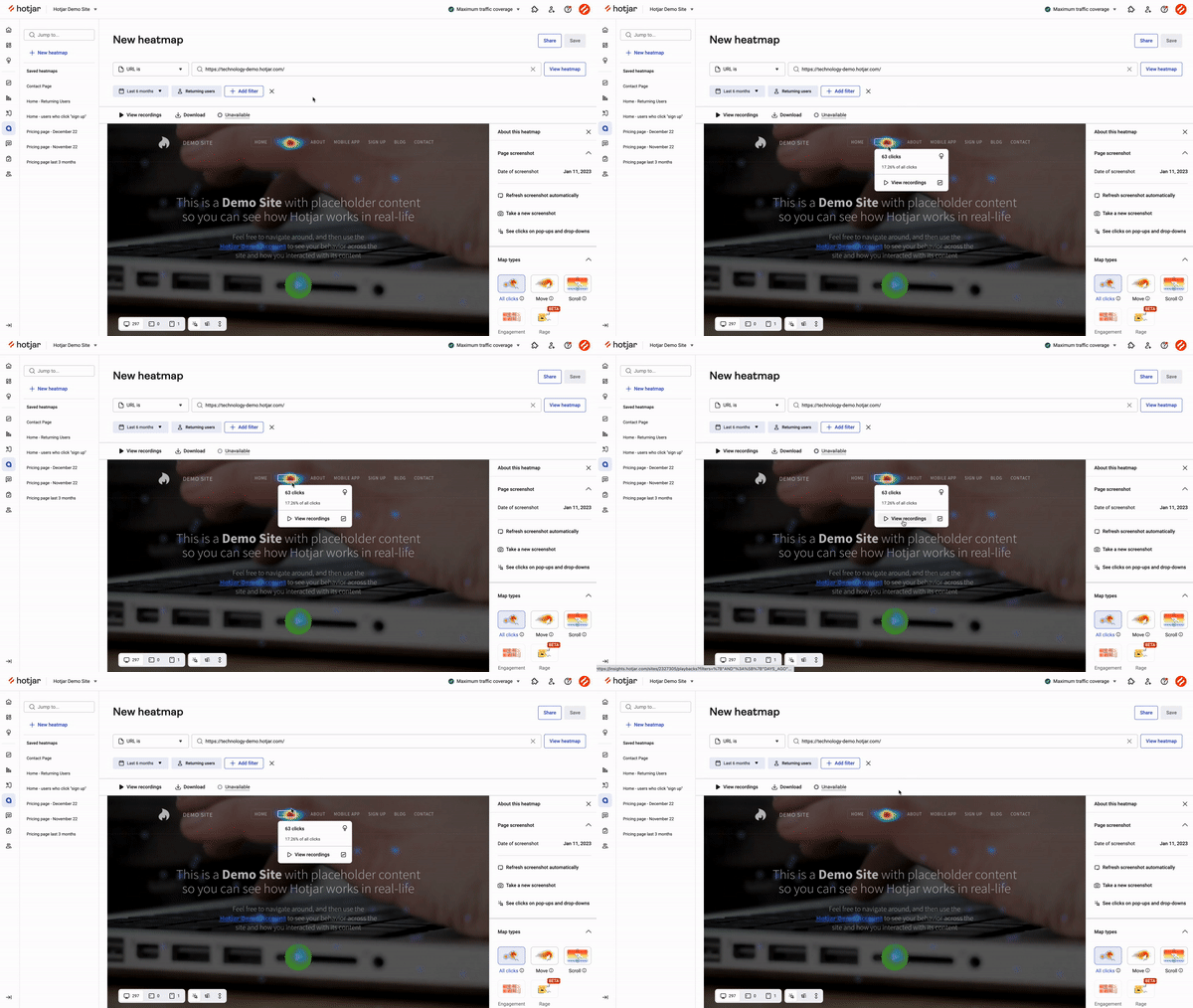
(source: Hotjar)
This information will be helpful in determining if viewers are actually scrolling all the way through your content.
If not, consider adding additional CTAs throughout your content rather than only at the end. Or ask yourself, are you answering searchers’ questions?
Regularly tracking your website traffic-to-lead ratio can help determine when it might be time to change your website page copy, design, CTAs, or even the attached form.
6. Lead-to-customer ratio
Why it's important
All the leads in the world won't do you much good if they don't become customers.
Your lead-to-customer ratio shows you the percentage of leads who become customers.
To make it better, ask yourself the following questions:
- Are my marketing efforts capturing leads?
- Is our CRM successfully passing qualified leads to sales at the right time?
- Do we have an acceptable close rate?
If the answer to any of these questions is no, meet with your sales team to determine what is missing and how you can work together to improve your numbers.
Here are a few sales enablement questions to help move the conversation along:
- What does the sales process look like?
- What qualities make a lead sales qualified?
- What are the most common objections leads have?
Another strategy for increasing your lead-to-customer ratio is utilizing assignment selling.
The premise of assignment selling is to use content to educate prospects in an effort to help close deals faster. Your prospects should see your sales team as a valuable resource whether they decide to work with you or not.
Broaden your mindset and focus on being a resource for your leads and customers — and you will close more deals along the way.
What to do
You will want to track both your sales qualified lead (SQL) conversion rate and sales accepted lead (SAL) conversion rate.
What’s the difference between the two?
- SQLs are leads considered to be sales-ready based on their lead score or specific activities and/or triggers they complete. Most companies would consider a lead who filled out a form (such as “contact a rep”) to be a potential customer, someone who is ready to buy your service or product.
For example, for a waste management company, a lead who fills out the form “rent a dumpster” would be considered an SQL. - SALs are leads that your sales team considers opportunities and have either contacted them directly or scheduled a call.
Note: It’s also possible for these two types of leads to overlap.
Track lead-to-customer ratio by dividing the number of leads by the number of sales for a given period.
7. Landing page conversion rates
Why it's important
So your landing page is live. It’s beautiful and it follows all the best practices, but is it actually converting?
Like any other page with a form on your site, a landing page that doesn’t generate leads is useless, no matter how much traffic it gets or how beautifully designed it is.
So be sure to monitor your conversion rate.
What to do
Like your traffic-to-lead ratio, if your landing page is getting a lot of traffic but has a low conversion rate, this is a red flag that you need to change something on the page.
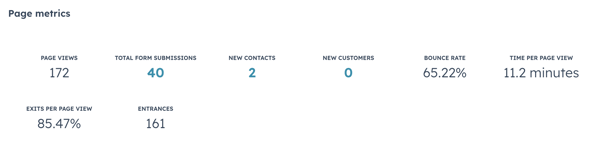
Try A/B testing some of the changes below to see which are delivering the highest conversion rate:
- Change your CTA color
- Convey more value in your CTA text
- Make your written content more persuasive
- Shorten your form
- Add social proof (i.e., reviews, social counts, awards, etc.)
8. Organic traffic and your top 5 entry pages
Why it's important
The goal of any business using inbound marketing is to have the majority of its website traffic come from organic search.
High organic traffic means people are finding your website on their own by clicking on results in search engines. It’s not traffic you paid for, so it’s extremely valuable.
Organic traffic is directly correlated to your content strategy, so make sure to monitor this number (along with your keywords) and refine your SEO strategy accordingly.
While each page should have targeted keywords, you also want to make sure that your content and website pages are optimized and actually answer the question your prospects are asking.
What to do
Look at the top five pages bringing visitors to your website. Those pages (likely landing pages or blog articles) are the first experience visitors are going to have of your company and website.
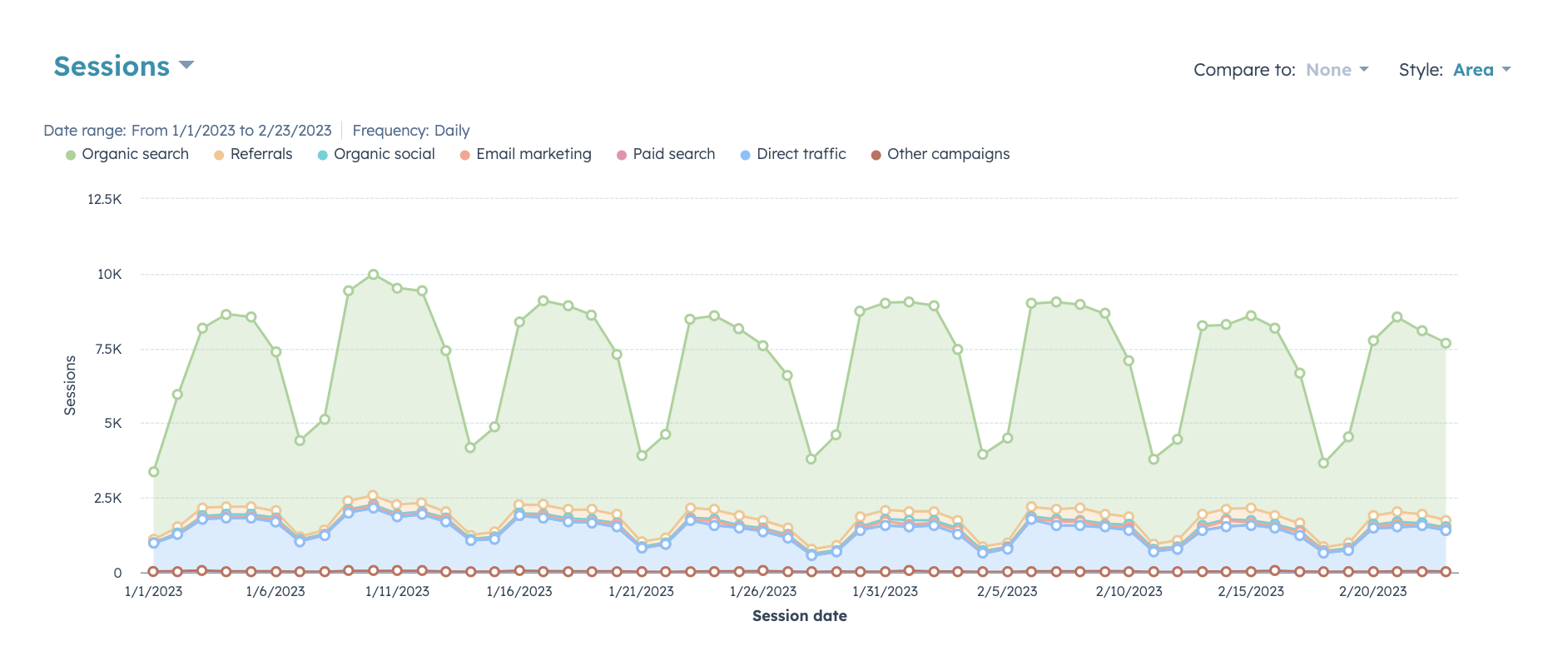
Not only should you know what those entry pages are, but you should be regularly making sure those pages are updated and optimized for user experience.
This is especially true if your website visitors could be landing on content that was published over a year ago.

You should be optimizing your content to not only generate leads but also to increase the number of pages your visitors are reading. The more pages they’re reading, the more educated they’ll be, and this is likely to reduce the amount of time it will take sales to close a deal.
9. Social media traffic and conversion rates
Why it's important
Many clients are wary about the importance of social media in their digital marketing. It’s not always seen as an avenue for generating leads, or even a way your audience would be engaging with you. However, we’ve found that social media has proven invaluable to every campaign’s success.
Social media platforms are great for getting discovered by an audience, educating that audience, generating buzz, and building trust and awareness.
What to do
Metrics you can utilize to show the importance and impact of social media on your marketing efforts include:
- Engagement
- Audience growth
- Lead conversions generated via each social media channel
- Customer conversions generated through each social media channel
- Percentage of traffic associated with social media channels
You might not have time to effectively utilize every platform, including Twitter, Facebook, LinkedIn, Instagram, Pinterest, TikTok, and others, but breaking them down by the number of leads, customers, and percentage of traffic coming from each will help you determine where to focus your efforts.
While there are a number of social media KPIs you can track, remember that the amount of engagement you’re seeing on social media is a reflection of how well your content and brand resonates with your audience on that platform, as well as how much trust you’ve generated with them.
10. Mobile traffic, leads, and conversion rates
Why it's important
Is your website effectively optimized for mobile? About 80% of smartphone users have purchased something online within the past six months using their phones, according to OuterBox.
You need to be sure your site is responsive to whatever device a potential customer is using.
What to do
With so many people browsing the web exclusively from their smartphones and other devices, and Google showing a preference for sites optimized for mobile, you need to know how your visitors are using their devices to access your site.
Pay close attention to:
- Mobile traffic
- The number of lead conversions from mobile devices
- Bounce rates from mobile devices
- Conversion rates from mobile-optimized landing pages
- Popular mobile devices
Understanding how and what your visitors are doing on your website on mobile will help you improve the experience, allowing you to optimize it to increase mobile conversions.

Then, whevener you build a new page or send a new email, be sure to preview it on a variety of screens.
Remember, metrics don't mean anything without context
These metrics aren’t something you should check once and then never track again.
You should be tracking each key performance indicator on a weekly or monthly basis. Regularly tracking these numbers will arm you with the data you need to do your job better, ultimately allowing you to pivot when a marketing campaign isn’t working.
You should make these metrics available to everyone on your sales and marketing team to provide insight into how well your efforts are going.
The overall goal of marketing is to acquire customers and increase company revenue. Tracking, reviewing, and improving those metrics can help your team accomplish that goal.
If you need more information about which KPIs to track or have questions, schedule a call with our coaches and they can walk you through your possible solutions.
You can also find a range of courses on how to improve your inbound marketing efforts using our They Ask, You Answer framework on our IMPACT+ digital marketing learning platform.
Once you get the important metrics down, you can have deeper conversations with your sales team, which in turn will help you identify any missing pieces in your digital marketing strategy — and finally see the results you’re looking for.

Author: cedgecomb@impactbnd.com (Carolyn Edgecomb)
* This article was originally published here
Wednesday, August 2, 2023
Tuesday, August 1, 2023
Reddit Shares New Insights Into How Redditors Are Researching Back-to-School Purchases [Infographic]
Some insights to help inform your back-to-school marketing approach.
* This article was originally published here
Subscribe to:
Posts (Atom)
-
Mobile app design is in the midst of a never-before turmoil and trans...
-
10 SIDE JOBS TO EARN AN EXTRA $100 DAILY Start Earning Money Fast With Internet Marketing - Subscribe Here! Via Make Money Online Channel...
-
As a newbie, I have tested some popular options out there: - Builerall: it runs so slow on my computer. Don't want it. - Wordpress: I...

