Make money online fast

Make Money Online Fast: The Ultimate Guide to Earning Quickly in 2025

  Introduction Want to make money online fast? Whether you need extra cash or want to build a full-time income, the internet offers endless ...

Thursday, May 23, 2024

Sales Training: How Much Does It Cost?

Every year, it gets more and more expensive to run your business. To keep up, you expect your team to increase sales so you can meet your business goals.

Many business leaders look to improve the performance of their sales team by investing in a sales training program. These sorts of training initiatives are big business: U.S. companies spend more than $70 billion on sales training each year. 

With a limited training budget, you need to know that the dollars you spend on training are going to come back to your business as increased revenue. 

With that in mind, let’s look at some sales training options and what you can expect to spend on them. 

Remember, sales training comes in all shapes and sizes — from free online options to fully customized training programs for enterprise-level teams. Below, I’ll break down some different options and what you (and your team) can expect to spend on each. I’ll cover:

  • The price range of sales training
  • Representative options for every budget
  • Some pro tips to improve the effectiveness of any training you do

Why you should invest in sales training

A business cannot prosper without sales, and there are graveyards littered with organizations that wasted away because they couldn’t get prospects to buy.

Whether you’re a solopreneur or a company of thousands, sales success is vital to your growth. The better your sales conversations go, the better your bottom line.

But sales is hard. Last year, only about a quarter of sales professionals exceeded their quota.

Improving these numbers takes time. In addition to sales training for your frontline sales reps, you should audit your entire sales process, including prospecting, sales enablement, pipeline management, and communication.

Sales performance depends on a dizzying number of variables, and the more you can improve each one, the more you’ll see your team sell. 

For this reason, sales training is a crucial investment for companies of all sizes and types. 

For the most successful sales teams, ongoing training is part of their culture. Sales reps are reviewing calls with their managers, practicing role-plays with their colleagues, regularly attending online workshops, and reading books to stay on top of their game. 

If organizations don’t create a training budget and invest in their teams, their sales performance will suffer. 

The cost of sales training 

So, what should you expect to spend on sales training? You probably won’t be surprised to learn that sales training runs a wide spectrum in terms of cost. There are free options, and there are options that cost tens of thousands of dollars. 

In general, what you’re going to pay will vary based on a few factors, all of which are pretty obvious:

  • The amount of personal feedback: In general, the more individual attention you get, the more you’ll pay.
  • The “prestige” of the teacher: The more well-known, the more you’ll pay.
  • Program duration and number of participants: The longer the training and smaller the cohort, the higher the cost.
  • The degree of customization: If you want your sales training content catered to your business or industry, expect to pay more. 

While the costs can vary widely, you can expect to pay between $400 and $3,000 for a reputable sales training program. However, there are numerous free (and cheap) options for those with smaller budgets, as well as high-end options for larger teams.

One final note: This is by no means meant to be an exhaustive list of the best sales training programs. There are literally thousands of options and hundreds of companies out there that promise to help you improve your selling. The examples below merely represent a range of price points. 

Now, let’s dive in, starting with free options. 

Free sales training options

Don’t look down your nose at free sales training programs. These are resources that you can consume on-demand, and some grant certifications as well.

Online training

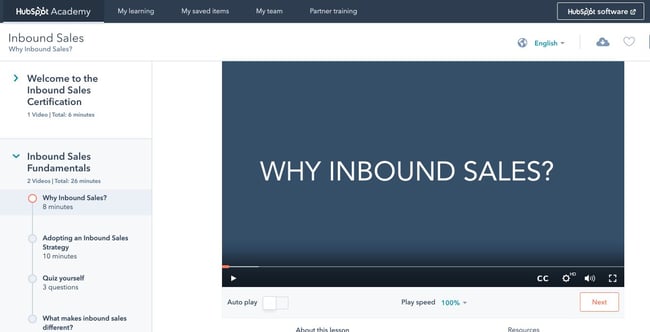
  • HubSpot Academy: Inbound Sales Certification 
    For those of you in the inbound space (and let’s be honest, everyone wants to be in inbound these days), this free, three-hour course (plus exam) offers a great overview of how you can use inbound principles to enhance your sales skill set. 
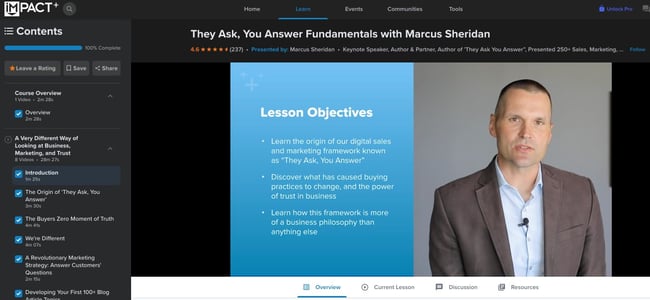
  • IMPACT+: Fundamentals of They Ask, You Answer with Marcus Sheridan
    This free course offers a new approach to sales that focuses on buyer education and trust. Marcus explains how savvy sales reps are using his framework to shorten the sales cycle and improve close rates. From there, you can take free courses that focus on prospecting, 1:1 video techniques, and sales enablement.
  • Coursera: Successful Negotiation: Essential Strategies and Skills
    There are hundreds of sales and marketing courses on Coursera. This one, put on by the University of Michigan, offers 17 hours of instruction on several sales-related topics. It’s free to enroll, but to earn the certificate at the end you’ll need to pay $90. 
  • Sales Scripter: SMART Sales System Training Program
    This is another example of a great free resource out there. In 13 hours, you’ll receive instruction in a range of sales skills, from writing sales scripts to how to prospect on LinkedIn.

Books and podcasts

Each year, there are whole libraries of new books written about sales — and weeks’ worth of podcast content. While these resources don’t offer you the interactivity of traditional training, they can be a vital supplement to learning you do through other pathways. 

  • Gap Selling by Keenan challenges traditional sales techniques so salespeople can break through and close more deals.
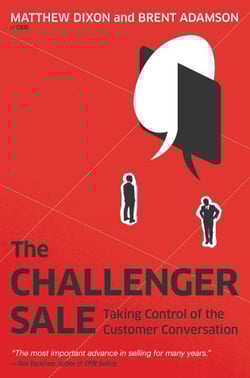
  • The Challenger Sale by Matthew Dixon and Brent Adamson explains how great salespeople build the right relationships with their customers.
  • The GTM Now Podcast puts out weekly episodes with top business luminaries who share their stories and advice. 
  • Sales Logic Podcast seeks to build your confidence by addressing the most challenging questions in sales. Episodes drop weekly. 
  • Endless Customers Podcast helps you win trust and close more sales by focusing on buyer education.

Pro tip: Want to multiply the learning you get from a book or online course? Take it with a friend or form a book group. Research shows that when you discuss ideas and engage with concepts, you’re more likely to retain what you learn. 

Mid-level options: Certificates and courses ($400-$6,000)

There are thousands of online and in-person options for sales training, so picking the right one will come down to your budget, time frame, and area of focus.

Major universities offer sales certificate programs to enhance your skills and build your resume. 

  • For example, check out this option from Northwestern’s Kellogg School of Business: Mastering Sales: A Toolkit For Success. This 10-week online course includes live lectures, activities, and homework. Those who enroll can expect to dedicate 4-6 hours each week, and the cost is $2,314.

    Screenshot 2024-05-06 at 11.38.08 AM
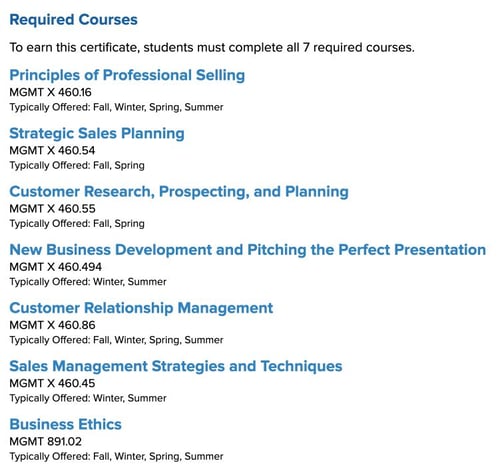
  • UCLA offers a certificate in Professional Selling and Sales Management that mixes online and in-person learning. The program is designed to be completed in half a year (full-time) or 18 months part-time, and includes courses on business ethics, market research, and customer prospecting. The cost is about $6,000, including all fees and course materials. 
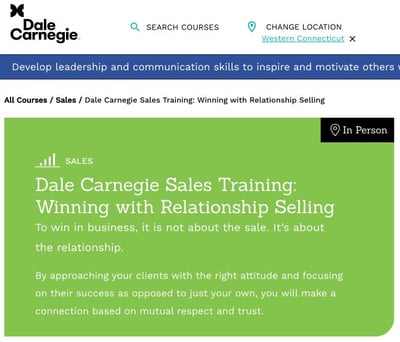
  • If you’re not interested in the university route, you can work with a reputable sales training company like Dale Carnegie. Their Dale Carnegie Sales Training: Winning with Relationship Selling program offers franchised learning opportunities all over the world. Three full-day sessions (or eight shorter ones) will run you $2,195. You’ll get hands-on instruction from certified trainers to help you develop and implement a sales strategy.
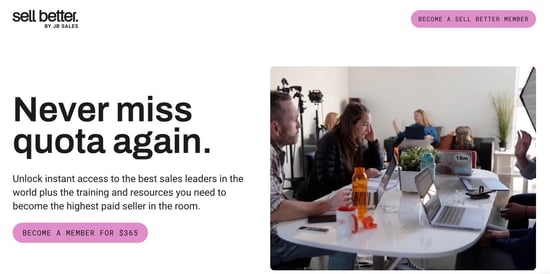
  • Sell Better offers individual access to its online learning platform for $395 per year (or $800 for lifetime access). The company guarantees its results, so you’ll get your money back if you’re not happy with what you’ve learned. Members get access to online master classes, monthly live training sessions, and certification options. 
Pro tip: Many of these options offer online communities and forums for connecting with other sales professionals just like you.

Make use of these!

Network with your peers and see if anyone will be willing to practice what you’ve learned. When you do low-stakes role-plays, you maximize your learning.

High-end sales training cost: Customized group instruction ($10,000 and up)

At the top end of the sales training pyramid are customized learning experiences. These could occur on site at your location or online, but you’re paying a premium for a personalized training program.

This type of training prices out most buyers, so it’s specifically for corporate group training and high-earning individuals who are looking for that extra edge to advance. At this level, price is highly customized based on the needs of the client and the number of participants.

Organizations like Hoffman and Rain Group offer programs for teams to reach the next level. Here, a Rain Group spokesman explains what the company does. 

If you’re in the market for this kind of tailored program, talk to your network to try and get a recommendation. See what options have been most impactful for others. Then reach out and negotiate. If you’re a high-end client, firms will fight to win you, so take advantage of that position. 

Note: You’ll be expected to pay travel costs if you’re looking to have an on-site training program. 

Pro tip: You can make the best sales training even better by actively incorporating it into your company culture after the training ends.

Before your training starts, form an “accountability pact” with your team that helps you keep practicing what you learn. During the training ask for materials and recommendations for bringing what you learn into long-term practice

Find the training you need

According to the U.S. Bureau of Labor and Statistics, there are over 13 million salespeople in the country. That’s over 8% of the total labor force in the United States. 

But recently, that number has been shrinking as salespeople play a smaller and smaller role in customer purchases. Today, buyers are looking to self-educate, only reaching out to a sales rep when they are in the final stages of their buying journey — if they reach out at all.

In such a competitive marketplace, it’s imperative that sales teams stay on top of their game, sharpening their skills with regular training and self-study. 

The options above can help you do just that. 


Author: jbecker@impactbnd.com (John Becker)

* This article was originally published here

How to make $1000/day with affiliate marketing 24/7 - start here!


Monday, May 20, 2024

Leveraging AI Tools To Close More Deals [Endless Customers Podcast S.1 Ep.33]

About This Episode

Artificial Intelligence (AI) is transforming the sales industry in profound ways. In this episode, Chris Duprey, IMPACT's Head Coach and Chief Customer Officer, explains how sales professionals can leverage AI tools to level-up their performance and drive better results.

“AI is at a point where it can be really, really helpful if sales folks are proactive in their approach,” Chris says. But only if salespeople are willing to get into the sandbox and start experimenting. 

Imagine having an AI assistant in your virtual meetings that provides real-time feedback. Chris mentions tools that can tell you, “you’re using too many filler words, you're speaking too fast, or you're using your hands way too much.” This immediate feedback helps salespeople refine their presentation skills and enhance their communication effectiveness.

Tools like Gong and Otter.ai can also help personalize follow-up communications based on previous interactions. By analyzing call transcripts, AI identifies major concerns and areas of interest, enabling salespeople to tailor their responses more effectively

Chris understands the concerns many have about AI, but he says this often comes from people who’ve never really seen what it can do. 

At a recent presentation, Chris saw initial skepticism about AI turn into excitement as attendees began to understand its potential. “Most people come in uneducated or undereducated on what's out there for AI,” he notes. However, once people see the practical applications and benefits, their mindset changes. “It’s about becoming aware and then choosing to leverage that awareness.”

AI can be a powerful ally for sales professionals. It’s not about replacing human interaction but enhancing it with data-driven insights and efficiencies. As Chris puts it, “The more efficiencies you can create, the more successful you will be.”

Connect with Chris Duprey

Chris Duprey is a sought-after speaker and business coach with over two decades of leadership experience. 

Get to know Chris through his IMPACT bio page

Connect with Chris on LinkedIn

Keep Learning

Other Tools Chris Mentioned


Author: awinter@impactbnd.com (Alex Winter)

* This article was originally published here
How to make $1000/day with affiliate marketing 24/7 - start here!


Thursday, May 16, 2024

How to Know When You’ve Outgrown HubSpot Sales Hub Starter

For companies looking to get their sales team started with HubSpot Sales Hub, the Starter tier offers a great balance of function and affordability. (After all, it’s called Starter for a reason.) 

Even getting your sales team to use a CRM (or customer relationship management software) can be a challenge for many businesses, so any step in the CRM direction means progress. 

Because some organizations anticipate hesitancy from their sales reps to fully embrace a CRM, they don’t want to plunk down more money than they need to.

For those in that position, Sales Starter is a good solution. But, I’ll say it again: It’s called Starter for a reason. Many sales teams find that they begin feeling the limitations sooner than they might think.

Jess Palmeri is a lead HubSpot trainer here at IMPACT. She notes: “Some of our clients begin with Starter for the low financial investment, thinking an upgrade to Pro could happen way down the line. But they find themselves ready to jump to Pro in six to 12 months — way faster than they anticipated.”

If you’re using HubSpot Sales Hub Starter — or are planning to — here’s how to know if and when an upgrade to Pro is the right call for your business.

Is Sales Hub Starter a long-term solution for my team?

First off, it’s important to note that different companies can have very different HubSpot needs. 

Larger companies coming to HubSpot from another CRM such as Salesforce or Zendesk are likely to jump right into Sales Hub Pro. (In fact, we usually recommend our clients use the whole Pro suite, which comes with discounts.) They’re likely to know what they need, and it’s just a question of integrations and data migration that need to be addressed before they get up and running.

Sales Hub Starter

A smaller business might be coming to HubSpot after using spreadsheets or another home-grown organizational system. For them, Sales Hub Starter is a big step up, and it might actually be a fairly long-term solution. If they’re not growing rapidly, Starter could work for them forever. 

But for many businesses, Starter is just that — a way to learn HubSpot and get their feet wet before upgrading. 

And the price is right. 

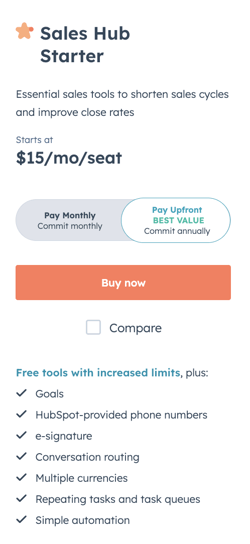
According to Jess, “If a company is starting from scratch, the Starter rate of $25 per seat per month is much more palatable than $100 per seat per month for Pro.”

But when they’re ready, the functionality of Pro easily justifies the cost. So, let’s see exactly what it is that Pro offers that’s worth the extra cost.

3 key Sales Hub Pro features that cause people to upgrade

Although Sales Hub Pro offers dozens of capabilities and functions that Starter does not, Jess says it comes down to three features that make it a worthwhile investment for our clients.

1. Custom reporting and sales analytics

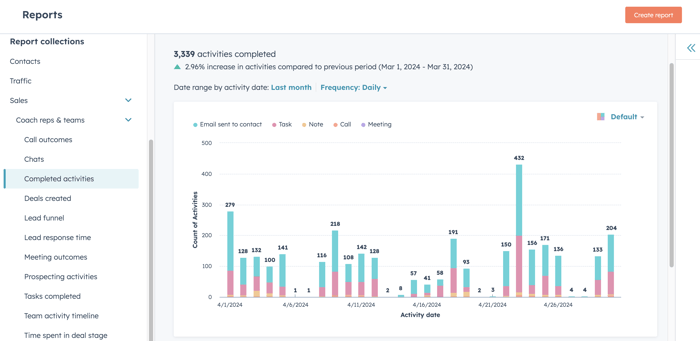
First up, with Pro you will have access to amazing reporting and analytics tools that let you easily look at data in ways that would normally take hours to compile.

Jess says “HubSpot has a sales analytics tool that almost eliminates the need to build your own sales reports.” There are numerous reporting options that can be configured to your team’s needs. 

HubSpot sales reports

If you want to look at a report on close rates or see how long your deals are taking, you can see that in a few clicks. Says Jess (affectionately), “It would take one of your nerdy people a good bit of time to build a report like the one you can easily get with Sales Hub Pro.”

So you can deploy your nerds elsewhere. 

2. Automation and sequences

“If you want to automate anything in your sales process,” Jess says, “you’ll need the functionality that’s available in Pro.” 

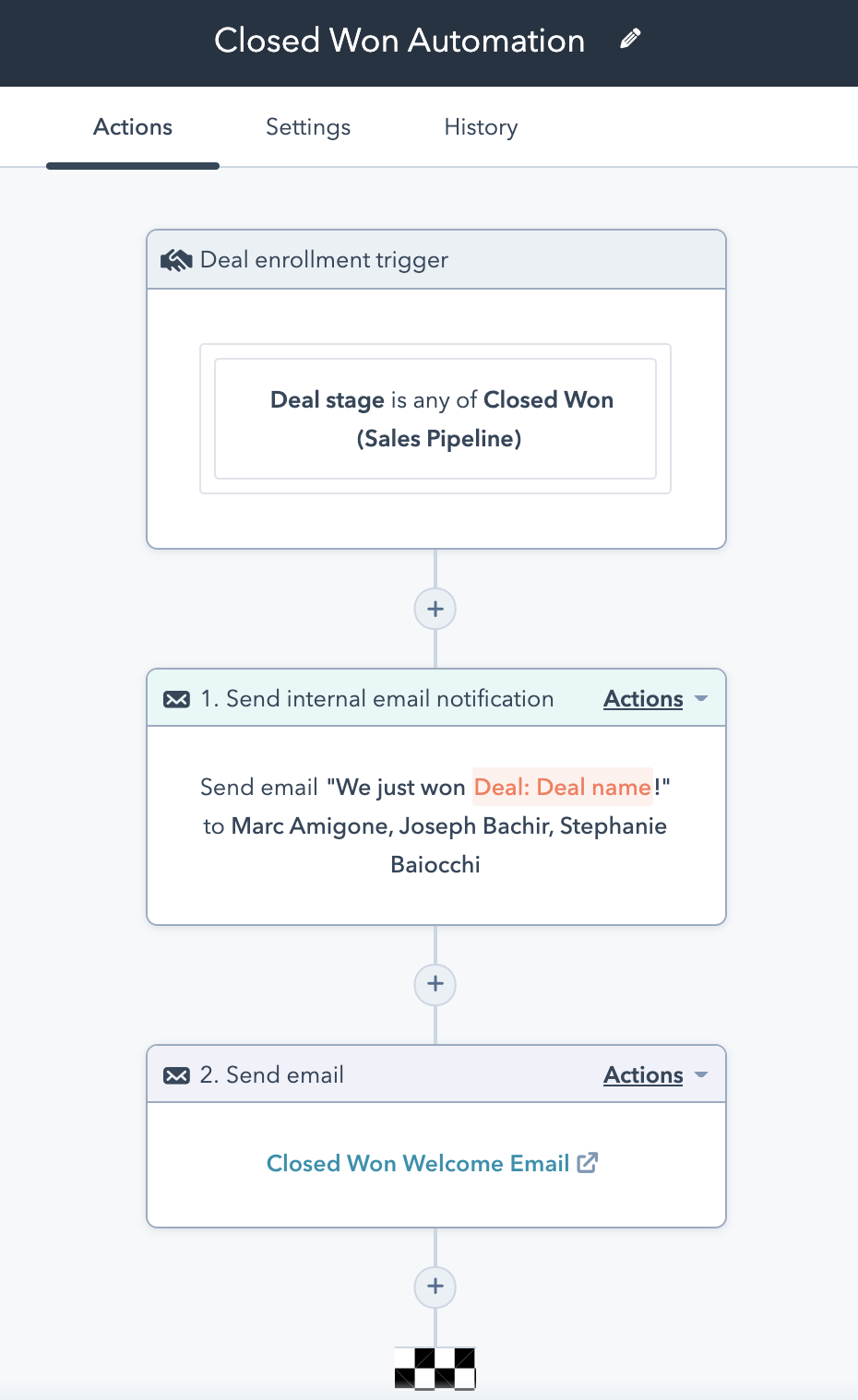
Automation improves your sales team’s performance from start to finish. Automation is generally used more by managers than by the sales reps themselves. When a lead comes in, that lead can be automatically assigned to one of your sales reps on a round-robin basis. 

Then, as a deal moves from one stage to another, that can trigger certain actions to occur, which could include emails being sent or notifications going to a manager.


These automation features keep teams running smoothly and give managers insights into each sales rep’s pipeline.

Sequences

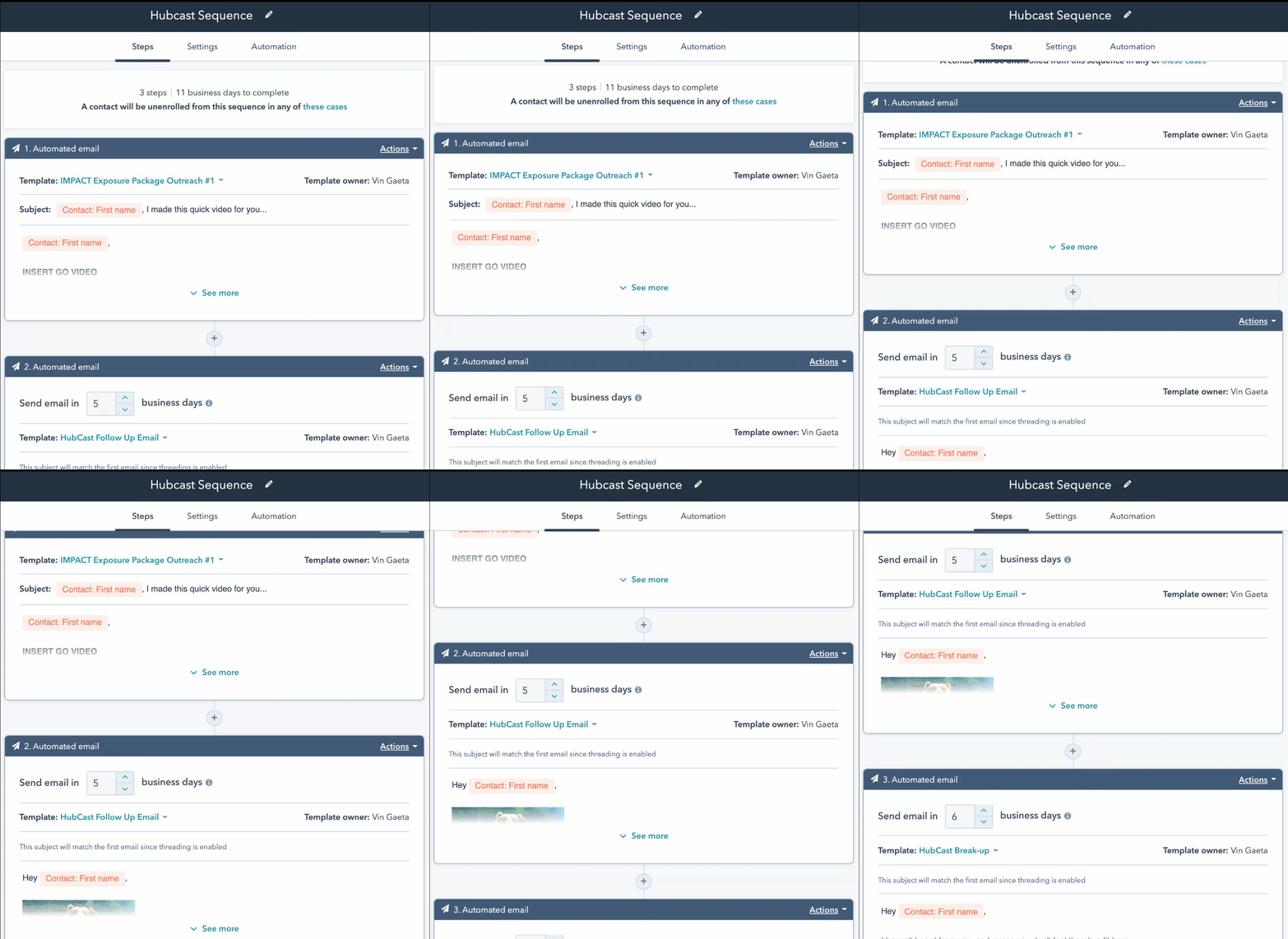
Related to automation are sequences, which allow your team to more easily follow up with prospects in the sales process. Email sequences allow for nurturing campaigns to keep prospects engaged who are not yet ready to buy. 

For example, if a site visitor comes and reads several articles about a particular product, a rep could trigger a sequence that sends several helpful emails related to their needs — without the sales rep having to send each one individually. 

Sales reps find themselves sending very similar emails to client after client. Rather than having to write out the same follow-up email after each exploratory call, say, they can build a template and start a sequence.

Then, they don’t have to remember to send another email in three days if the first one didn’t get a response. The sequence automatically takes care of this.

For sales reps working dozens of deals at once, sequences help economize the process and prevent things from slipping through the cracks. 

3. Prospecting Workspace

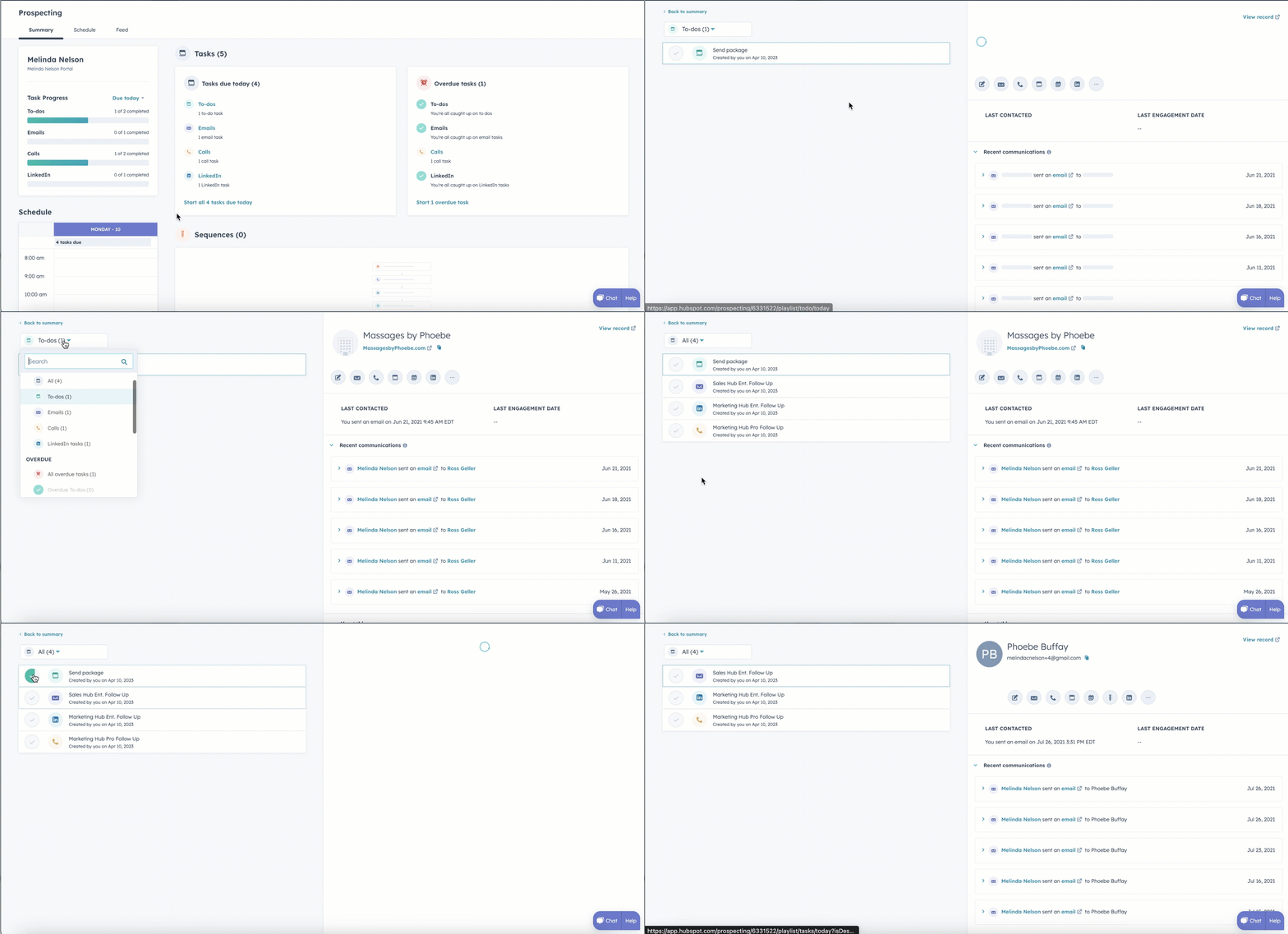
HubSpot's Prospecting Workspace is the center of a salesperson's day-to-day workload. Here they can see their tasks, access their contacts, and stay up on what actions are the highest priority. 

tasks-video

(source)

For salespeople used to less sophisticated systems, Prospecting Workspace is a game-changer — and it's a compelling reason to upgrade. You'll see much more efficiency from your sales team almost immediately. 

How to know when the time is right for your HubSpot upgrade

Considering your unique needs, how will you know if or when an upgrade makes sense? Jess offers a simple solution to this complex question: Listen to your sales team. 

“If they’re just using the CRM to keep track of their pipeline,” she says, “you’ve probably not outgrown Starter.” But when they start using the tool more heavily — and mentioning how expanded functionality could help them — you might be ready to upgrade. 

“Once your sales reps are logging and tracking all of their deal activity, as well as all of their communication with prospects,” Jess says, “they’re going to start to feel the limitations of the Starter tier.”

The same thing can be said for data. If your sales team bemoans the fact that they can’t parse and analyze the HubSpot data because doing so is too labor-intensive, Sales Hub Pro is probably in your near future. 

Remember, an upgrade to your HubSpot CRM is a good sign!

Although no business wants to spend money it doesn’t have to, don’t be upset by the fact that you’re moving from Starter to Pro. If you’re in the market to upgrade, it usually has to do with three things:

  1. Your sales team is fully bought into using the CRM. They’re tracking deals and logging call notes with it. This should be celebrated. Some sales teams are very resistant to getting even this far. 
  2. You’re growing. More revenue means more sales reps, more deals, and more customers. You might just need a bigger and better system to keep track of it all.
  3. You’re using data to make decisions. Paying for HubSpot is paying for data. When you have data you can make sense of, you can make better decisions about how you market and sell to your customers. Paying a little more each month to make more informed decisions sounds like a good deal to me. 

Still, you want to make sure you’re not overpaying to get what you need. Check out this article: Think you’re paying too much for HubSpot? Here’s how to get your money’s worth. 

When you’re ready to make the jump, though, you should see the upgrade to Pro as a clear metric of progress. You’ll be amazed by what you can do. 


Author: jbecker@impactbnd.com (John Becker)

* This article was originally published here
How to make $1000/day with affiliate marketing 24/7 - start here!


Wednesday, May 15, 2024

Data-Driven Success: HubSpot Fuels Berry Insurance's Massive Growth [Endless Customers Podcast S.1 Ep. 32]

About this Episode

They say a decision is only as good as the data it’s based on. For Massachusetts-based Berry Insurance, better data means better decisions — and better decisions mean better outcomes.

Corin Cook joined Berry in 2019 as the company’s first content manager. At that point, Berry was early in its They Ask, You Answer journey. Corin focused on writing educational content that would be helpful to anyone in the market for insurance. Soon, traffic began to explode, bringing tens of thousands of visitors to the Berry website. 

Self-service tool chatbot Berry Insurance-jpg

With visitors come opportunities, but only if you have the necessary tools.

Berry began using HubSpot to track its website engagement. HubSpot became the platform where all digital marketing efforts could be centralized — from email communications to full website management.  

“HubSpot is just so user-friendly,” says Corin. “It was really a game changer being able to have all of our content up there, all of our videos, everything just integrated into the site and being able to look at the analytics of everything."

In time, Berry’s marketing team grew to include a videographer and another content writer. That means a lot of content spread out across Berry’s website, social platforms, and YouTube. "Over the past few years,” Corin estimates, “we've written hundreds of articles on insurance, and we have hundreds in the queue.”

Today, Corin and her team use HubSpot to publish their content — and they use its reporting capabilities to track how that content performs. 

In turn, they use this information to inform their future strategy. After all, better data means better decisions. 

Connect with Corin

Corin Cook is the Senior Marketing Manager at Berry Insurance — a 100-year-old business based in Massachusetts. 

Learn more about Corin

Connect with Corin on LinkedIn

Learn how Berry Insurance tripled its revenue by creating better content

Keep Learning


Author: awinter@impactbnd.com (Alex Winter)

* This article was originally published here
How to make $1000/day with affiliate marketing 24/7 - start here!


Thursday, May 9, 2024

When You're Spending on Marketing, Here's What You're Buying

As you’ve grown your business over the years, you've added staff to every department. But you've resisted handing off the important tasks to outside agencies. 

Hiring a sales agency to talk to your prospects?

No way!

Hiring an engineering agency to help you design your product?

Not a chance!

Hiring a customer services agency to help soothe upset customers?

Absolutely not!

Why do these options seem so off-target? I’ll tell you why: You don’t want some outside company you hardly know handling such an important part of your business.

Instead, you’ll hire salespeople, engineers, and customer service pros to join your team. If any department needs to expand its skillset, you’ll hire accordingly, or you might bring in a consultant to help train them.

But here’s what always confuses me: These same businesses think nothing of hiring a marketing agency to handle all of their critical outreach:

  • Website messaging
  • Content marketing
  • Emails
  • and Social media

The fact that this is so commonplace has helped me understand a dangerous truth: When we pay for an agency to do our marketing, we don’t really understand what we’re buying (or what we’re getting).

The implications of this miscalculation are alarming.

What you’re actually getting when you pay an agency

To me, hiring a marketing agency only makes sense in a fraction of circumstances.

In nearly every case, paying an agency to “take care of” your marketing is as absurd as hiring a sales agency to sell to your customers.

In the back of your head, you know it doesn’t totally make sense. You know you’ll be sacrificing authenticity, but you assume you’ll be getting expertise in exchange. 

Here’s the thing: You might not end up getting authenticity or expertise. 

Many agencies suffer from constant client churn and frequent employee turnover.

They overpromise in the sales process and then can’t deliver. Clients get angry and leave, cutting into profit margins and destabilizing the agency. 

And on top of that, those agencies often outsource their client work to freelance writers, designers, and video producers. So that expertise you were sold never turns into the results you need. 

How do we know all this? We were in this business for close to a decade. We came to see the traditional agency-client relationship as deeply flawed.

Today, we’re consultants and coaches, helping businesses bring marketing in-house. 

You think, ‘We’re buying deliverables — and expertise’

So, let’s say you shell out 10 grand a month, each month, to an agency. As an example, your contract says you’ll get three articles, two videos, several supporting materials, and a whole lot of 'strategy' each month.

What you think you’re getting with an agency is these deliverables: articles, ebooks, email copy, graphic design, and videos.

Then, on top of that, you think you're getting expertise: how and when to use each type of content to generate leads.

In your mind, it’s pretty clear. You pay, and you get the deliverables back.

But the truth is more complex. 

What you’re really paying for is agency overhead

Think about it like this.

How long does it take to produce a blog article? On average, around four hours, according to a thousand writers surveyed by Orbit Media. On top of that, there’s research and promotion. So, let’s call it six hours total.

Okay, so your agency delivers three of those each month. That’s 18 hours.

Next up is video: Let’s say each video takes 10 hours to produce, including planning, shooting, and editing. 

Two videos is 20 hours.

In addition, let’s say there’s some email copy, maybe a quick landing page design, keyword research, strategy, etc. In all, let’s call that another eight hours of design and planning work. 

Okay, got your calculator? That’s a total of 46 hours of work. On top of that, let’s throw in some meetings. Maybe another two hours. 

That’s 48 hours of work each month.

Your bill? $10,000.

That’s $210 an hour — for every hour the agency is working on your behalf.

That means that blog article is costing you $1,260. That video costs $2,100. 

Now, back up a bit. How much is that writer actually getting paid? How about that videographer?

According to payscale.com, the average content marketer makes $56K a year. A videographer is $47K. Factor that out and convert it to hours: That’s an average of about $25 an hour. 

Remember, you’re paying the agency almost10 times that: $210 an hour.

Sure, there’s equipment and software, there’s expertise and strategy, but ten times?

If the deliverables cost X, and you’re paying 10 times X, where’s all that money going?

To get more and pay less, hire a marketing team

The old benchmark is that a company should spend around 10% of its revenue on marketing. Research shows that it’s often a bit higher for B2B businesses. 

If you’re a $5 million business, 10% is half a million dollars. So, before you throw it all at an agency, consider a different approach.

Instead of paying an agency for questionable returns, build an internal marketing team. It’s less expensive, way more effective in our experience, and it keeps our investments in-house. 

Building your internal marketing team with a $500,000 budget

As a former COO, I’ve spent plenty of time around budgets and spreadsheets.

If I were to allocate marketing budget for a $5 million business, I would think about salaries first.

Anytime you hire someone internally, you’re going to get a lot more out of them without the agency serving as a middleman. 

Remember how the agency gave you three articles per month? Hire an internal writer and you’ll get three articles a week — and it’ll cost you much less.

So, my budget allocation?

  • Marketing director: $100K salary
    Oversees all marketing, publication calendar, social posting, and email marketing
  • Content manager: $60K salary
    Writes three articles per week, interviews subject matter experts, and starts a newsletter
  • Videographer: $60K salary
    Films, edits, and publishes two videos per week, oversees your company's YouTube channel
  • Marketing software: $25K
    CRM, video hosting software, and analytics tools
  • Hardware: $15K
    Computers, cameras, equipment, and the like

Right here, we’re looking at $260K a year — and you’re paying salaries above the market rate. 

How you spend the rest would depend on your unique needs. I work with clients from more than a dozen different industries. You might need, for example:

  • An SEO expert
  • A social media manager
  • A graphic designer
  • A website strategist who can do design and development for your site
  • Social media and search ads (especially if you’re in ecommerce)

And so on. 

The team you build can outperform any agency. You’ll get more content that’s authentic and sounds like you. You’ll get better email messaging and more engaging videos — all for a lot less money.

But in order to get your team on board and rowing in the right direction, we suggest coaching and training. This way, you can supercharge their skill development and production. 

Marketing is no different than any other department

When your company’s growing and you need a bigger sales team, there’s no way you’d ever contract a sales agency to have them speak to customers. Why not? Because they don’t know your business or your industry.

Yet we do this every day for our marketing needs. And we do it without batting an eye, writing checks to far-off agencies, expecting them to instantly onboard through a few Zoom calls so they can take control of all aspects of our messaging.

And the worst part of all is that we're spending way more than we need to — and often getting sub-par results. 

It’s crazy.

Your website, your content, your social media account — these are the first things every future customer will see about your brand. When you hire an outside expert to handle that for you, you hand over the keys to your own growth engine.  

Instead, hire an internal team and see the benefits first-hand. 

Want to learn more about how to do it? Talk to us. 


Author: cduprey@impactbnd.com (Chris Duprey)

* This article was originally published here
How to make $1000/day with affiliate marketing 24/7 - start here!


Monday, May 6, 2024

Don't Be Held Hostage By an Agency [Endless Customers Podcast S.1 Ep.29]

About this Episode

Is your agency holding you hostage?

It sounds funny to use those terms, but that’s really what it is. 

Imagine this: Let’s say a company hires an agency to help them set up HubSpot. To get started, the agency takes control of all the login credentials and the seats that come what that HubSpot portal.

At first, this might make sense. The agency has the know-how to get everything set up. But as the months go by, the business might start to get uneasy. Their team can’t do ANYthing in HubSpot without the agency doing it for them. 

Run a traffic report?

Call the agency

Build a landing page?

Call the agency

Schedule an email?

Call the agency

In each case, it’s the agency that holds all the cards. 

And on top of that, all of the HubSpot knowledge remains with the agency. If they’re never teaching the business how to use HubSpot, the business can never do away with the agency. The business is stuck paying the agency, month after month, to see results. The business is a hostage. 

If this sounds familiar, maybe it has happened to you. We promise you’re not the only one.

As Connor Delaney explains in this episode, agencies can do all sorts of things to lock in their clients. From keeping login credentials to using their own servers or even a homegrown CMS that stores all of the client’s contact records.

All too often, businesses sign a contract without reviewing it closely, trusting that the agency is acting in their best interest. 

While we can’t force agencies to follow more scrupulous practices, we can equip you with the knowledge so you’re more informed the next time you ask an agency for help.  

Connect with Connor

Connor is a sales consultant at IMPACT who helps businesses understand how they can break free from unproductive agency agreements. 

Learn more about Connor

Connect with Connor on LinkedIn

Learn more about how we help break the cycle of agency dependency

Keep Learning


Author: awinter@impactbnd.com (Alex Winter)

* This article was originally published here
How to make $1000/day with affiliate marketing 24/7 - start here!