Make money online fast

Make Money Online Fast: The Ultimate Guide to Earning Quickly in 2025

  Introduction Want to make money online fast? Whether you need extra cash or want to build a full-time income, the internet offers endless ...

Thursday, August 15, 2024

How to Plan a Learning Center For Your Website

Your content is the soul of your business. It represents your personality, your culture, and your unique POV. But just writing and filming and recording great content is not enough. If that content isn't easy to find and easy to sort, it can feel like a disorganized mess to your audience.  

Savvy marketers know that they need to present their content in a way that makes it easy for people to find what they are looking for.

For this reason, more and more businesses are developing “learning centers” to be a content library for their visitors.  

A learning center is a place on your website where your best content can be easily accessed and searched. A learning center makes it easy for your prospects to find the content that answers their questions.

A learning center on your site doesn't just benefit your site visitors. Your sales reps can use your learning center to quickly find resources to share with prospects.

A great learning center should have a variety of content types, such as articles, videos, webinars, podcasts, and ebooks, that are categorized and searchable.

The first step to building a great learning center is to take stock of the content you already have. These are the steps you should follow:

  1. Inventory the content you already have
  2. Identify gaps in your content
  3. Categorize your content

Let’s take a closer look at each of these steps, then we'll share some real-world examples to inspire you.

1. Inventory the content you already have

Inventory all of the content you have and what topics you have already covered. At IMPACT, we teach clients to focus their efforts around five core topics, which we call The Big 5. So, when a client starts compiling content, we make sure they've covered these topics thoroughly. (You can learn more about The Big 5 here.)

How about video content? What videos perform the best for you. Do you have any podcasts? What about other resources such as landing pages, calculators, ebooks, or white papers?

Taking inventory

There are different ways of taking inventory. Some content management systems will allow you to export your data with titles and links into a spreadsheet.

If not, tools such as Screaming Frog’s SEO spider tool will crawl your site and give you a report with the titles and URLs for all of your content.

If you don't have a lot of content, you may be able to just manually go through your posts to see what you have.

Some of the information you may want to include in your inventory are:

  • Type of content (blog article, video, ebook, etc.)
  • Resource title 
  • URL for the resource
  • Resource CTA (read more, watch now, etc.)
  • Resource topic category
  • Meta description
  • Author/creator/featured SME

You can even add things such as how long the resource will take to read (factored by word count), target persona, or where a piece of content fits in the buyer's journey. 

Once you have an inventory of your content, you can decide which content should go in your learning center. To do so, think about the buyer's journey. Focus on content that content that fits each step. 

Remember, a learning center will allow your visitors to find the type of content that is best suited to them. Some people love to read, while others prefer to watch videos or listen to podcasts. Still others like interactive content, so be sure to include a variety of content types. 

You may not have all of these types of content yet. In the next step, you will identify those gaps so you can create needed content.

2. Identify gaps in your content 

What content do you still need to create? Are there gaps? Perhaps you don’t have content that covers all of the questions that your visitors may have. Maybe you have a lot of content about your products, but none that covers the cost of those products. Are you missing videos or any interactive content?

What content will help your visitors? What content will help your sales team provide the answers to help in the sales process? 

Make a list of content that still needs to be created and add it to your editorial calendar. You will always be creating content that will be added to your learning center, but in the beginning, you will want to be sure you are covering, or have a plan to cover, content that addresses the questions your prospects are asking most about your products or services.

To find out what content your prospects are asking, you will want to talk to all of your client-facing personnel to see what questions they are hearing every day.

3. Categorize your content

You will want to make it easy for your visitors to find the topics that they are interested in, so they will need to be able to filter content by category. 

At IMPACT, we categorize by the type of service you may be looking for. So, for instance, if you are looking specifically for help with website design, there is a filter that allows you to check a box and get only website design content.

You can also add filters for the format of content, such as videos or articles. For your learning center, you need to decide what makes the most sense for you and your customers, but if you inventoried your content properly, this step should go smoothly. 

Now you are ready to start building your learning center. For inspiration, let's look at some examples.

Learning center examples

Here are some examples of great learning centers to give you some ideas. Some come from IMPACT clients, some do not.

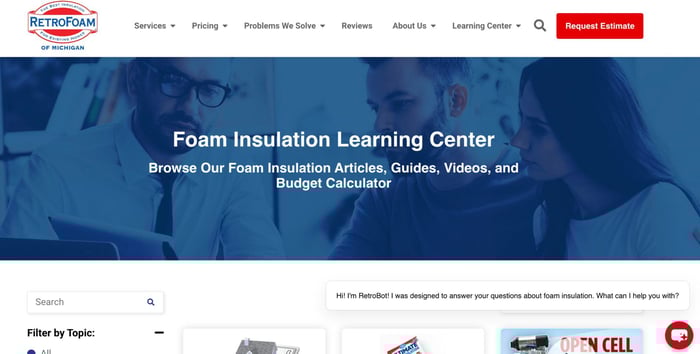
RetroFoam of Michigan 
retrofoam-learning-center

RetroFoam Michigan provides foam insulation for pre-built homes. In their learning center you can access articles, pricing calculators and a chatbot to help you find the information you're looking for. 

Users can filter by topic as well as resource type so, for example. They can choose also to watch a video or see a checklist about their topic choice.

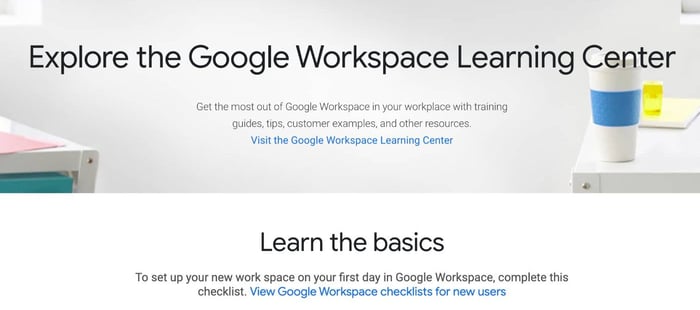
Google Workspace
google-workspace-learning-center
Google Workspace's learning center allows you to search by the product you want to learn about. You'll also find sections that provide tips, links to certifications, and a way for users to contribute.

New users get a step-by-step checklist to get them up and running quickly. 

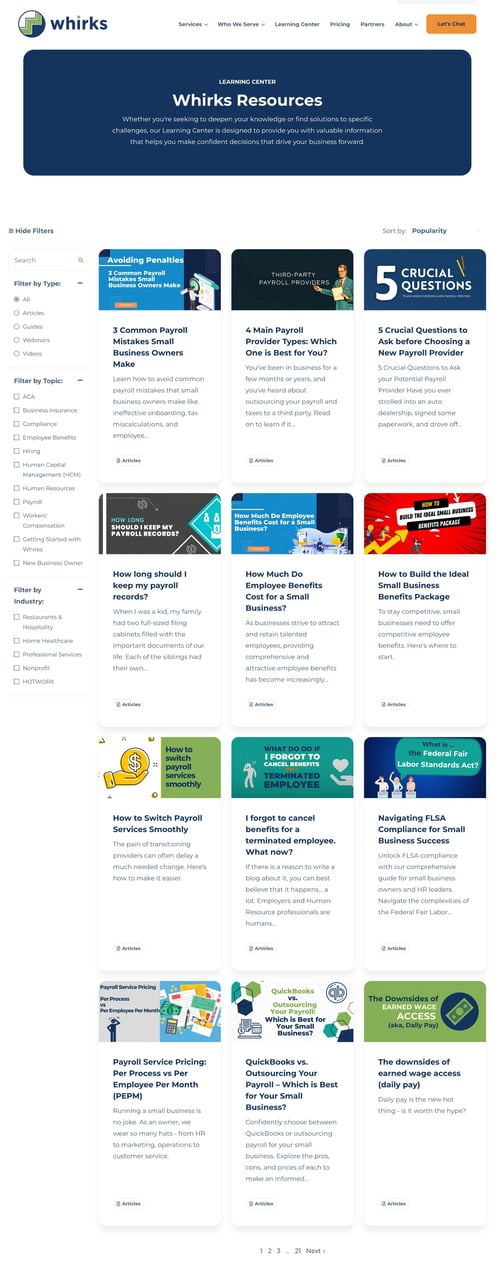
Whirks
Whirks-learning-center

Tennessee-based Whirks offers payroll and HR services, and they've got a pleasing learning center with a clean layout and effective search functions. 

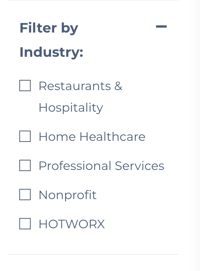
Because they work with so many different companies, the folks at Whirks allow visitors to sort by industry to find content that fits their needs. 
Screenshot 2024-08-05 at 10.14.30 AM

It's great to see some top-notch premium resources here as well — full-length guides that provide in-depth information about complex topics like hiring and HR. 

IMPACT
impact-learning-center

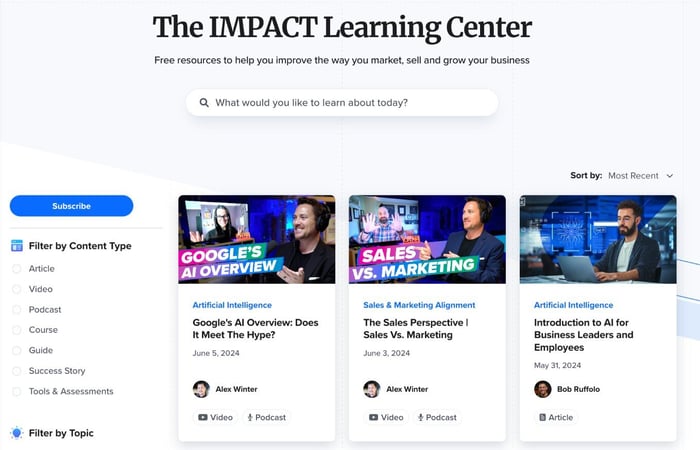
Our learning center at IMPACT allows users to find content with an easy search function as well as the ability to sort by topic, content type, or role. 
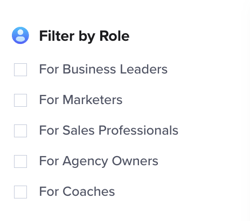
filter by role

This makes it simple for our visitors to find what they are looking for. It also makes it easy for our sales team to quickly identify articles that will be helpful to send to prospects asking questions to give them just what they need.

All of the examples feature an easy search function and the ability to sort by topic. 

Pulling it all together

Ready to get started? Building a learning center will require some technical knowledge, so you may need help. 

How you set up your learning center will depend on your platform. For example, if your site is on WordPress, you may automatically filter data using custom post types. If your site is on HubSpot, you will need to manually add your data to your learning center via HubDB.

Either way, you'll likely need some development help to actually get everything set up. 

Next steps

Researchers believe that over 80% of a buying decision is made before a prospect ever contacts you.

Creating a learning center is a great way to put education at the center of your marketing. Right now, your potential customers are researching and learning about what you sell. A learning center allows your firm to be the one that educates them. This way, you help your prospects by educating them and helping them make an informed decision to buy.

To make it easy, IMPACT has created learning center templates for both WordPress and HubSpot and can walk you through the process of creating your own learning center.

Whether you choose to create your own or use one of our templates, you should get started! As Marcus Sheridan says, buyers want to find trustworthy, unbiased educational content. And, “just like everything else in the digital age, industry leaders will be made by those that can do it well, and do it first.”

If you get stuck, reach out to the team at IMPACT. We can get a brand new learning center on your site in a matter of weeks — and for a lot less than you'd think. 


* This article was originally published here

How to make $1000/day with affiliate marketing 24/7 - start here!


Monday, August 12, 2024

The Learning Center: Your Website's Key to More Qualified Leads [Endless Customers Podcast Ep. 53]

About this Episode

As a business owner or marketing leader, you've likely invested significant time and resources into your company's website. You've crafted compelling copy, optimized for SEO, and maybe even launched a blog to share your expertise. But despite your efforts, you may still be struggling to effectively educate potential customers and guide them through the buyer's journey.

Sound familiar? You're not alone. Many businesses face challenges when it comes to organizing and presenting their content in a way that truly serves their audience. The good news? There's a powerful solution that can transform your website into an educational hub: the Learning Center.

In this episode, we explore what a Learning Center is, why it's crucial for your business, and how to implement one effectively. We'll draw insights from Janet Mendez-Latouche, a web strategist at IMPACT, to help you understand the gigantic potential of a well-designed Learning Center.

The Problem: Information Overload and Disorganization

Before we dive into the solution, let's address the elephant in the room: the traditional blog format. While blogs can be valuable for sharing timely updates and company news, they often fall short when it comes to educating potential customers about your products or services.

As Janet explains, "Think about when you visit a blog. You typically see this really long list of articles in chronological order, and you're probably scrolling through all of it. And it can really be anything from the latest article you posted about your product to 'Hey, we just hired a new marketing director' to the 'Hello World' post from when you first started your blog."

This information overload can be frustrating and time-consuming for users who are genuinely interested in learning about your offerings. Imagine a potential customer visiting your site, only to find themselves wading through irrelevant posts or struggling to find the specific information they need. It's enough to make anyone bounce from your page and look elsewhere.

The Solution: Enter the Learning Center

A Learning Center is not just another name for your blog – it's an organized hub for all your educational content. As Janet puts it, "Your Learning Center is not your blog. It is so much more comprehensive than just a blog."

So, what exactly makes a Learning Center different? Here are the key distinctions:

  1. Organized Content: Unlike a chronological blog feed, a Learning Center categorizes content in a way that makes sense for your audience. This makes it easy for visitors to find exactly what they're looking for.
  2. Multiple Content Types: A Learning Center isn't limited to just articles. It can include videos, webinars, ebooks, landing pages, guides, and more – all in one centralized location.
  3. User-Focused Structure: The organization of a Learning Center is built around your customers' needs and questions, not your company's timeline or internal structure.
  4. Educational Focus: While blogs often include company news and updates, a Learning Center is laser-focused on providing valuable, educational content that helps your audience solve problems and make informed decisions.

The Impact of a Well-Designed Learning Center

You might be wondering, "Is it really worth the effort to create a Learning Center?" The answer is a resounding yes, and here's why:

  1. Improved User Experience: By organizing your content in a logical, user-friendly way, you make it easier for potential customers to find the information they need. This leads to increased engagement and time spent on your site.
  2. Better Lead Qualification: As Janet notes, "As I'm reading, as I'm consuming those 3 to 5 pieces of content and becoming more educated on what you're offering, it actually allows me to better qualify myself as a good fit or bad fit for your sales team. It's a win-win for everybody."
  3. Support for the Buyer's Journey: Research shows that 44% of buyers typically consume 3 to 5 pieces of content before engaging with a vendor. A Learning Center facilitates this process, ensuring that potential customers have easy access to the information they need to move forward in their decision-making process.
  4. Increased Trust and Credibility: By providing comprehensive, well-organized educational content, you position your company as a trusted authority in your industry.
  5. Sales Team Support: A Learning Center can serve as a valuable resource for your sales team, helping them address common questions and concerns more efficiently.

Key Components of an Effective Learning Center

Now that we understand the value of a Learning Center, let's explore the essential elements that make it work. According to Janet, there are four main components to consider:

  1. Searchability: "Visitors have to be really easily able to find what they need by just typing a few words," Janet explains. Robust search functionality is crucial for helping users navigate your content quickly and efficiently.
  2. Ease of Use: The layout should be intuitive and user-friendly. Users should be able to sort content by date, popularity, and other relevant factors.
  3. Segmentation: This is where a Learning Center really shines compared to a traditional blog. Janet recommends implementing three specific types of filters. The first is filtering by topic, which sorts content into categories that align with your products or services. Next is filtering by content type, allowing users to choose their preferred format such as articles, videos, guides, or webinars. Finally, if you serve multiple industries or personas, you should include a filter by audience, letting users find content based on their specific role or needs. These filters work together to create a highly personalized and efficient user experience.
  4. Relevant Content: Focus on including content that directly addresses your audience's questions, concerns, and pain points. As Janet advises, "We don't get to throw everything in the kitchen sink in there. You've got to curate the most important content for that buyer's journey so people are able to find those answers really quickly."

Implementing Your Learning Center

At this point, you might be thinking, "This sounds great, but how do I actually create a Learning Center?" Here's some practical advice to get you started:

  1. Start Small: If you're just beginning to organize your content, you can start by manually segmenting it into categories. This can be a good first step while you build up your content library.
  2. Consider Professional Help: For a more robust Learning Center, you may want to work with a coach, web developer, or agency to create a custom solution.
  3. Plan Your Strategy: Before diving into the build, work on brainstorming your filters and organizing your existing content. This preparation will make the development process smoother and more effective.
  4. Focus on Optimization: Remember, a Learning Center is not a "set it and forget it" solution. Janet emphasizes the importance of ongoing optimization: "This thing needs to be optimized. There's so many great tools out there like heat mapping tools that you can install on the site to see where people are clicking and see what content they're most interested in."

Real Results from Learning Centers

Businesses that implement Learning Centers often see significant improvements in user engagement. Janet notes, "What we've seen on these pages in relation to the data is that people are spending more time on page. People are actually seeing more related blogs and actually exploring the site a bit longer."

This increased engagement can lead to better-qualified leads, more efficient sales processes, and ultimately, more customers. By providing a clear path for users to educate themselves about your offerings, you're building trust and positioning your company as a valuable resource in your industry.

Transform Your Website into an Educational Powerhouse

Today, simply having a website isn't enough. To truly stand out and serve your potential customers, you need to provide a user-friendly, educational experience that guides them through their buyer's journey. A well-designed Learning Center can be the key to achieving this goal.

By organizing your content in a logical, easy-to-navigate format, you're not just making life easier for your website visitors – you're also setting your business up for success. You're creating a powerful tool that can generate leads, support your sales team, and establish your company as a trusted authority in your field.

Remember, implementing a Learning Center is just the beginning. To maximize its effectiveness, you'll need to continually update and optimize your content based on user behavior and feedback. But with commitment and the right strategy, your Learning Center can become your website's secret weapon for generating endless customers.

Connect with Janet

As a Web Strategist, Janet runs hands-on strategy sessions with clients to build easy-to-manage websites that not only align with their business goals but also drive real sales. She empowers her clients with the knowledge and tools they need to take ownership of their websites, ensuring they can manage and optimize them long after the launch.

Connect with Janet on LinkedIn

Keep Learning


Author: awinter@impactbnd.com (Alex Winter)

* This article was originally published here
How to make $1000/day with affiliate marketing 24/7 - start here!


Sunday, August 11, 2024

Thursday, August 8, 2024

How Should My Marketing Budget Change with AI?

Age-old wisdom says that you should spend about 10% of your budget on marketing. And while that might be a good benchmark to start with, there are some reasons it’s outdated. 

First off, this will depend greatly on whether you’ve got an in-house marketing team or not. If you’re outsourcing your marketing to an agency, that comes with a hefty markup, so the same budget will buy fewer results. 

Second, the line between marketing and sales gets more blurry every year. In the olden days, the sales team was responsible for a lot of buyer education. Today, that falls on marketing.

Heck, we’re seeing more and more businesses embrace a touchless sale model, where customers can buy without ever talking to a salesperson. If that’s your business, you’re going to be spending a lot more on marketing (including website upkeep) than you are on sales.

But the advent of AI has the potential to upend the way we think about marketing. So, should AI change your marketing budget? Let’s dive in together.

Make room for AI in your budget

Budgets, to me, are not just about money. They’re also about time. So, as you start to think about shifting your marketing budget, I want you to first think about shifting your time budget. 

marketing-budget-time

There’s no question that AI has already changed many aspects of the work we do. If that makes you feel uncomfortable, you’re not alone. Public opinion is deeply divided, with more and more professionals afraid that AI will take their jobs in the near future. 

As with anything new, the best thing to do to combat these fears is to learn. 

Commit time each week to learning about AI, playing with the technology, and thinking creatively about ways it can help you improve your work.

If you’re a manager or in charge of budgets, ask everyone who reports to you to spend time each week working with AI. (I’d suggest 30-60 minutes per week.)

Make room for AI in your tech stack

What we’re seeing right now is a profusion of new AI tools coming on the market. We’ve got major players like ChatGPT, Claude, and MidJourney — and then we’ve got thousands more making endless promises. 

Screenshot 2024-08-02 at 2.34.33 PM

(Source)

These tools will fight for market share, and many will get bought up by the bigger players in each niche. And the brands you know and love (Google, HubSpot, ClickUp, Canva, and every other one) will incorporate AI into their tools so it becomes a seamless part of your experience.

There aren’t a ton of stand-alone AI tools that are 1) worth the budget and 2) going to break the bank. ChatGPT-40 is free. Claude is $30 per month, MidJourney is $10 per month for a basic plan. 

That’s way less than a lot of the tools already in your tech stack. So adding in some advanced AI capabilities is a no-brainer. 

Make room on your team

But the big question on everyone’s mind is this: Will AI replace people?

Realistically, yes, it will replace some people. Teams will get smaller. It's said that people who are good with AI will replace people who aren’t, but I just think that everyone will be using AI — if they aren't already.

AI-marketing-strategy

If you’re a very small business that has not made a marketing hire yet, AI may help you hold off that cost for a little while, but don’t expect AI to be your marketer. Or to be your marketing strategy.

For small businesses without a marketing team

If you’re a small business without an internal marketing team, AI can really be the multiplier that changes everything. 

With the right tools, whoever handles your marketing will be able to do more. In some cases, that might be another team member who’s got other responsibilities. In some cases, it might be someone you’re looking to hire. The key is, you need to be smart when you fill that role.

Look for someone ready to learn, ready to embrace the tech, and ready to grow their skillset. 

That first content manager can utilize AI to produce content MUCH faster — and in a variety of formats. So, they come in as a writer and quickly learn to produce social media videos, podcasts, and more. Provided they’re willing to learn. That’s what you should be looking for. That’s how AI can multiply.

For businesses with a marketing team

For businesses with a marketing team in place, AI will still be a multiplier, but in a different way. AI tools will help cut down busy work for your team so they can focus on the things people do best, like creativity and strategy.

So, AI helps the content manager summarize an interview so they can fine-tune a blog post. AI helps your videographer get rough cuts for shorts that they can polish into a final product. 

AI-marketing-help

And, if a team member leaves, AI can fill the hole as a stop-gap. So, your video production doesn’t have to grind to a halt while you find a person. Non-experts can produce decent videos in the meantime. 

In some cases, you might find that you don’t need to backfill a certain position if AI is pulling a lot of weight. So, If someone on your six-person marketing team leaves, maybe you CAN actually get by with five. But beware: When you ask people to do more with less, it can sometimes lead to burnout. 

Your future marketing budget

There’s an old saying in marketing — “I know I’m wasting half of my marketing budget, I’m just not sure which half.” 

But I’ll go one better: “Most businesses are wasting half of their marketing and they know exactly which half — but they don’t do anything about it.”

I was talking to a business leader recently that told me they’re spending about $15K per month on Google Ads, and they only get a handful of leads each month — and he couldn’t remember the last time one of them became a customer. 

The fact is, there’s a lot of wasted money in marketing. While AI can be a great tool and, as I said before, a great multiplier, it is not a strategy in and of itself. It’s not going to immediately solve team dynamics or stop you from making bad decisions. 

AI-is-not-a-strategy

Find great people. Encourage them to use the right tech. And let them do what they do best. Keep an eye out for the waste that may already be in your budget. That’s a better place to cut than the salary of a dependable employee that you’re hoping to replace with AI.

Staying on top of trends

How are you and your organization feeling as the AI revolution gets underway? Not sure where to get started and how to do this the right way across your organization?

We can help.

We work with businesses to help them improve their sales and marketing — and part of that is knowing how and when to use AI to improve your outcomes.

If you want to learn more, you can read our blog here, or you can reach out to schedule a time to talk with one of our experts. (Don’t worry, it’s free.)


Author: msheridan@impactbnd.com (Marcus Sheridan)

* This article was originally published here
How to make $1000/day with affiliate marketing 24/7 - start here!


Monday, August 5, 2024

What You Should Actually Measure to Have Better Closing Rates [Endless Customers Podcast Ep. 51]

About this episode:

As a business leader, you've built something great. But now you're asking: 'What's next?' You know there's potential for growth, but the path forward isn't always clear. The challenge isn't just growing - it's knowing exactly what to grow. So how do you identify those key areas that, when nurtured, could transform your solid business into a true leader in your industry?

In this episode of Endless Customers, Alex Winter sat down with Connor DeLaney, Lead Sales Consultant at IMPACT, to dive into how businesses can uncover their true obstacles to growth and develop strategies to overcome them. 

The Growth Dilemma: More Leads or Better Processes?

Many business owners come to us at IMPACT believing they simply need more leads to fuel their growth. But as Connor explains, that's often not the real issue:

"For a lot of them, they say we're not getting enough leads right now. And you know, the initial reaction is we can help you get more leads, but that's not actually what we want to talk about. Instead, it's, ‘Okay, why not?’ Or ‘what does more new leads look like?’"

The key is digging deeper to uncover the true challenges. Maybe you're getting enough leads, but your close rate is abysmal. Or perhaps you have the right volume of opportunities, but your team lacks the systems and processes to capitalize on them effectively.

As Connor notes, "When you start digging into those challenges, that's when you really get into the nitty gritty of things and you start talking about real problems, not the surface level stuff, but the stuff that drives a business to be successful or not."

Defining Success: The First Step to Bridging the Gap

Before you can solve your core business challenges, you need to clearly define what success looks like. As Connor explains:

"Where I always start is where are you today? So it always has to begin with, what are we doing right now? Quantify what today's success looks like."

He recommends starting by breaking down your current state:

  • How many leads are you getting per month?
  • Where are they coming from?
  • What's your appointment rate?
  • What's your close rate?

Once you have a clear picture of where you are, you can define where you want to go. Do you want to double revenue? Increase market share? Expand into new territories?

"You now have an understanding of the things they're doing. You have an idea of what's working, what's not working," Connor says. "As you start to dig into those, then you dig deeper."

This process allows you to quantify the gap between your current state and desired future state. And that sets the stage for developing a targeted strategy to bridge that gap.

Uncovering the Real Problems Holding You Back

As you analyze your business, you may discover that your assumed problems aren't actually the core issues. Connor shared an eye-opening example:

"There was this payroll company that we had maybe two conversations with, and they came in and they said, yeah, we're struggling to generate leads and we're struggling to generate opportunities. And as we got talking with them, the owner said, I'm not sure I have the right person in my VP of sales seat."

By digging deeper, they uncovered that the real challenge wasn't lead generation - it was that the owner had never taken the opportunity to clearly define what success looked like for his VP of Sales.

"He had this moment of realization of like, I am responsible for this. As much as I want to blame it on him," Connor explains.

This highlights the importance of looking beyond surface-level symptoms to identify root causes. Your perceived "lead problem" may actually be a lack of clear goals, misaligned teams, or ineffective processes.

The Gap Isn't Always About Revenue

While revenue growth is often the ultimate goal, the gap you need to bridge may be more nuanced. As Connor notes:

"Maybe you're at $5 million of revenue here and you want to be at $10 million and you say, how do I get to that extra five million? You have a $5 million gap. But the actual gap you have is I don't know how to get there. I'm struggling to fill that gap."

The true gap could be:

  • Lack of in-house expertise
  • Misalignment between sales and marketing
  • Ineffective systems and processes
  • Inability to scale operations

Identifying these core challenges allows you to develop targeted solutions, rather than just throwing money at surface-level fixes.

Bridging the Gap: A Collaborative Process

Once you've defined your gap, bridging it requires a collaborative effort. As Connor explains:

"At the end of the day, I want it to be something where I'm not just going to fix the problem for you, but everyone's going to work together to build the solution that's going to work for everybody."

This means getting buy-in across your organization and potentially bringing in outside expertise. But it starts with you as the business leader being willing to take an honest look at your challenges.

"If they believe in something and they see the opportunity and they see how you can help them get to where they want to go, they will help form a solution," Connor says. "It's not all on you as a salesperson, and it's not all on you as a business leader. That's where that outside help can be really, really helpful for them."

Overcoming Budget Objections

Of course, investing in growth initiatives requires financing. But as Connor points out, it's often a matter of priorities rather than lack of funds:

"I always start by challenging that business owner. If it's enough of a priority. I believe that you can manipulate your budget to make it something you have to solve."

He recommends quantifying the potential return on investment:

"When we quantify it, we're saying you're a $5 million company. You want to get to ten. Same example we've used throughout. That's a $5 million revenue gap. If you're going to spend money with IMPACT, let's say you're spending $10,000 a month. If you're saying you're going to work with us for 12 months, is $5 million over the course of the next five years worth investing $120K into?"

When framed that way, the investment often feels less intimidating. It's about reallocating resources to your highest priorities and biggest opportunities.

Key Takeaways for Business Leaders

As you look to bridge the gaps in your own business, Connor offers two key pieces of advice:

  1. Ask lots of questions. "Don't jump to assumptions so much or jump to this isn't working. Ask yourself a lot of questions and it's going to help you dig deeper”
  2. Be aware of misplaced effort. "Be really self-aware of the potential that you're putting too much effort into the wrong things. And that's where most business owners can go wrong”

By continually questioning your assumptions and analyzing your efforts, you can uncover your true challenges and develop targeted solutions to bridge the gap to your goals.

The growth journey is rarely linear or simple. But by digging deep to identify your core obstacles, clearly defining success, and developing collaborative solutions, you can overcome the challenges holding your business back.

Remember - the gap isn't always what you think it is at first glance. Take the time to truly understand your business, your team, and your market. That self-awareness is the first step to explosive growth.

Connect with Connor

Connor Delaney is a Lead Sales Consultant at IMPACT who helps businesses understand how they can create the growth they have always dreamed of. 

Learn more about Connor

Connect with Connor on LinkedIn

Keep Learning


Author: awinter@impactbnd.com (Alex Winter)

* This article was originally published here
How to make $1000/day with affiliate marketing 24/7 - start here!


Thursday, August 1, 2024

How To Set Marketing Goals Based on Business Goals

Goal setting is one of the most critical challenges for any business leader.

Your entire team is watching: If you set goals that are too ambitious, you’re seen as an unrealistic tyrant. Goals that are too small can make it seem like you lack vision or direction.

Even perfect goals without the right plan in place will leave your team feeling confused and frustrated.

In our company’s work with clients of all shapes and sizes, we’ve helped hundreds of business leaders set goals and develop plans for growth. What we tell our clients is this: Start with the end in mind — and then plan backward to spell out the necessary steps to get you there.

When it comes to marketing goals, follow this same approach. Start with where you want to go, then plan the steps that will get you there.

Even if you have a great digital marketing plan, if it’s not connected to specific goals, it will be difficult to measure your success and course-correct as needed.

In this article, I’ll set you up for goal-setting success by sharing:

  • How to set well-defined goals.
  • A step-by-step plan for setting marketing goals based on business goals.

By setting SMART goals — that is, goals that are specific, measurable, attainable, realistic, and time-bound, you and your team will know exactly what you are working toward — with no questions. 

Here’s how to begin.

How to set well-defined goals

It is often said that a goal without a plan is just a wish — but a plan without a goal is equally incomplete.

To move your business forward, you need both: goals that are well-defined — and the plans to get you there.

Examples of poorly defined marketing goals

Here are some marketing goal examples that need more work:

  • I want more website visitors, leads, and sales
  • We need to generate a larger email list
  • Our goal is to rank higher in Google
  • We want to use more AI in our marketing

You can see that these are vague.

It's easy to say that you want to generate more leads, but how many more leads do you need to achieve your goal? 10 more? 100 more? Thousands more? How many contacts do you want on your mailing list? What do you want to rank in Google for? How will you use AI?

Without a clear goal, it's hard to define success.

Examples of well-defined marketing goals

Here are the same goals turned into well-defined marketing goals. What’s more, these marketing goals are based on the overall goals of the business.

  • We need 20,000 visitors, 500 leads, and 12 customers within the next 12 months from our inbound marketing efforts to achieve our revenue goal of $600,000 from inbound marketing.
  • We would like to generate two customers from our current client list using email marketing. We would also like to add all qualified leads to our mailing list, allowing us to keep these leads warm for future sales.

When it comes to marketing goals, specifics are your friend. It’s better to start out with numbers in mind, even if you have to adjust them over time.

At IMPACT, we set goals and then determine a range of outcomes, and we regularly update these along the way.

Red means we were way below our target.

Yellow is closer, but not actually on target.

Green means we reached our goal.

Super green means we surpassed it.

How to set marketing goals based on business goals (in 7 steps)

Below are seven steps for setting well-defined marketing goals that are in sync with the goals of the business:

1. Identify how much revenue you need to generate from your digital marketing efforts

This is easy, but it’s a critical first step. Say your business did $2 million in sales last year. Your CEO just said he wants to grow the business by 30% next year.

You know you already have $1.8 million on the books for next year and expect another $200,000 from other marketing efforts, such as trade shows and events.

That leaves you with a gap of $600,000 that you need to close within the next 12 months.

2. Determine how many sales you need to hit those revenue goals

Take your revenue gap and divide it by the value of your average sale. For example, if the revenue needed is $600,000 and your average sale is $50,000, then you need 12 new customers to achieve your goal.

If your average sale is $500, then you need 1,200 sales.

But for now, let's stick with the 12 for the sake of our example.

3. Identify your closing rate and how many opportunities you need

Continue working backward to identify how many opportunities you need. Say that your close rate is 25%. So, if you need 12 new customers, you’ll need 48 opportunities (or 'ops' for short).

4. Identify how many SQLs you need

A sales qualified lead (SQL) is a lead that is ready to be passed to your sales team. Some will become ops, some will not.

If this is something you haven't tracked before, you may not know this number. Take your best estimate. I often find that 50% is a good number to start with. In other words, half of all SQLs that you pass over to sales will become legitimate opportunities. Your number might be higher or lower, so start with 50% and adjust it over time.

For our example, we can estimate that we need to pass 96 SQLs to our sales team in order to get 48 opportunities (and 12 customers).

5. Identify how many MQLs you need

A marketing qualified lead (MQL) is a lead that is qualified, but not sales-ready. MQLs need more education before they’re ready to talk to sales. Maybe they get enrolled in a lead nurturing campaign to learn more about your offerings so they become sales-ready over time. Or, they might opt out, seeing that they’re a bad fit to do business with you.

So, how many will be ready to become SQLs? Again, 50% is a safe number to assume. If you have no experience with digital marketing, start with 50%. You can always adjust this later.

To continue with our example, we'll need to generate 192 MQLs within the next 12 months, which will turn into 96 SQLs that enter the sales process.

6. Identify how many leads you need

We define a lead as a visitor who has converted on one of your offers. Remember, not all of your leads will be MQLs. Some will be too early in their buyer’s journey, others may just be gathering information. So, when it comes to estimating the number of leads you need, keep all of this in mind.

First off, how are visitors converting on your site? What are you offering them in exchange for their contact information?

The more attractive your content is for your qualified leads, the higher your conversion rate from lead to MQL will be. To generate our 192 MQLs, in this example, I would estimate that we’ll need to generate 500 leads.

As you get started, monitor these numbers closely and make the necessary adjustments over time.

7. Identify how much traffic you need to achieve your goals

How much traffic will you need to capture 500 leads? Based on our experience, we would estimate a traffic-to-lead-conversion rate of 2.5% over the next 12 months.

At first, this rate will be lower as content gets created and rolled out. Then, it will climb as rankings improve.

In our example, you'll need 20,000 website visitors within the next 12 months.

Now put it all together

And there you have it: 20,000 website visitors will turn into 500 leads, who will become 192 MQLs, who will become 96 SQLs, who will become 48 ops, who will become 12 customers, who will spend an average of $50,000 and bring in $600,000 to your company.

Obviously it’s not always a perfect science. But you can see how a revenue goal can translate into a marketing goal, as long as you go backward and take it step by step.

Next, set quarterly benchmarks

As you're just getting started, remember that results will take some time. You'll get a lot more traction in the fourth quarter than you did in the first. Set your benchmarks for the fourth quarter much higher than your benchmarks for the first quarter. For our example, our quarterly benchmarks may include generating 1,000 visitors in the first quarter and 8,000 visitors in the fourth quarter.

Set benchmarks for every metric you’re tracking, from traffic all the way down to new customers. This way, you can continually tweak and make updates to your formula. If you’re struggling to hit a benchmark, don’t panic. Work with your team to figure out ways to improve.

Make sure you include metrics for your other key business goals as well.

Remember to implement your other key business goals

These goals are not supposed to be an exhaustive list. Most likely, what we’ve spelled out above will represent only one aspect of your business. Don’t forget to set up similar formulas for other goals you may be tracking. For example:

  • Sales for a particular product line
  • Revenue from existing customers
  • Retention rates from current customers
  • Number of job applicants (which may be important if your business is growing)
  • Downloads of a high lead-to-customer converting offer

As with the example above, make sure you clearly define these goals and make them SMART. Then, work backward to determine the steps to take to get yourself there.

Take the first step and get started

In his book Scaling Up, author Verne Harnish recommends focusing your business around what he calls a big hairy audacious goal (or “BHAG” for short). This is sort of a “where do you want to be in 10 years?” type thing. Your BHAG might seem far-fetched today, but that’s okay. It’s going to take a long time to get there.

Any goal you set will remain forever in the distance if you don’t plan the steps that will get you there. Whether you’re talking about a goal that’s 10 weeks or 10 years away, break it into smaller chunks so you know how to move forward.

Remember, your goals will not be perfect.

Don't waste hours upon hours tweaking numbers and then never getting started. Gather accurate data about previous time periods, define the capabilities of your team, and make smart decisions on where you want to go with your marketing.

Then, get started and begin tracking your progress. You can always course-correct along the way.

Build your marketing strategy around these goals, and after one quarter ends, take a step back with your new data. Adjusting goals (whether you overshot or undershot) shouldn't be perceived as negative — it's something that's completely necessary to keep moving forward.

You can do this — but you don't have to do it alone.

A business coach can help you plan goals and track progress. Here at IMPACT, we've helped hundreds of businesses in dozens of industries.

You can speak to one of our experts to see how we can help you set goals to build a more profitable future.


Author: rruffolo@impactbnd.com (Bob Ruffolo)

* This article was originally published here
How to make $1000/day with affiliate marketing 24/7 - start here!