The new regulations would set significant fines for violations.
* This article was originally published here
The new regulations would set significant fines for violations.
Google continues to evolve its data usage tools.
The report commissioned by LG Electronics found that 75% of social media users felt it can have negative mental health impacts.
When a marketer or business leader first hears about They Ask, You Answer — whether they see Marcus Sheridan speak or they read the book — they almost always get excited.
They see the big picture.
They understand that creating written and video content to address their ideal buyers' most pressing questions and concerns will help them become the most trusted brand in their industry.
Sales folks, however, are an entirely different story.
In all fairness to sales, I do not blame them one bit for not seeing the potential of They Ask, You Answer at first.
But once they catch the vision, they'll be glad they did.
Here's why they might be skeptical at first.
One of the buzzy little phrases bandied about by industry pros is "sales and marketing alignment". This is a polite way of saying that these two departments — that is, sales and marketing — need to work well together. Unfortunately, that's not typically the case.
You see, what lack of "sales and marketing alignment" really means is that sales teams don't trust marketing to create anything of value for them to use. Instead, they see marketers produce fluffy content that may boost brand awareness but does little to close deals.
Marketers, on the other hand, see the sales team as people who care more about closing deals than customer loyalty and long-term brand success. 
With this kind of disconnect in place, it's no wonder that marketers feel misunderstood and sales teams don't trust anything that sounds like marketing.
To many sales pros, blogs, social media posts, and YouTube videos don't seem to do anything to bring in revenue. Instead, they sound more like expensive line items in a marketing budget.
And, honestly, those sales teams aren't wrong a lot of the time.
So, when marketers come along with a new book/vision/framework/outlook, sales has every right to be skeptical.
But this time is different. I promise.
At the core of They Ask, You Answer is a simple idea:
Educated prospects become happier, better customers.
If your prospects are asking questions, you must answer them — openly and honestly — on your website. That’s where the name for our framework comes from: They Ask, You Answer.
When you commit to answering your customers' questions, you:
While many of the core tenets of They Ask, You Answer sound like marketing (content creation, blogging, YouTube, social media, website learning center), it's actually a sales-first initiative.
You see, the basics of They Ask, You Answer are simple: Address your customers' questions and concerns so it's easier for them to buy from you.
Yes, some of what you produce will drive search traffic and social media impressions, but the biggest beneficiary is ultimately the prospect entering and moving faster through the sales process.
When implemented properly, every single blog article, every video, every website page is created through the lens of what the sales team needs —based on their front-line knowledge of what their ideal buyers are thinking and asking.
When this happens, marketing materials are suddenly relevant and useful to the sales team.
Salespeople can share them with prospects, and they can feel confident that organic leads haven't been reading something on the website that's out of sync with the sales process.
However, the marketing team can't do this without the help of the sales team. Marketing doesn't speak to buyers face to face like sales does.
But when the teams work together, they can produce content that actually helps sales.
Let's dive into the specifics of how that works.
To succeed with They Ask, You Answer, the sales team and marketing team will need to collaborate. They'll meet together, run brainstorms, and check in on the content marketing produces. (Sometimes this is done in what we call a revenue team.)
I promise this is a minimal time commitment and totally worth everyone's time. here's why.
The core of They Ask, You Answer is an absolute obsession with knowing what your buyers are thinking, feeling, and searching.
Understanding your buyers is an all-hands-on-deck initiative.
Marketers must work with sales reps, customer service pros, and other company experts to get to know the customer before, during, and after purchase.
They need to dive into data and analytics and interview past customers.
When your company understands its customers, it can produce messaging that speaks to their needs, worries, and concerns
The result is customer-focused content that drives revenue, not vanity metrics.
Sales professionals have heard most of the questions a prospect could ever ask, and they've answered every one. They've seen which answers have satisfied customers — and which have missed the mark.
When sales teams are connected to the content production process, they sharpen the way they answer the tough questions, improving the way they communicate with clients in the future.
You likely know your prospect is going to ask a specific question at a specific time. Nearly everyone asks the exact same question at that time, right?
Rather than spending valuable minutes answering the question during the sales call, you send along a video or article that provides a fully-vetted answer to this question — before the prospect even answers it.
 Now, your call be more productive, and you will gain the buyer's trust in the process.
This is the beauty of assignment selling — the time-tested, proven way to use educational content in the sales process.
When you have content you can trust, you can "assign" this content ahead of time to get ahead of buyer questions and objections.
With advanced sales and marketing automation and analytics platforms like HubSpot, sales teams can see every single website page, article, and video a prospect looked at prior to reaching out to talk to someone in sales.
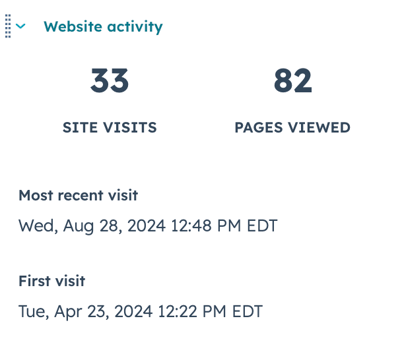
This is priceless intelligence that will empower you to understand exactly what your prospects are interested in and how much they know about you and what you sell — all before a single sales conversation has even taken place.
That’s an incredible amount of lead intelligence right at your fingertips.
When customers self-educate before speaking with a sales rep, they enter the sales process with an established relationship with your company.
They know you. They trust you.
And buyers are more likely to purchase from businesses they trust.
Sales reps can spend more time during meetings having deep conversations specific to the needs of the people they are speaking to.
That allows you to do what you do best — sell.
The more content you create, the more articles, videos, and more you’ll have at your disposal for current and future employees to use as training materials.
It will help them learn company doctrines, philosophies, and so on more effectively and more efficiently.
By empowering your buyers to educate themselves through the content you create and publish, you give your sales teams the gift of time.
More time to spend with qualified leads, more time at the end of the day to clock out on time.
It's a lot of work to get your entire company aligned around They Ask, You Answer as a way of doing business.
That's because, unlike strategies in the past, They Ask, You Answer must be embraced by all teams — leadership, sales, marketing, service, etc. It is not owned by one team or one individual. It's a cultural shift within your company, not a flash-in-the-pan tactic.
If you are in a sales role specifically and want to learn more, I would encourage you to create a free IMPACT+ account and educate yourself with the following course:
This course will arm you with the insights and knowledge you need to see an immediate lift in your close rates by embracing the principles of They Ask, You Answer.
Yes, it's likely a significant departure from "the way it's always been done" at your company. But trust me, the results will speak for themselves.

Running a growing business can often feel like a constant push and pull. You’re doing a lot of things right, but there’s always a new challenge on the horizon. Launching a new initiative or strategy can be one of those challenges. How do you get your whole company on the same page when bringing in new ideas and principles? The stakes are high, and misalignment can lead to wasted time, resources, and worse—missed opportunities.
In this episode of Endless Customers, Alex Winter sat down with Chris Duprey, Principal Coach at IMPACT, to dig deep into this issue. Chris has worked with countless businesses to optimize their marketing, sales, and overall strategy. In this episode, he shares why getting everyone aligned—leadership, sales, marketing, even operations—isn't just important. It’s essential if you want your next big idea to stick.
So, how do you make sure your team is tracking toward the same goals, especially when there’s resistance or confusion? The good news is that the solution is simpler than you think: alignment days.
Imagine this: you have an exciting new initiative that you know will drive results—maybe it’s a new approach to customer service, a pivot in your marketing strategy, or a complete shift in how you sell. You’re ready to implement, but there’s one big hurdle. How do you get everyone to care about it as much as you do?
"You're likely not doing the majority of the stuff that's in Endless Customers," Chris said. "So, we have to get everybody...and when I mean everybody, I mean everybody in the organization aligned around this new thing."
Getting buy-in across the entire company isn't just about giving the green light from the top down. Leadership can't just say, "This is what we're doing, now go do it." Chris pointed out how easy it is for people to resist if they don’t understand why things are changing. And that’s a recipe for failure.
People aren’t robots. They need to feel connected to the why behind the strategy. Why are we changing direction? Why does this new initiative matter? "Think about when people resist or don’t fully engage," Chris explained. "It's because they don’t understand."
The lack of understanding or fear of change can create confusion and hesitation. Chris emphasized the importance of empathy. The moment your team understands the purpose behind the change and how it impacts their role, the faster you'll see real buy-in.
And it’s not just leadership that needs to be on board. "Sales has to be aligned, leadership has to be aligned, marketing has to be aligned...everyone has to be aligned," Alex pointed out.
So, how do you create that alignment? That’s where alignment days come in.
An alignment day isn’t just about sitting everyone down and giving a presentation on the new strategy. It’s about creating a deeper understanding across all levels of your organization. "The first half of the day is really about getting buy-in, removing fears, worries, and doubts," Chris explained. This is the time to answer the questions that people might be too afraid to ask and to make sure they understand why this change is necessary.
In the second half of the day, things get practical. Once the team has a strong grasp of the why, you move into the how. "Now that we get it, how do we apply this?" Chris said. This part of the day is dedicated to planning how the new initiative will be rolled out across different departments.
By the end of the day, the entire team is not only on the same page but excited and empowered to execute the new strategy.
A key element of successful alignment is making sure everyone—from leadership to sales reps—feels like they’re part of one unified team. "It’s one team, one dream," Alex emphasized. When people are united around a shared goal, things move faster and more smoothly.
But it’s not just about speed. It’s about making sure everyone is contributing toward the same objective. When each department is moving in its own direction, chaos ensues. Chris pointed out that often, leadership can have a visionary idea, but if it doesn’t trickle down effectively, execution falls apart.
"If leadership doesn’t align with the rest of the team, then there’s a disconnect," Chris said. And that disconnect can lead to failed initiatives, frustrated employees, and wasted resources.
Once your team is aligned, it’s time to focus on accountability. Chris stressed that without proper follow-through, even the most inspiring alignment day won’t create lasting change.
"The make or break in this situation really is accountability," Chris said. It's not enough to just be excited on day one. How do you track progress and ensure everyone is sticking to the plan?
One way to do this is through what Chris referred to as a scorecard. After the alignment day, the team continues to monitor progress, track key performance indicators (KPIs), and make adjustments where necessary. Chris mentioned that with IMPACT’s scorecard used for clients, it’s very common for initial scores to be low. Through work and consistent effort, businesses see massive improvement. Regular check-ins with the scorecard are made throughout the year.
This ongoing evaluation is critical because it provides the team with a clear picture of what’s working and what isn’t. It keeps everyone accountable and ensures that momentum doesn’t fizzle out after the first 90 days.
Chris explained why this timeframe of 90 days is so effective for businesses. Monthly evaluations can be too short, and yearly goals too broad. "When you look at a quarter, you can start to see some trends," Chris said. The 90-day cycle gives businesses enough time to gather meaningful data and adjust their strategy without reacting to short-term fluctuations.
This approach helps businesses make smarter, data-driven decisions rather than reacting emotionally to short-term results. Chris pointed out that some companies see quick wins, while others take more time. But regardless of the industry, the key is consistent effort and adjusting as you go.
So, what kind of results can businesses expect from alignment days? Chris shared the story of one company that had tried to launch Endless Customers on their own but struggled for months. After going through an alignment day with IMPACT, their results skyrocketed. "Now, nine months later, they're on fire," Chris said.
These success stories aren’t just lucky breaks—they’re the result of intentional planning, execution, and accountability. Chris has seen firsthand how alignment days set the foundation for long-term success. "The proof is in the pudding," Alex added, emphasizing how the difference is night and day between companies that invest in alignment and those that don’t.
So, what's the main takeaway from this conversation? Alignment is the foundation of any successful business initiative. Without it, even the best ideas can fall flat. "You have to get everyone on board, from leadership to sales to marketing," Chris said. And once you have that buy-in, accountability and consistency are what keep the momentum going.
If you’re serious about making big changes in your business, an alignment day might be the missing piece. It’s not just about getting your team to understand the new strategy—it’s about creating a culture where everyone is pulling in the same direction and excited about the future.
So, what’s your next move? If you're ready to take your business to the next level, it might be time to bring your team together for an alignment day and start creating lasting change.
Chris Duprey is a sought-after speaker and business coach with over two decades of leadership experience.
Get to know Chris through his IMPACT bio page
Connect with Chris on LinkedIn


Australia is the latest country to propose social media age limits.
Running a business comes with many ups and downs—one of the biggest challenges being seasonality. You’ve been there: business is booming in one quarter, and the next, it slows to a crawl. This inconsistency can be frustrating. So, how do you keep the leads flowing year-round?
Marcus Sheridan (renowned speaker, author of They Ask,You Answer, and partner at IMPACT) shared powerful strategies to overcome seasonality and keep growing, even during slow periods. By shifting your mindset and embracing new tools and tactics, you can make sure your business doesn’t just survive those dips—it thrives.
For many businesses, the off-season is a real struggle. Whether it's due to the weather, customer buying cycles, or industry trends, things can slow down for months at a time. This dip in activity can be stressful, especially when it happens like clockwork every year.
Sound familiar? It’s a common challenge that leaves many business owners feeling stuck, thinking this cycle is just the way things are. Marcus shared a story of a company that had been fully embracing They Ask, You Answer to build trust and engage customers. But like many businesses, they still struggled with seasonal dips. To combat the off-season slowdown, they decided to try something new—a pricing calculator. What happened next was unexpected.
"Over the weekend, they got 20 leads—20 leads in just one weekend," Marcus shared. "And this is during their offseason." The leads kept coming too, with the company averaging ten leads a day after making that one simple change. Two walk-ins even made immediate purchases after using the calculator.
This simple tool made a world of difference because it helped potential customers get instant answers to their pricing questions. And when customers get immediate value, they’re more likely to act. This story shows how a small shift in approach can lead to major results.
A big takeaway from Marcus’s advice is that businesses need to embrace self-service tools that allow customers to access information whenever they need it. Pricing calculators are a great example, but there are other options as well. Marcus also mentioned ScoreApp, which allows businesses to offer assessments that help drive leads.
The idea is simple: the easier it is for customers to get answers on their own, the more likely they are to engage with your business. In a world where consumers crave instant gratification, it’s essential to be transparent and provide tools that empower potential customers. This helps build trust, and trust leads to action. If you’re not making it easy for people to learn about your offerings or pricing, you could be missing out on opportunities.
While tools and strategies like calculators can generate leads, Marcus emphasized that success isn’t just about tactics. There’s a psychological factor at play, too. He introduced a concept called the "Pride Cycle," which is all too common among businesses and leaders.
"The Pride Cycle affects every human, every company, every society," Marcus explained. "When we’re at the bottom, we’re feeling pain and frustration, so we push ourselves to make changes. But when we reach success, we stop doing the little things that got us there, and that’s when we start sliding back down."
This cycle is all too familiar: when things are going well, you might ease up on your efforts—fewer calls, less outreach, skipping a few marketing initiatives here and there. But as Marcus noted, that’s exactly when businesses start slipping back into the slow lane.
It’s easy to feel comfortable when things are going well, but that’s precisely the moment when you need to double down on the strategies that brought you success in the first place. "We forget about the extra call, the extra door knock, or the training we should have been doing," Marcus said. And before you know it, you’re back in a slump, wondering how it all fell apart.
One of the most impactful lessons Marcus shared was the importance of "thinking like a farmer." Just as a farmer plans ahead and plants crops long before the harvest, business owners need to invest in marketing and lead generation before they hit their slow periods.
"You have to plant the seed early if you want to harvest later on," Marcus explained. This means that when business is booming and cash flow is strong, that’s when you need to ramp up your marketing efforts. Too many businesses wait until they’re in a slump to start pushing hard, but by then, it’s often too late.
Farmers don’t wait until they’re out of food to plant their crops, and neither should you. If you anticipate a slower season coming up, the time to act is now. Invest in new tools, focus on content that builds trust, and make sure you’re doing the little things—like consistent outreach and follow-ups—that keep your business top of mind for potential clients.
Marcus Sheridan’s insights remind us that seasonality doesn’t have to control your business. By thinking ahead, leveraging tools like pricing calculators and self-assessments, and maintaining the same level of effort during busy times, you can ensure a steady flow of leads even during the slower months.
It’s easy to get complacent when things are going well, but as Marcus said, that’s when you’re most at risk of falling into the pride cycle. The key is to stay consistent, plan ahead, and never stop planting seeds. Whether you’re using innovative tools or simply sticking to the basics, the companies that succeed are the ones that keep pushing, even when they don’t "need to."
Marcus Sheridan is a writer, speaker, and business expert who’s worked with companies all over the world. Marcus is the author of They Ask, You Answer and co-author of The Visual Sale.
Connect with Marcus on LinkedIn
Learn more about They Ask, You Answer
See how companies have used They Ask, You Answer to fuel their success

Brazilian users are shifting to other apps in the wake of the X ban in the region.
YouTube is trying to limit the harm caused by repeated exposure to certain content.
When companies decide to invest in growth, they need to choose between hiring an agency to do the marketing work for them or building an in-house team to do it.
You want to grow your business and drive revenue, and you know there’s a lot of marketing work to be done. You need to build your brand and increase leads and sales, and you need a partner that can help you get there as soon as possible.
You want to make the choice that helps your business get the best ROI possible.
In this article, we’re going to explain how to choose the right marketing option for your business, be it an agency or hiring and training an internal team.
Now, we know that the "best" option depends on your needs, but we promise to help you make the best decision possible.
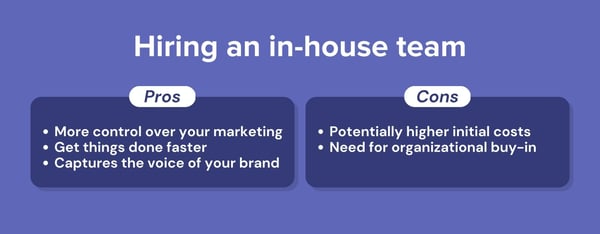
Hiring an in-house marketing team can seem like a huge undertaking — especially if you're starting from scratch. However, the benefits can be massive. There are drawbacks to consider as well. Let's dive in, starting with the Pros.
When you bring marketing operations in-house you have more control. This includes your tools and staff, but most importantly your strategy.
What goals are you prioritizing?
What activities are you going to engage in?
What will the publication cadence be?
When marketing is internal, your team can be more hands-on with the details of your plan. Plus, they will also arguably be more invested in the outcome of marketing strategies, as your business is their sole focus.
When your entire marketing efforts are done in-house, you're also more likely to get things done quickly. As the team's "only client," you get their full attention.
You don't have to worry about waiting for projects as they work for different clients or the constraints of a contract like you would with a third party.
You also have more flexibility to pivot, request edits, and have them turned around quickly, without going through layers of red tape.
While agencies can be incredibly talented and may have experience in your industry, they will never have the same brand or operational-level understanding of your business as the people who are in it every day.
In-house talent will be the ultimate source of the most honest, helpful, and transparent marketing available, anywhere.
Their institutional knowledge is reflected in every marketing strategy they develop and that authentic voice is what's needed to build trust with your audience.
Along with the favorable outcomes of hiring an in-house marketing team, there are also a few drawbacks to consider.
If you do decide to build an internal marketing team for the first time, you will need to make a few additional hires, such as a content manager or videographer.
Finding and onboarding new team members takes time, and once you do, they do come with their price tag.
A content manager who has the knowledge and experience to lead your internal marketing team will require an average salary of $75,672 (according to Glassdoor).
And PayScale reports that videographers earn an average salary of $52,000, and these numbers can increase depending on your company size, location, or the candidate’s level of experience.
You may be thinking you already have people on your team who can fill these roles. That's great! But marketing will need to be their full-time job and focus.
Their original jobs may need to be filled by a new hires, if their workload can't be distributed to others.
If you're going to build a team internally, these additional salaries are something you need to be ready and equipped to take on.
Additional staff members also require paperwork, onboarding, one-on-ones, up-to-date job descriptions, performance reviews, raises, career-path conversations, supplies, tools, and much more.
Insourcing your marketing requires all parties from executives to sales to be bought in and aligned on the vision and activities.
Achieving stellar results with marketing requires that each person must have a shared understanding of the value, what it takes to be successful, and be committed to making it happen.
This can certainly be a challenge.
For our clients, we recommend conducting a workshop as a critical first step.
Even if you decide to hire an in-house marketing team, you don't have to go it alone.
There are training companies to help you go through the hiring process and train your talent. At IMPACT, for example, we offer marketing training for your in-house staff.
We help you to build your team and teach them to create great content. Once they're up to speed, we phase out our services, so the cost of working with us is temporary.
Our main objective is to help businesses learn to generate so many leads and sales on their own they won't need an agency.
Now that you understand the pros and cons of hiring in-house, here’s what to consider when hiring a marketing agency.
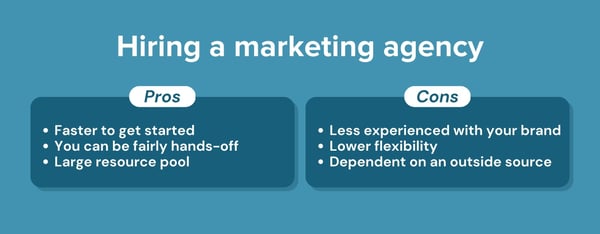
For businesses that do not want to bring their marketing initiative in-house, here are the pros of hiring an agency.
The faster you can get your marketing going, the sooner you’ll see the benefits of your efforts.
When you work with an agency, they have processes, talent, and resources all lined up so you don't have to do any of the vetting or planning.
While there is always some initial setup when kicking off your marketing, with the experience of an agency, this stage should move quickly compared to doing it on your own.
Depending on your needs, you may not be in a place to give your marketing much focus.
When you work with an agency, they are equipped to develop your strategy, produce your content, film your videos, and write your emails, among other things. You generally don’t have to worry about much, with the exception of sharing initial goals and business insights — as well as ongoing feedback.
With marketing as their focus, an agency can provide you with an array of talent, including experts in strategy, website copy, social media, YouTube, email marketing, graphic design, and more.
They also likely have a large network of trustworthy talent outside their organization to pull in if needed.
Hiring an agency might appeal to you, but there are some cons to consider.
While this model is a good fit for some companies, it’s our experience that many end up unhappy with the results because the work they get back “doesn’t sound like us” and lacks authenticity.
Yes, there are industry-specialized agencies available, but truth is they are unlikely to capture your true particulars or voice, and you might end up with content that sounds the same as everyone else in your industry.
This results in potentially slower production, labor-intensive editing, and constant back-and-forth with your account manager.
When you rely on an agency or any third party for that matter, you will be limited to the conditions of your contract. This means you're held to a certain number of deliverables and time spent on your company's needs.
This makes it harder to pivot your strategy or make changes quickly if need be.
When you hire an agency to do the work for you, you will always depend on them for the work. This is perhaps the greatest drawback of leveraging an agency.
Instead of building the expertise and proficiencies of your internal team, you’re investing in the growth and development of people outside your organization.
Even if you find someone you like, if the platform, agency, or talent is no longer available, you’re left high and dry. Once you stop writing checks, the campaigns shut down and you lose access to agency expertise.
Hiring an in-house marketing team or an outside agency aren’t the only options for implementing a marketing strategy for your business.
You can also consider an independent contractor or freelancer.
Independent contractors and freelancers can have a wealth of knowledge. Many of them have left successful careers to start their own one-person operation and have a lot of talent.
It's common to hire them in a consultative nature when you need to complete one-off marketing activities and deliverables.
Independent contractors are not treated as employees; therefore, they are not subject to payroll taxes or state and federal employment laws, which is a benefit over hiring an internal team, but many of the cons are similar to hiring an agency.
They can never understand your brand like an in-house marketing team does and they are limited in their ability to provide a full array of service offerings.
For example, they may have great ideas and a vision for how to help you reach your marketing objectives, but lack the technical expertise to execute it. This may cause you to need multiple independent contractors (strategists, content creators, designers, developers) to really get the job done.
In terms of cost, working with a freelancer or contractor can vary.
Someone who has a high level of expertise starts at around $200 per hour. If they’re providing you with 15 hours of service a week, that’s around $12,000 per month, which is more than what a typical agency would cost you.
The good news is there are a few questions you can ask yourself to help narrow down your thoughts on which marketing option is for your organization:
These questions can help you have the right discussions and determine what factors are more important in your decision between in-house marketing and an agency or third party.
Perhaps you just need a content marketing solution for a short period of time, or maybe you're a small organization that doesn't have the budget for a full-time hire yet.
That's fine — an agency will get you where you need to go to.
Use the information we shared above to help you determine the best solution for your organization. However, should you realize insourcing your content is the way to go, we're happy to help you get started.

Ads are coming to Snapchat's sacred inbox.
Another way to promote topical engagement in the app.
The end date has been set for X's San Fran exit.
Some tips to help you formulate an effective employee advocacy plan.
The latest round of Snap updates has a distinctly retro feel.
A handy update from the Threads team.
If you’re one of the thousands of businesses out there that will redesign its website this year, you’ve probably got the same nagging thought in the back of your head.
This had better work.
It might be a twinge as you write a five-figure check to your web design agency.
Our new website MUST bring in more revenue.
It might be a pit in your stomach when you look at traffic numbers or conversion data.
The leads have to start rolling in right after launch.
If these thoughts keep you up at night, you're not alone.
A new website is a huge investment — in both time and money. You want to be sure that the investment is going to pay off.
And here’s the sad truth of it all: Most businesses that buy a new website this year don’t really need it. They’ve been sold a “miracle cure” that’s not actually going to solve the problem they’re facing.
Of course there are times when a new website IS needed — when it’s a really sound investment in the future of your business. And that’s what this article is going to do. To help you know when you do need a new website, and when you don’t.
Below, I’ll explain:
Before you spend big, let’s look at some hard truths together.
Agencies are eager to sell you a fancy new website with all of the bells and whistles. Their job is to sell websites, and you’ve got money to spend. They’ll take your money and build you a website, whether you need it or not.
This strategy is successful because businesses think a new website will solve all their problems.
When a business leader sees their traffic or their leads fall off, they think a new website will solve everything.
While I’m not saying a new website is necessarily a bad investment, it can be an expensive gamble. Websites often come in over budget and behind schedule — and they don’t always deliver a clear ROI.
Say you spend $75K on a new site that takes nine months to launch. How can you be sure that it will be worth the investment?
If you're not connecting that website to a strategy, you can't.
You think you need a new website because you need more leads and more revenue. But pause for a moment and think this through: what about the new site is actually going to do this?
Or, put it this way: What’s going to make prospects find your shiny new website?
In any case, you need a strategy for how your customers will use this new website — and any agency not talking about strategy is unlikely to deliver the site you need.
Now, most agencies do talk about strategy, but they’re talking about a website strategy — that is, page layout and UX, not a marketing, sales, or business strategy.
Despite what you’ve been told, most website issues can be solved without a full redesign. If you’re facing one of these challenges, don’t spring for a new website just yet.
If what you’re facing is an aesthetic challenge, you could opt to update the styles of the current website instead of doing a full website redesign. You’ll pay about 80% less and can potentially be done in weeks instead of months.
A new marketing leader often wants to shake things up and a new website might be first on the list.
However, a new website by itself is not going to fix whatever issues you’ve faced in the past. Pump the brakes and look at some numbers before you give your new CMO a blank check.
That’s exciting! Do you need a whole new website to support this launch? Almost certainly not.
If you need help, an agency can build new pages without designing and developing a whole new site. (And with a bit of training, you could even do it yourself.)
I get it. It’s stressful when your lead pipeline shrinks, but unless you’re addressing your underlying marketing strategy, a new website is unlikely to solve the problem in and of itself.
So, if any of those were your reasons for wanting a new site, I advise you to slow down and think twice. But there are some times when you do need a new website. Let's look there next.
Now let’s look at the other side of things. When is the right time to redesign your site?
Having worked with hundreds of businesses over the years, I believe there are only two situations when you absolutely need to update your site.
This is the biggest one. If your business can’t update its own site without contacting an agency or hiring a freelancer, it’s time for a new site.
The way modern sites are built, your team should be able to do everything from building landing pages to updating product listings without needing to code.
An outdated website is a liability that makes your business look bad.
Whatever you do, don’t work with any agency that tells you they can’t build you a site you can update on your own. This is a major red flag that's designed to keep you from being independent.
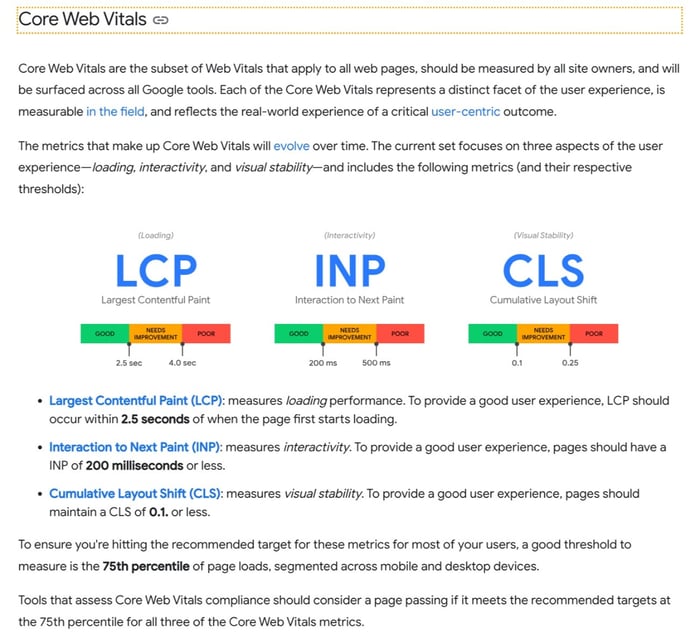
This has nothing to do with graphics or user experience. Nothing to do with stock images or page layout. Instead, we’re talking about Core Web Vitals, such as site speed, mobile responsiveness, and page scripts.
(Source: Google)
If your site doesn’t meet the modern standards established by the search engines, it’ll be hard to rank well in them, and it’s time for a new site.
If your website is unable to deliver in these two fundamental ways, new images and designs won’t save it. Your indexed pages will continually slip in search rankings, and your traffic will dwindle.
You need a site that meets up-to-date thresholds for performance.
Before considering a new website, take stock of your current site. Here are some important steps to take:
If you follow all of those best practices, you will almost certainly notice improvements in your website’s performance. And if you do need a new website, you’ll be armed with the knowledge you’ll need to make it as effective as possible.
A website is a big investment — and the process is both exciting and stressful.
If you think you’re in the market for a redesign for your custom site, do your research. Don’t just talk to agencies that are jumping to sell you the thing you’re still deciding if you need.
We work with businesses every day who come to us after spending a ton of money on a new website. Instead of being the salvation they were hoping for, the website fails to deliver results. Their numbers stay flat, and they’re left scratching their heads as to why it didn’t work.
Avoid their costly mistakes.
Ask the right questions so you know you’re getting the site you need.
And if you're not sure what you need, start with our free website performance assessment. You'll get the insights you've been looking for.


